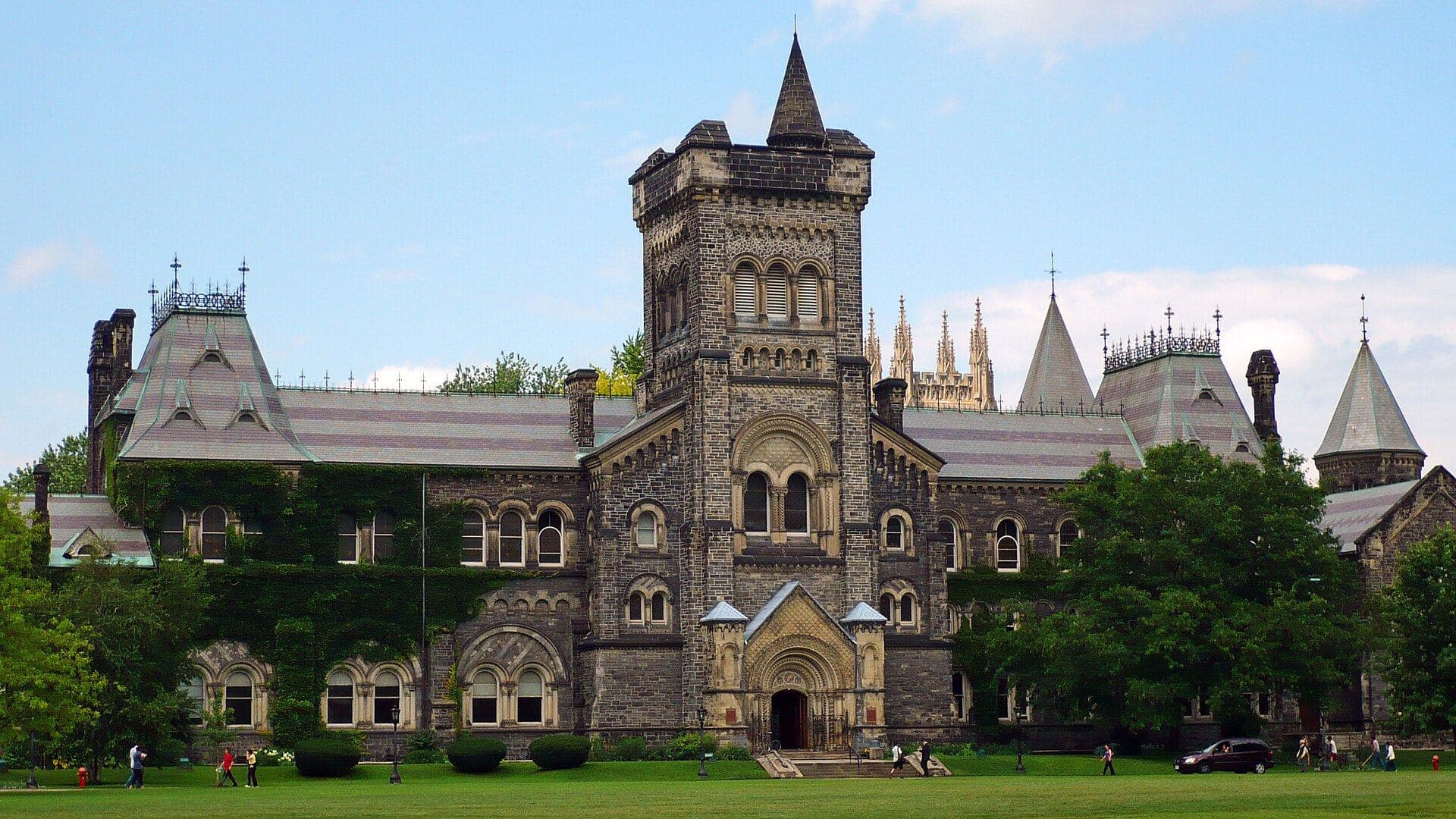

U of T Admissions & Deadlines 2027
Toronto, Ontario
Follow the U of T application process from OUAC choice and prerequisites through supplements, fees, deadlines, documents, and conditional offers.
The short answer
- St. George Computer Science asks for ENG4U and MCV4U, with a current planning range in the low 90s and a Computer Science supplemental application.
- St. George Engineering wants ENG4U, MHF4U, MCV4U, SCH4U and SPH4U, with a planning range from the high 80s to mid-90s depending on the program.
- Scarborough Computer Science needs ENG4U, MHF4U and MCV4U, with a low 90s planning range and mid to high 90s for co-op.
- Mississauga Commerce asks for ENG4U, MHF4U and MCV4U, with a mid-80s planning range and no category-wide supplement.
- These ranges are approximate prior-year Ontario averages for planning, not minimums or Fall 2027 cutoffs.
Reviewed August 13, 2026 · Official university sources · How we review guides
Save this to your free account
Keep these dates where you'll see them. The calendar file needs no account.
- OUAC Group A deadline (Ontario high-school students)January 15, 2027
Free account. No card needed.
University of Toronto admission requirements and averages
Ontario high school applicants generally need an OSSD (your Ontario high school diploma). They also need six Grade 12 U/M courses (Grade 12 university (U) or university/college (M) preparation courses). These must include ENG4U or EAE4U. They must also include every prerequisite for the campus you chose. They must include every prerequisite for the admission category you chose. U of T does not publish one guaranteed university-wide cutoff. Program prerequisites matter. Competitive grades matter. Supplements matter. Repeated courses matter. Available space matters.
The current 2026–2027 admissions bulletin reports prior-year planning ranges, not future guarantees. U of T now publishes scoped 2027 application, document, and supplemental deadlines. Match each date to your campus, program area, and application route.
Ontario foundation
Six Grade 12 U/M courses
Include senior English and every admission-category prerequisite. The co-op component of a course is not used.
Application route
OUAC, then U of T portal
The personalized portal checklist is authoritative for transcripts, supplements, test results, and documents.
Fall 2027 timing
Dates are published
Most listed full-time routes close January 15, 2027. Document and supplement deadlines vary by program area.
University of Toronto application fees
The application cost depends on the route. It also depends on citizenship. It depends on the number of Ontario university choices. It depends on the program. Most full-time undergraduate applicants apply through OUAC (Ontario's university application site). Some eligible applicants may instead use the U of T International Application. They must live outside Canada. They must not have studied in Canada. They must not be applying to another Ontario university. U of T permits only one application. Application fees are non-refundable.
| Application route or charge | Current fee | What it covers |
|---|---|---|
| OUAC undergraduate application | CAD 159 base fee | Includes the first three Ontario university program choices; each additional choice is CAD 51. |
| U of T International Application | CAD 196 | Available only to eligible applicants outside Canada who have not studied in Canada and are not applying to another Ontario university; only one U of T application may be submitted. |
| OUAC Group B document evaluation | CAD 98 where applicable | Collected once for U of T when the current OUAC exemption rules do not apply. |
| Selected program fees | CAD 45–102 | OUAC lists Architecture CAD 102; UTM Computer Science, Rotman Commerce and St. George Computer Science CAD 52; Engineering CAD 45 for Group A or CAD 67.32 for Group B; Medical Radiation Sciences CAD 50; and Music CAD 75. The Engineering Ontario-applicant page separately displays CAD 43.86, so confirm the charged amount in OUAC. |
The selected-program row lists the current programs checked here; it is not a universal charge. The Engineering faculty's Ontario page still displays CAD 43.86 while OUAC lists CAD 45 for Group A and CAD 67.32 for Group B. OUAC-route applicants should confirm exemptions and the exact total in OUAC's Review and Payment step. Pay an OUAC application fee through OUAC—not the U of T Flywire page used for tuition and student-account payments.
U of T prerequisites and current admission averages
U of T admits to a campus-specific admission category. It does not admit to one general first-year pool. The table condenses selected Ontario examples. These come from the current 2026–2027 domestic bulletin and Engineering FAQ. Always verify the exact category. Individual programs can have additional first-year selection or progression rules.
| Campus and category | Ontario prerequisites | Current planning range | Supplemental requirement |
|---|---|---|---|
| St. George · Computer Science | ENG4U and MCV4U | Low 90s | Computer Science supplemental application |
| St. George · Rotman Commerce | ENG4U and MCV4U | Mid to high 80s | Rotman Commerce supplemental application |
| St. George · Humanities | ENG4U | Low to mid-80s | No category-wide supplement |
| St. George · Life Sciences | ENG4U; mathematics and science prerequisites vary by intended program | Mid to high 80s | No category-wide supplement |
| St. George · Engineering | ENG4U, MHF4U, MCV4U, SCH4U, and SPH4U | High 80s to mid-90s, depending on the engineering program | Engineering Supplemental Application (formerly Online Student Profile) |
| Mississauga · Commerce | ENG4U, MHF4U, and MCV4U | Mid-80s | No category-wide supplement |
| Mississauga · Life Sciences | ENG4U; mathematics and science prerequisites vary by intended program | Low to mid-80s | No category-wide supplement |
| Scarborough · Computer Science | ENG4U, MHF4U, and MCV4U | Low 90s; co-op mid to high 90s | No category-wide supplement |
| Scarborough · Management | ENG4U, MHF4U, and MCV4U | Mid-80s; co-op mid to high 80s | Supplementary Application Form |
These are approximate prior-year Ontario admission averages published for planning. They are not minimums, Fall 2027 cutoffs, or guarantees. Students comparing computing options should also use the U of T Computer Science pathway guide.
How U of T assesses Grade 11, Grade 12, and repeated courses
U of T can use available Grade 11 and Grade 12 results for conditional decisions. If a Grade 12 prerequisite is not yet available, the corresponding Grade 11 course can help support an early review. The final offer conditions still require the OSSD, required Grade 12 courses, and competitive prerequisite results. The Grade 11 marks guide explains how to separate early evidence from final admission requirements across Canadian universities.
Repeated courses can be considered alongside the full academic record. Engineering has a more specific rule. Its current FAQ says the first attempt at each prerequisite is normally used. There is space in the Engineering Supplemental Application to explain extenuating circumstances. Applicants should read the faculty policy that applies to their program. They should not assume one repeat rule covers all of U of T.
Which U of T programs require a supplemental application?
Most U of T admission categories use academic results only. The current exceptions are program- and campus-specific. If you complete a supplement for one choice, it does not complete a different choice.
St. George
All Engineering programs, Computer Science, Rotman Commerce, Architecture or Visual Studies, Kinesiology, and Music
Mississauga
Computer Science, plus Theatre and Drama audition requirements
Scarborough
The categories are Management. They also include Management and International Business Co-op, Double Degree, International Development Studies Co-op, Music Industry and Technology, and Paramedicine.
Engineering applicants must submit the Engineering Supplemental Application through the Engineering Applicant Portal. The dated 2026–2027 bulletin calls it the Online Student Profile. The applicant portal checklist controls. It can include a written response, recorded response, profile, portfolio, questionnaire, audition, or other program material.
Current U of T application deadlines and offer timing
The official page separates full-time, part-time, and non-degree application routes. For full-time applicants, the published application date does not replace a later document deadline. It does not replace a later supplemental deadline either. Medical Radiation Sciences, Nursing, and Physician Assistant applicants must also have at least some prior university preparation. Earlier-cycle extensions do not change these published 2027 dates. Music recommends applying by December 1, 2026. This is before its January 15 application deadline.
| Item | 2027 admission date | Planning note |
|---|---|---|
| Recommended early application for listed full-time programs | November 7, 2026 | Engineering, Architecture, St. George Arts & Science, Information, Kinesiology, UTM and UTSC; submit available documents by December 1 for early consideration |
| Most listed full-time applications | January 15, 2027 | Engineering, Architecture, St. George Arts & Science, Information, Kinesiology, Music, Nursing, Physician Assistant, UTM and UTSC; Medical Radiation Sciences is due February 1. Medical Radiation Sciences, Nursing and Physician Assistant require prior university preparation |
| Supporting documents | January 15 or February 1, 2027 | Engineering and Music use January 15; Architecture, Information, Kinesiology, UTM, UTSC and all listed St. George Arts & Science areas use February 1 |
| Supplemental applications | January 15 or February 1, 2027 | Engineering and Music use January 15; Architecture, Rotman Commerce, St. George Computer Science, Kinesiology and applicable UTSC programs use February 1 |
| Part-time applications | January 15, 2027 | Fall Engineering, St. George Arts & Science, UTM and UTSC; UTM and UTSC also use January 15 for the summer session |
| Non-degree applications | January 15 or June 2, 2027 | January 15 for summer and June 2 for fall at St. George Arts & Science, UTM and UTSC |
| Admission decisions | January through late May 2027 | Some decisions can continue into summer depending on the program and applicant type |
Applicants using the November 7 early date should submit available documents by December 1, 2026. Early consideration is not a separate admission stream. It is not an admission guarantee. The central page does not publish every applicant-specific document. It does not publish every supplemental deadline. This includes a UTM Computer Science supplemental date. Follow the personalized applicant portal checklist. Do not assume a time of day unless the owning program publishes one.
International, IB, A-Level, and CAPE requirements
IB applicants need the complete diploma with English at Higher or Standard Level. For a mathematics prerequisite, U of T accepts Analysis and Approaches SL or HL and Applications and Interpretation HL. Applications and Interpretation SL satisfies Advanced Functions but not Calculus.
British-pattern applicants generally need five academic IGCSE, GCSE, or O Level subjects. They generally need three academic A Levels. Caribbean applicants generally need six CAPE units awarded by CXC. CSEC or CAPE English can satisfy the English route. CAPE Pure Mathematics is required when the intended category has a mathematics prerequisite. English-language proof is assessed on its own. Program prerequisites are assessed on their own.
How to apply to the University of Toronto
- Choose the exact campus and admission category, then record every Ontario or curriculum-specific prerequisite.
- Submit the undergraduate application through OUAC. Select the intended U of T program choices.
- Open the Join U of T applicant portal or Engineering Applicant Portal when U of T sends access instructions, normally about a week later.
- Follow the personalized checklist for transcripts, self-reported grades, English-language results, and any supplemental application.
- Monitor the portal and email for document requests, decisions, and offer conditions. Accept an offer through OUAC by its stated deadline.
Review the Ontario university deadline guide alongside the U of T portal checklist.
Official U of T sources
Requirements, dates, ranges, and supplements can change. Application deadlines, application fees, and the Engineering application name were checked on September 28, 2026. The other source checks below remain dated August 3, 2026. Official pages and your applicant portal remain the source of truth for your application.
- Canadian high school admission requirements
- How to apply through OUAC and the applicant portal
- U of T undergraduate application routes and fees
- Current OUAC undergraduate fees
- Engineering application information for Ontario applicants
- Current application dates and deadlines
- Programs requiring supplemental applications
- 2026–2027 Domestic Undergraduate Admissions Bulletin
- Engineering Supplemental Application instructions
- Engineering admission requirements and recent ranges
- International high school requirements
- English-language requirements
- Admission decisions and offer conditions
- Required documents and transcripts
U of T mature student admission
Compare academic-background assessment, OUAC and part-time routes, prerequisites, transfer rules, and academic bridging pathways.
St. Michael's College at U of T
Understand Arts & Science college preferences, membership, sponsored programs, residence, awards, and degree status.
University of Toronto scholarships and financial aid
Compare entrance scholarships, Pearson deadlines, Awards Profile, OSAP, UTAPS, and campus aid routes.
Ontario co-op program comparison
Compare direct-entry, later-entry, PEY, internship, and work-term models.
Application Checklist
| Academic Requirements | Verify prerequisite courses, minimum averages, and program-specific requirements on the official admissions pages. |
|---|---|
| Supplementary Review | Competitive programs may ask for essays, portfolios, interviews, experience profiles, or timed video responses. |
| International Applicants | Plan transcript evaluation, English-language proof if required, study permit timing, and proof-of-funds documentation. |
| Deadlines | Confirm application, document, scholarship, residence, and portfolio deadlines every cycle before submitting. |
| Stellar Coaching Use | Bring your target program, transcript, activities, and draft responses to a coaching session for school-specific planning. |
Official Sources and Next Steps
Stellar keeps this guide structured for comparison, but official university pages remain the source of truth for program requirements, tuition, residence, scholarships, deadlines, and policy changes.
Prepared by Stellar Advisers Editorial Team · Reviewed August 13, 2026 · Editorial, corrections, and source methodology