
University of Manitoba
Winnipeg, Manitoba
Compare University of Manitoba programs, admissions, costs, residence, student support, and career pathways in one source-reviewed guide. Jump to the decision section you need below.
The short answer
- Ontario students need an OSSD, the Ontario Secondary School Diploma, plus six Grade 12 U or M courses (university or university/college preparation).
- Latest Ontario minimums cover 2026–27: University 1 and Arts 70%, Engineering and Science 80%, Commerce and Health Sciences 85%. Fall 2027 minimums remain pending.
- Apply at apply.umanitoba.ca, not through OUAC, the Ontario Universities' Application Centre. The fee is $100 domestic or $130 international.
- Fall 2027 dates remain pending. Fall 2026 applications closed March 1, 2026 for general direct entry and May 1, 2026 for international University 1.
- 2026–2027 residence totals run from $10,293 to $17,453. Tuition is charged per credit hour by teaching unit.
Reviewed August 14, 2026 · Official university sources · How we review guides
Save this to your free account
Track University of Manitoba with a checklist for how you apply. Free account. Add your dates in the tracker to request reminder emails; unsubscribe any time.
Free account. No card needed.
Overview
Quick Facts
| Location | Winnipeg, Manitoba |
|---|---|
| School Type | Research-intensive / broad program university |
| Directory Size | Large university |
| Campus Setting | Major-city campus environment |
| Ranking Signal | No QS World 2026 position listed in this guide |
| Program Strengths | Medicine, Engineering, Agriculture, Business, Science |
Start with campus and program fit. Then check official admissions, residence, and cost details before you build the final application list.
Detailed application guides
University of Manitoba acceptance rate and grades by program
Manitoba's 2024-25 undergraduate offer ratio was about 63%, by our calculation from UM's counts. See program offer counts, minimum grades and decision timing.
Canadian University Application Deadlines 2027
Compare this university's published date with application dates in eight provinces. Those dates may be confirmed, annual, or still pending.
Admissions Planning
Fall 2027 application planning
University of Manitoba admission requirements for Ontario students
Ontario applicants need an OSSD and six Grade 12 U or M credits. University of Manitoba then calculates admission using the four courses listed for the intended direct-entry route. The published percentages below are the latest available 2026-27 minimums. Fall 2027 requirements remain pending. These grades don't guarantee admission when a program is competitive.
University 1 and Arts
70% minimum
ENG4U, one 4U mathematics course, and two other 4U/M courses.
Engineering and Science
80% minimum
The required mathematics and science courses differ by faculty.
Commerce and Health
85% minimum
Course floors and the exact science mix still apply.
Ontario prerequisites and minimum averages, 2026-27
The direct-entry bulletin still covers 2026-2027, checked October 18, 2026. These are latest-available rules, not confirmed Fall 2027 minimums. The full guide keeps its earlier review date.
| Direct-entry route | Minimum average | Required Ontario courses | Course minimum |
|---|---|---|---|
| University 1 | 70% | ENG4U, one 4U mathematics, and two additional 4U/M courses | 60% in each required course |
| Arts | 70% | ENG4U, one 4U mathematics, and two additional 4U/M courses | 60% in each required course |
| Agriculture | 70% | ENG4U, MHF4U or MCV4U, and two additional 4U/M courses | 60% in each required course |
| Asper Commerce | 85% | ENG4U, MHF4U or MCV4U, and two additional 4U/M courses | 70% in each required course |
| Engineering | 80% | ENG4U, MHF4U or MCV4U, SCH4U, and SPH4U | 70% in each required course |
| Science | 80% | ENG4U, MHF4U or MCV4U, one of SBI4U/SCH4U/ICS4U/SPH4U, and one additional 4U/M course | 60% in each required course |
| Health Sciences | 85% | ENG4U, MHF4U or MCV4U, SBI4U, and SCH4U | 60% in each required course |
| Kinesiology or Physical Education | 85% | ENG4U, MHF4U or MCV4U, one of SBI4U/SCH4U/SPH4U, and one additional 4U/M course | 60% in each required course |
| Environment, Earth and Resources | 70% | ENG4U, MHF4U or MCV4U, SPH4U, and one of SBI4U/SCH4U/ICS4U | 60% in each required course |
| Music | 70% | ENG4U, one 4U mathematics, and two additional 4U/M courses, plus an audition and recommendations | 60% in each required course |
Choose the correct entry route
Direct entry
Best fit: High-school applicants and students with fewer than 24 post-secondary credit hours.
Apply to an eligible direct-entry faculty. Or apply to University 1. Meet the requirements for your curriculum. These are published.
University 1
Best fit: Students who want an exploratory first year. Or students who do not yet meet a faculty's direct-entry requirements.
Complete up to 30 credit hours that can count toward a degree. Then transit or apply to a faculty after at least 24 credit hours.
Advanced entry
Best fit: Applicants who have completed 24 or more post-secondary credit hours.
Use the advanced-entry requirements for the faculty you want. High-school direct-entry averages do not replace that review.
Fall 2027 deadline status
The Fall 2027 application calendar is not yet published
The live admissions pages currently publish Fall 2026, Winter 2027, and Summer 2027 dates. Use the latest September-entry dates below to plan backwards, but do not treat them as confirmed Fall 2027 deadlines.
| Applicant or program | Latest published date | How to use it |
|---|---|---|
| Most direct-entry programs | March 1, 2026 | The current September-start benchmark. Fall 2027 dates are not yet published. |
| Music direct entry | January 15, 2026 | A program-specific date from the latest published cycle; do not reuse it as a confirmed 2027 deadline. |
| University 1 — international | May 1, 2026 | Fall 2026 international University 1 date, checked again October 18, 2026. This is not a Fall 2027 deadline. |
| University 1 — domestic | August 1, 2026 | The latest published September-entry date for domestic University 1 applicants. |
| Diploma in Agriculture | May 1, 2026 domestic; March 1, 2026 international | The diploma route keeps its own September-entry dates. These are separate from the degree programs in the same faculty. |
Application workflow
- 1. Choose direct entry, University 1, or advanced entry before selecting the application.
- 2. Submit the online application and fee by the applicable program deadline.
- 3. Upload or arrange every requested record, English-language result, portfolio, audition, statement, or reference.
- 4. Have official transcripts sent by the issuing school or institution. Do this when the university requests them.
- 5. Monitor the application portal for document status, decisions, and the accept-or-decline step.
The current application fee is $100 for Canadian citizens. It is also $100 for permanent residents and refugees. The fee is $130 for international applicants.
Fall 2027 cycle status
2027 pending · Fall 2027
Not yet published. The direct-entry applicant page is labelled for the 2026-2027 academic cycle: its latest September intake is Fall 2026 (March 1, 2026 for all other direct-entry programs), and the only 2027 dates on it are Winter 2027 and Summer 2027. The admissions overview still says only 'To start classes in September, you must apply by March 1.'
Focused October 18, 2026 check: Fall 2027 dates remain pending. Use the labelled Fall 2026 dates only as prior-cycle benchmarks. No new-cycle deadline can be inferred from the annual pattern.
Applies to: All applicants
University of Manitoba: Direct-entry applicant information: Ontario minimums and 2026–2027 deadlines · Verified October 18, 2026
Size and academic scale
Fall Term 2025 census · Published for this period
UM publishes 31,922 students for Fall Term 2025. That is 27,372 undergraduate and 3,771 graduate students. It includes 6,278 international students from 123 countries. It also includes 3,292 self-declared Indigenous students, or 10.3% of the overall population. UM also publishes 228,000 alumni across 137 countries. It publishes 250+ programs of study. It publishes $246M in sponsored research income in 2024.
UM's marketing pages round this to '30,500+ students'; the facts-and-figures page is the census figure and should be preferred.
Applies to: All applicants
University of Manitoba: Facts and figures: Fall 2025 enrolment, alumni, and research income · Verified August 14, 2026
What UM claims about itself
University-published counts · Published for this period
UM dates itself to 1877. It describes itself as Manitoba's largest and most research-intensive university. It publishes a $7.3 billion overall economic impact in Manitoba. It also publishes 100 Rhodes Scholars to date, 'more than any Western Canadian university,' and 400 patents covering 300 UM-developed technologies.
These are UM's own marketing counts, not audited third-party data. UM does not publish a national undergraduate ranking on this page—do not add one.
Applies to: All applicants
University of Manitoba: About UM: history, impact, and published institutional claims · Verified August 14, 2026
Fort Garry and Bannatyne campuses
Current campus context · Published for this period
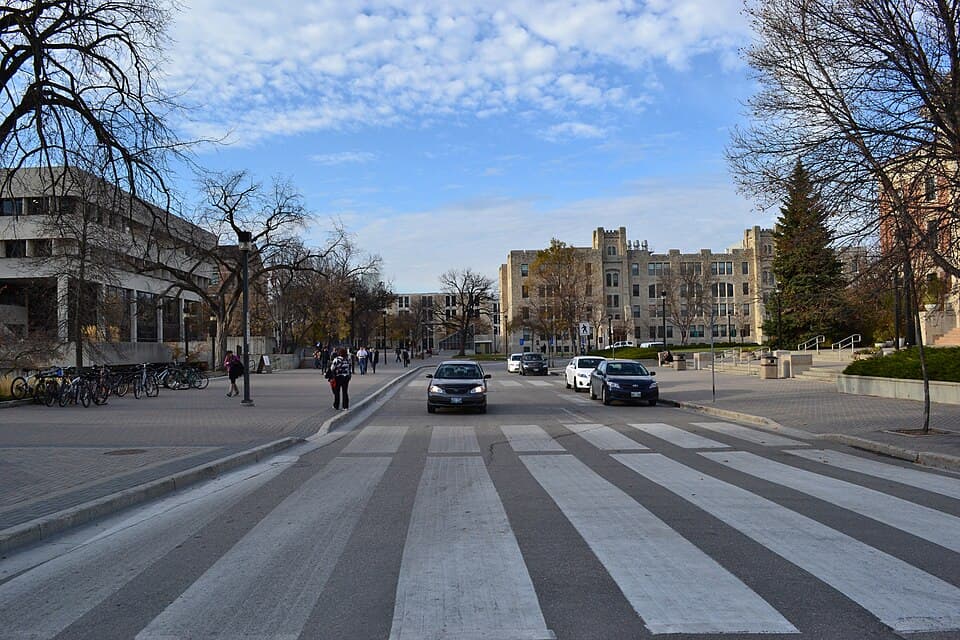
The Fort Garry campus is where undergraduate direct-entry study happens. It covers more than 280 hectares. It is 'cradled in a bow of the Red River in a treed, green setting.' It sits 20 minutes from the city centre. It holds more than 90 major buildings, including four colleges, libraries, recreation facilities, and residences. Bannatyne is UM's downtown campus. It is a nine-building complex next to the Health Sciences Centre. It trains health professionals.
Applies to: All applicants
University of Manitoba: Our campuses: Fort Garry and Bannatyne · Verified August 14, 2026
UM runs its own application—there is no OUAC step
Current fee schedule · Published for this period
Applicants apply directly through UM's own portal at apply.umanitoba.ca. They do not apply through OUAC (Ontario's university application site). The application fee is $100 for Canadian citizens, permanent residents and refugees. It is $130 for international students. The program's deadline must receive both the form and the fee. UM also requires a non-refundable $2000 CAD tuition deposit. It is paid by credit card. This is for students who need a Provincial Attestation Letter (PAL) for a study permit application.
Some Ontario applicants assume every Canadian university uses OUAC. They miss this: a UM application is separate work. It has its own deadline and its own fee.
Applies to: All applicants
University of Manitoba: Learn how to apply: application portal, fees, and PAL deposit · Verified August 14, 2026
Direct entry, University 1, and advanced entry
Current structure · Published for this period
Direct entry covers 'current high school students or people who have already graduated from high school but who have completed fewer than 24 credit hours of post-secondary level study.' Advanced entry covers 'those who have already completed 24 or more credit hours of post-secondary level study.' University 1 is a direct-entry option for applicants who are undecided or who do not meet another direct-entry program's requirements.
Applies to: All applicants
University of Manitoba: Undergraduate admission requirements: direct, advanced, and U1 routes · Verified August 14, 2026
Published Ontario direct-entry minimums by faculty
2026-2027 direct-entry cycle, latest available; Fall 2027 pending · Latest published information; newer cycle not yet confirmed
UM publishes an exact minimum average and per-course floor for each Ontario route. University 1 and Arts need 70%, with no less than 60% in each course. University 1 also lists Limited Admission at a 65% minimum. Agricultural Sciences needs 70%. School of Art BFA needs 70%, with ENG4U at 60% plus a portfolio. Desautels Music needs 70% plus audition and recommendations. Riddell Environmental Science and Physical Geography needs 70%. Faculty of Science needs 80%, with 60% per course. Price Faculty of Engineering needs 80%, with 70% in each of ENG4U, MHF4U or MCV4U, SCH4U and SPH4U. Asper Commerce needs 85%, with 70% per course. Rady Health Sciences and Health Studies needs 85%, with 60% per course. Dental Hygiene diploma needs 85%. Kinesiology, Physical Education and Recreation Management needs 85%.
Focused October 18, 2026 check confirms that the bulletin still covers 2026-2027. Fall 2027 minimums remain pending. These eligibility minimums don't guarantee an offer; the full-guide review date is unchanged.
Applies to: Ontario high school
University of Manitoba: Direct-entry applicant information: Ontario minimums and 2026–2027 deadlines · Verified October 18, 2026
Latest published deadlines by program and applicant type
2026-2027 cycle, latest available · Latest published information; newer cycle not yet confirmed
The live Fall 2026 table is the latest September intake: March 1, 2026 for all other direct-entry programs, January 15, 2026 for Music, May 1, 2026 for international University 1 applicants, March 1, 2026 for international Diploma in Agriculture applicants, May 1, 2026 for the domestic Diploma in Agriculture, and August 1, 2026 for domestic University 1. Winter 2027 dates are October 1, 2026 (Environment, Earth and Resources, Arts and Science, and international University 1) and December 1, 2026 (domestic University 1); Summer 2027 dates are February 1, 2027 and April 1, 2027.
The Fall 2026 international University 1 deadline alone was checked again October 18, 2026: May 1, not the international Agriculture diploma's March 1. Other benchmark dates keep their earlier source checks. Domestic University 1 applicants get August 1, later than most direct-entry programs; leaving an application that late compresses residence and scholarship planning.
Applies to: All applicants
University of Manitoba: Direct-entry applicant information: Ontario minimums and 2026–2027 deadlines · Verified October 18, 2026
Auditions, portfolios, and program-specific evidence
2026-2027 direct-entry cycle · Published for this period
Two Ontario routes need more than grades. Desautels Faculty of Music requires an audition and recommendations on top of ENG4U, a 4U mathematics course and two academic 4U/4M courses, and carries the earliest published deadline (January 15, 2026 for Fall 2026). The School of Art BFA requires three 4U/4M credits, ENG4U at a minimum of 60%, and a portfolio.
Applies to: All applicants
University of Manitoba: Direct-entry applicant information: Ontario minimums and 2026–2027 deadlines · Verified August 14, 2026
English-language evidence
Current requirements · Published for this period
Here are the published minimums. IELTS Academic (computer or paper) or IELTS Indicator: 6.5 overall with 6.0 in each of the four modules. TOEFL iBT: 86 overall with 20 in each component for tests taken before January 20, 2026. On the revised scale from January 21, 2026 onward: 4.5 overall with 4.0 in each component. Duolingo English Test: 120 overall with 105 in Literacy, Comprehension, Production and Conversation. CAEL: 60. Pearson Test of English: 58. Cambridge C1 Advanced or C2 Proficiency: 180. Or a pass at Level 5 of UM's Intensive Academic English Program (AEPUCE). Results expire two years from the test date. They must be valid at the beginning of the admission term.
UM's Duolingo bar is 120 with 105 subscores. This is higher than several Ontario universities' 110. Check the subscores, not just the overall number.
Applies to: International
University of Manitoba: English language proficiency requirements and exemptions · Verified August 14, 2026
How Caribbean and Commonwealth applicants get exempted
Current requirements, with Fall 2026 additions · Published for this period
UM lists nine exemption criteria, including ten consecutive years of residency in Canada, successful completion of a three-year secondary school program in Canada, a Manitoba Grade 12 English 40S result of at least 75%, an IB Higher Level English score of 4 or higher, and 30 credit hours of university-level coursework including six credit hours of transferable English. Four further criteria take effect for Fall 2026 covering GCE curricula, a full IB Diploma at 24+ points, CIS-accredited schools, and U.S. or Canadian curricula schools. UM also lists 68 countries whose applicants are exempt outright.
Many Caribbean and West African applicants are exempt if they are on GCE or CIS-accredited curricula. Check the country list and the GCE clause before you pay for a test.
Applies to: International
University of Manitoba: English language proficiency requirements and exemptions · Verified August 14, 2026
Official University of Manitoba admissions sources
Application Checklist
| Academic Requirements | Verify prerequisite courses, minimum averages, and program-specific requirements on the official admissions pages. |
|---|---|
| Supplementary Review | Competitive programs may ask for essays, portfolios, interviews, experience profiles, or timed video responses. |
| International Applicants | Plan transcript evaluation, English-language proof if required, study permit timing, and proof-of-funds documentation. |
| Deadlines | Confirm application, document, scholarship, residence, and portfolio deadlines every cycle before submitting. |
| Stellar Coaching Use | Bring your target program, transcript, activities, and draft responses to a coaching session. Use it for school-specific planning. |
Programs and Pathways
University of Manitoba programs and University 1
The university lists more than 100 undergraduate programs. The important application decision is not just the subject. It is whether the faculty permits direct entry. It may expect University 1 or another qualifying year. It may use advanced entry after post-secondary study. University 1 can hold up to 30 credit hours. It is designed so eligible courses count toward a later degree. It does not automatically add a year.
Direct-entry examples
Arts, Agriculture, Commerce, Engineering, Environment, Fine Arts, Health Sciences, Kinesiology, Music, Science, and University 1 publish high-school entry routes.
Professional and later-entry routes
Do not assume Medicine or another professional program is available directly from high school. Check the program directory for prior study, advanced-entry, test, and supplementary requirements.
Looking for St. Paul's College?
St. Paul's is an affiliated Catholic and Jesuit college within the University of Manitoba, not a separate undergraduate application destination. Read the St. Paul's College membership, programs, scholarships, and housing guide after choosing the UM faculty or program you want.
Faculties, colleges, and schools
Current structure · Published for this period
UM's programs-of-study directory lists fourteen undergraduate-facing units: University 1, Agricultural and Food Sciences, the School of Art, Arts, the I. H. Asper School of Business, Education, the Price Faculty of Engineering, the Clayton H. Riddell Faculty of Environment, Earth and Resources, the Rady Faculty of Health Sciences, Kinesiology and Recreation Management, Robson Hall Faculty of Law, the Desautels Faculty of Music, Social Work, and Science. UM states it has 'more than 100 undergraduate programs to choose from.'
Applies to: All applicants
University of Manitoba: Programs of study: faculties, colleges, and schools · Verified August 14, 2026
University 1 is the real structural differentiator
Current program · Published for this period
University 1 is 'a direct-entry option with a unique, flexible approach to your first year at UM.' Students take 24 to 30 credit hours, then 'apply or transit to an undergraduate degree program at the University of Manitoba where they will enter year 2.' UM states it does 'not add an extra year of studies to your degree' because 'all of the courses you take in University 1 can become part of your degree program.' Eligibility is limited to applicants who have not attended a post-secondary institution or have completed fewer than 24 credit hours, and meeting minimum requirements 'does not guarantee acceptance into the program.'
University 1 is a real second route into a competitive faculty. You need a 70% minimum. But entry into that faculty in year 2 is a separate decision. It is not an automatic transfer.
Applies to: All applicants
University of Manitoba: University 1 program page · Verified August 14, 2026
Price Faculty of Engineering structure
Current structure · Published for this period
The Price Faculty of Engineering runs four undergraduate departments. They are Biosystems, Civil, Electrical and Computer, and Mechanical. It also runs a Department of Engineering Education. It publishes 'nearly 20 unique programs of study across multiple engineering disciplines.' It also publishes the Engineering Access Program (ENGAP) and a Post Baccalaureate Diploma. Co-op/Industrial Internship is listed as an option. It is not a direct-entry admission decision.
Applies to: All applicants
University of Manitoba: Price Faculty of Engineering: departments and programs · Verified August 14, 2026
Rady Faculty of Health Sciences: what is and is not direct entry
Current structure · Published for this period
The Rady Faculty comprises six colleges—Community and Global Health, the Dr. Gerald Niznick College of Dentistry, the Max Rady College of Medicine, Nursing, Pharmacy, and Rehabilitation Sciences—and teaches more than 3,100 students each year with over $103.7 million in external research funding annually. The only Rady routes that appear on UM's Ontario direct-entry list are the Health Sciences and Health Studies degrees at 85% and the Dental Hygiene diploma at 85%.
Medicine, Dentistry and Pharmacy do not appear on the direct-entry requirements page. Plan a qualifying-year route, not a high-school application, for those.
Applies to: All applicants
University of Manitoba: Rady Faculty of Health Sciences: colleges and scale · Verified August 14, 2026
Asper School of Business scale and departments
Current structure · Published for this period
Asper publishes approximately 1800 students. They are at the bachelor's, master's and doctorate levels. Asper emphasises 'intimate class sizes.' Its Department of Accounting and Finance publishes undergraduate majors in accounting, finance, and management information systems (MIS). It also publishes Supply Chain Management and actuarial studies through the Warren Centre. Asper publishes a 2025 Employment Report. That report is built from graduates' own reporting.
Applies to: All applicants
University of Manitoba: I. H. Asper School of Business: departments and student body · Verified August 14, 2026
Agricultural sciences: two separate routes with separate rules
2026-2027 cycle · Latest published information; newer cycle not yet confirmed
Agricultural and Food Sciences runs a degree route and a Diploma in Agriculture, and UM treats them as separate applications. Both sit at a 70% Ontario minimum over ENG4U, MHF4U or MCV4U and two academic 4U/4M courses, but the Diploma has its own deadlines (May 1, 2026 domestic and March 1, 2026 international for Fall 2026) and its own tuition band—$114.18 per credit hour domestic and $479.96 international in 2026-2027, the lowest published undergraduate rates at UM.
Applies to: All applicants
University of Manitoba: Direct-entry applicant information: Ontario minimums and 2026–2027 deadlines · Verified August 14, 2026
Official program and University 1 sources
University of Manitoba Residence Costs and Housing
University of Manitoba residence costs and application
Academic-year residence applications open in late October. Applicants pay the non-refundable application fee. They wait for an offer. They choose available room and meal-plan preferences. Then they complete the contract and deposit. The live application page does not publish a blanket first-year guarantee. So apply early and keep a backup plan.
| Residence | Room | 2026–2027 total |
|---|---|---|
| Mary Speechly Hall | First-year; single or double, meal plan included | $10,849–$14,327 |
| Pembina Hall Residence | First-year; 360 single units, meal plan included | $15,651–$16,729 |
| University College | First-year; 236 singles and 10 doubles, meal plan included | $10,293–$14,451 |
| Arthur V. Mauro | Upper-year suites; meal plan optional | $10,297 without a meal plan; $13,267–$17,453 with one |
These official 2026–2027 figures are pending approval. Meal-plan inclusion varies by residence and row. Verify the selected contract. Do not compare the headline total alone.
2026-2027 rates by building
2026-2027 · Latest published information; newer cycle not yet confirmed
UM publishes four residences with pending-approval 2026-2027 totals. First-year buildings: Mary Speechly Hall singles $13,249.00–$14,327.00 and doubles $10,849.00–$11,927.00, all with a meal plan (10 or 15 meals weekly, or unlimited); Pembina Hall Residence, 360 single units, $15,651.00–$16,729.00 with a meal plan; University College, 236 singles and 10 doubles, singles $12,739.00–$14,451.00 and doubles $10,293.00–$12,005.00. Arthur V. Mauro is the upper-year residence: 155 suites housing 316 students at $10,297.00 without a meal plan or $13,267.00–$17,453.00 with one.
UM labels every one of these figures 'pending approval from the Board of Governors.' Budget with them. Do not quote them as final.
Applies to: All applicants
University of Manitoba: Explore residence spaces and 2026–2027 rates by building · Verified August 14, 2026
What a residence total actually contains
2026-2027 · Latest published information; newer cycle not yet confirmed
Arthur V. Mauro's $10,297.00 no-meal-plan total breaks down as room $4,886.00 each term plus a $355.00 holiday break charge, an $85.00 program fee, and $85.00 tenant insurance. Mauro is restricted to students who have completed 8+ months of study or are 19 or older, so most Ontario first-year applicants are comparing the three first-year buildings, where the meal plan is bundled into the headline number.
Never compare Mauro's total with a first-year building's total directly. One excludes food and one includes it.
Applies to: All applicants
University of Manitoba: Explore residence spaces and 2026–2027 rates by building · Verified August 14, 2026
Application process and the absence of a guarantee
Current process · Published for this period
The Academic Year residence application 'opens to new applicants in late October,' and UM states 'There is no specific deadline for new applicants' residence applications.' The published sequence is: complete the residence application, pay the residence application fee, wait for a room offer, confirm the reservation with a $1,000 room deposit, and—for international students—complete the study permit step. The Winter application opens in May or two months before January move-in; the Summer application opens in February for students continuing into the next Fall/Winter term.
UM publishes no first-year residence guarantee. 'No deadline' is not the same as 'space available.' Apply in late October. Treat the room offer, not the application, as confirmation.
Applies to: All applicants
University of Manitoba: How to apply for residence: opening dates, offers, and deposit · Verified August 14, 2026
Fall 2027 residence rates
2027 pending · 2027-2028
Not yet published. The housing pages currently carry the 2026-2027 rate tables, and each building's rates are explicitly marked as pending approval from the Board of Governors. No 2027-2028 residence figures appear.
Budget with the labelled 2026-2027 rates. Check the explore-spaces page when UM opens the next academic-year application in late October.
Applies to: All applicants
University of Manitoba: Explore residence spaces and 2026–2027 rates by building · Verified August 14, 2026
Campus life, transit, and the Winnipeg winter
Living on the Fort Garry campus keeps residence, class, recreation and the Bisons inside one 280-hectare footprint about 20 minutes from downtown Winnipeg. This matters in a city where the walk between buildings is a winter decision for months at a time. Every full-time student already pays for the U-Pass. So plan the commute around transit rather than a car, and budget for real winter clothing.
Clubs, colleges, and Bison Sports
Current campus life · Published for this period
UM's student-experience page publishes 30,500+ students across two main campuses and satellite locations, 200+ campus clubs, student organizations and volunteer programs, and 350 student athletes competing in nine sports for the Bisons. It also describes four colleges, some of which provide private residences and 'over $150,000 in scholarships.'
Applies to: All applicants
University of Manitoba: Student experience: community, clubs, Bisons, and colleges · Verified August 14, 2026
UMSU and the student associations
Current campus life · Published for this period
The University of Manitoba Students' Union (UMSU) 'supports a range of activities for UM students,' and UM describes clubs 'from ethnic origin groups and sororities to sports clubs and political parties.' Separately represented communities include the University of Manitoba Indigenous Students' Association (UMISA), the Métis University Students' Association, and the graduate students' association (UMGSA). UM Recreation Services covers group fitness, intramurals and Bisons events.
UM does not publish a club count on this page—confirm a specific group is still active before planning around it.
Applies to: All applicants
University of Manitoba: Get involved: UMSU, student groups, and recreation services · Verified August 14, 2026
U-Pass, health and dental, and international health coverage
2026-2027 · Latest published information; newer cycle not yet confirmed
Published 2026-2027 amounts: the Winnipeg Transit U-Pass is $238.70 in the Fall Term and $238.70 in the Winter Term for full-time students with UMSU or UMGPS membership; the UMSU Health and Dental Insurance fee is $381.60 per year for students with UMSU or UMGPS membership carrying at least 6 credit hours or full-time status in the Fall Term; and the Manitoba International Student Health Plan (MISHP) is $440.00 for Fall coverage (Sept. 1-Dec. 31) and $880.00 for Winter coverage (Jan. 1-Aug. 31).
International students carry MISHP on top of the UMSU plan—budget $1,320.00 of health coverage per year, not $381.60.
Applies to: All applicants
University of Manitoba: 2026–2027 undergraduate tuition, compulsory fees, and co-op fees · Verified August 14, 2026
Winnipeg, and being honest about winter
Current city context · Published for this period
UM publishes that 857,300 people live in Winnipeg. It publishes that 100+ ethnic groups are represented in the city. It publishes that the city hosts more than 130 days of festivals each year. These include Festival du Voyageur, the Jazz Festival, the Folk Festival and Folklorama. It publishes that the city has five professional sports teams. These include the Winnipeg Jets and Blue Bombers. It also has more than 1,100 restaurants. It has the Assiniboine Park Zoo's Journey to Churchill exhibit. On winter, UM's own framing is that 'Manitobans eagerly embrace winter.' It points to ice-skating, cross-country and downhill skiing, snowshoeing and sledding.
UM does not publish temperature data here. A Caribbean or southern-Ontario applicant should not read 'embrace winter' as a description of the January commute. Budget for genuine winter clothing. Plan a Fort Garry commute that does not depend on long outdoor waits.
Applies to: All applicants
University of Manitoba: Winnipeg, Manitoba: city context published by UM · Verified August 14, 2026
Official residence sources
Housing and Location Questions
| Campus Setting | Major-city campus environment |
|---|---|
| Residence | Check residence guarantee rules and first-year room styles. Check meal plans, deposit deadlines, and off-campus housing pressure. |
| City Fit | Students should compare transit, weather, cost of living, safety, and community feel in Winnipeg. |
| Commuting | If you live off campus, map commute time to classes, labs, placements, and evening activities. Do this before committing. |
Tuition, Scholarships, and Aid
University of Manitoba tuition and entrance scholarships
The teaching unit that offers a course usually charges undergraduate tuition per credit hour. So University 1 students pay the rate for each course, not one rate for all of University 1. The figures below are 2026–2027 base tuition per credit. Compulsory, course, co-op, health-plan, and living costs are extra.
| Teaching unit | Domestic per credit | International per credit |
|---|---|---|
| Arts | $163.97 | $689.23 |
| Engineering | $186.37 | $683.43 |
| Science | $187.65 | $804.00 |
| Agricultural and Food Sciences | $198.63 | $808.09 |
| Asper School of Business | $213.09 | $895.68 |
| Health Sciences | $181.80 | $764.11 |
| Nursing | $177.76 | $723.22 |
| Diploma in Agriculture | $114.18 | $479.96 |
Automatic general entrance scholarships
95% or higher
$3,000
90% to 94.9%
$2,000
85% to 89.9%
$1,000
Current rules require the application and fee by March 1, at least 85% across the best five approved courses in five subjects, and full-time fall-and-winter enrolment of at least 24 credit hours. Scholarship offers use interim grades. Check the dates and values for Fall 2027 before budgeting.
2026-2027 tuition per credit hour by teaching unit
2026-2027 · Latest published information; newer cycle not yet confirmed
UM charges undergraduate tuition per credit hour by the unit that teaches the course. Here are the published 2026-2027 rates, shown as domestic / international. Agriculture Diploma is $114.18 / $479.96. Arts is $163.97 / $689.23. Nursing is $177.76 / $723.22. Community and Global Health and Interdisciplinary Health Sciences is $181.80 / $764.11. Kinesiology and Recreation Management is $186.10 / $782.27. Engineering is $186.37 / $683.43. Science and Environment, Earth and Resources is $187.65 / $804.00. Social Work is $194.19 / $789.96. Agricultural and Food Sciences is $198.63 / $808.09. Asper Management is $213.09 / $895.68.
The rate follows the teaching unit. So a University 1 student pays a different rate for each course. They do not pay one University 1 rate.
Applies to: All applicants
University of Manitoba: 2026–2027 undergraduate tuition, compulsory fees, and co-op fees · Verified August 14, 2026
What a full course load actually costs—Manitoba's genuine draw
2026-2027 · Latest published information; newer cycle not yet confirmed
UM publishes approximate base tuition and associated fees for a full course load during the Fall and Winter terms. Domestic: Arts $6,900, Education $7,300, University 1 $7,400, Environment, Earth and Resources $7,600, Business $8,100, Science $8,200, Agricultural and Food Sciences $8,200, Kinesiology and Recreation Management $8,500, Nursing $8,800, Engineering $9,700. International: Arts $24,000, University 1 $25,800, Nursing $26,600, Business $26,700, Science $28,000, Engineering $31,400. The estimates exclude textbooks and supplies.
A domestic Arts or University 1 year under $7,500 all-in is much lower than similar Ontario flat fees. This is the real reason Ontario students look west.
Applies to: All applicants
University of Manitoba: Tuition and financial supports: full-load estimates and aid totals · Verified August 14, 2026
2026-2027 compulsory fees on top of tuition
2026-2027 · Latest published information; newer cycle not yet confirmed
Published 2026-2027 compulsory fees: UMSU is $142.62 in Fall, $142.61 in Winter and $6.37 in Summer. A $28.96 library fee and a $28.96 registration fee apply per Fall and Winter term. A $132.86 technology service fee applies per Fall and Winter term. A $109.96 sport and recreation fee applies for full-time Fall/Winter students. Endowment fund fees vary by faculty. Science charges $7.00 per credit hour.
Applies to: All applicants
University of Manitoba: 2026–2027 undergraduate tuition, compulsory fees, and co-op fees · Verified August 14, 2026
Automatic entrance scholarship bands
Current award cycle, March 1 deadline · Latest published information; newer cycle not yet confirmed
UM's General Entrance Scholarships need no separate application. Level 1 (Queen Elizabeth II) is $3,000 at an average greater than or equal to 95%. Level 2 (Guertin Centennial) is $2,000 at 90% or higher. Level 3 (Hogg Centennial) is $1,000 at 85% or higher. Eligibility requires a minimum 85% across five approved courses. It also requires enrolment in 24 or more credit hours in both Fall and Winter. The deadline is March 1. Higher automatic awards exist. The Isabel Auld, Chancellors' and President's Laureate Scholarships are $5,000. They are renewable for three years at a minimum 95% average. President's Scholars receive $1,000 in each of second, third and fourth years. Renewal requires a 4.0+ GPA (grade point average).
The March 1 scholarship deadline is the same day as the general direct-entry application deadline—applying in August as a domestic University 1 applicant forfeits this consideration.
Applies to: Ontario high school, Other Canadian, International
University of Manitoba: Entrance awards: automatic scholarships and application-based awards · Verified August 14, 2026
IB and AP entrance scholarships
Current award cycle, March 1 deadline · Latest published information; newer cycle not yet confirmed
UM publishes International Baccalaureate Entrance Scholarships of $1,100 to $3,500. They are based on diploma points from 25 to 44. They are open to first-time university entrants from any province or country. They require the full IB diploma with Theory of Knowledge, the extended essay and CAS. Advanced Placement and IB Enhancement Scholarships add $250 per AP (Advanced Placement courses and exams) score of 5. They add $150 per AP score of 4. They add $250 per IB higher-level 7. But this is only for students who already qualified for a UM entrance scholarship. Both carry a March 1 deadline.
Applies to: Ontario high school, International, Other Canadian
University of Manitoba: Entrance awards: automatic scholarships and application-based awards · Verified August 14, 2026
Awards that need a separate application
Latest published deadlines · Latest published information; newer cycle not yet confirmed
These are published application-based entrance awards and their latest deadlines. Fairfax Financial Holdings Entrance Awards are $6,000 each, with three awarded annually. They need a minimum 80% average plus demonstrated financial need. They are renewable in years 2-4 at a 3.5+ GPA. The deadline is July 31, 2026. The Asper Foundation Entrance Bursary is $1,000 each. It is renewable for three years at a minimum 70% average with financial need. The deadline is July 31, 2026. The Chown Centennial Scholarship is $1000 per student for an 85%+ Grade 12 average. It is by high-school nomination only. The deadline is June 30, 2026. The Alumni Association Entrance Scholarship is a minimum $1,000 with an essay. The deadline is August 1, 2026. The Premier's Healthy Living Scholarship for Youth is $1,000 for up to 10 recipients. The deadline is August 1, 2026. Schulich Leader Scholarships have a deadline of February 18, 2026.
The Asper and Fairfax awards exclude international students in their first year of post-secondary study in Canada. Several of these dates belong to the current cycle. Confirm each one when the Fall 2027 award pages post.
Applies to: Ontario high school, Other Canadian
University of Manitoba: Entrance awards: automatic scholarships and application-based awards · Verified August 14, 2026
How much aid UM says it distributes
University-published totals · Published for this period
UM publishes $40 million in scholarships and bursaries awarded each year. It publishes $3.5 million in entrance scholarships each year. It says 1,600 first-year students receive entrance scholarships each year. It also says over $14 million in bursaries is available.
Applies to: All applicants
University of Manitoba: Tuition and financial supports: full-load estimates and aid totals · Verified August 14, 2026
2027-2028 tuition status
2027 pending · 2027-2028
Not yet published. UM states that fees are approved annually by the University of Manitoba Board of Governors and that 'In the event of a discrepancy between the fee rates approved by the Board and those published on this website, the fee rates approved by the Board will prevail.' The current undergraduate tables cover 2026-2027, and the registrar's important-dates page publishes only Summer 2026, Fall 2026 and Winter 2027.
Use the labelled 2026-2027 per-credit rates to plan your budget. Re-check the registrar's undergraduate tuition page before you treat any figure as a Fall 2027 quote.
Applies to: All applicants
University of Manitoba: 2026–2027 undergraduate tuition, compulsory fees, and co-op fees · Verified August 14, 2026
Official tuition, award, and bursary sources
Cost Planning
| Tuition | Tuition depends on your program, your student status, and the year. Check domestic and international tuition on the official fee schedule. |
|---|---|
| Scholarships | Check automatic entrance awards, competitive major awards, faculty scholarships, and international-student awards. |
| Living Costs | Plan for residence or rent, food, books, transit, health insurance, winter clothing, and emergency funds. |
| Proof of Funds | International students should confirm current study-permit financial requirements and school-specific cost estimates. |
Student Life and Support
Fit Signals
| Community | Large university profile: compare the class feel and access to professors. Also compare student clubs and how easy it is to build community. |
|---|---|
| Student Supports | Review academic advising, accessibility services, mental health supports, international student services, and writing centres. |
| Clubs and Leadership | Look for discipline clubs, cultural groups, entrepreneurship programs, varsity/intramural sports, and volunteering. |
| First-Year Transition | Ask how orientation, peer mentorship, residence programming, and advising help students settle in. |
Co-op, Research, and Career Outcomes
University of Manitoba co-op programs
University of Manitoba co-op is faculty-specific. It is not one guaranteed high-school entry system. Applicants should compare the eligible majors. They should also compare the in-course application point, academic standing, number of work terms, and current co-op fee. Do this before choosing a degree.
Arts
Eligible majors can add three paid, full-time work terms; the four-year degree normally becomes five years.
Engineering
Students apply after entering an Engineering department and while in good academic standing.
Agricultural and Food Sciences
Admitted undergraduate students can apply for faculty co-op opportunities. Being admitted from high school does not guarantee you a co-op place.
Science
Students apply during second year with 54–90 credit hours completed and at least 30 remaining, then take three or four four-month work terms.
Asper School of Business
BComm students take IDM 1010, need a 2.5 degree GPA and 45–81 credit hours at the first work term, then complete three paid four-month terms.
The 2026–2027 fee table lists co-op work term fees for each faculty. The fees are $897.99 for Arts and $937.31 for Management. They are $796.70 for Agricultural and Food Sciences and $710.80 for Science. They are $462.85 for Engineering and $415.69 for Architecture (Environmental Design). Check the number and timing of charges for your exact program.
Which faculties publish co-op—and which do not
Current programs · Published for this period
UM Career Services lists co-op or internship programs in seven units: Agricultural and Food Sciences, Architecture, Arts, the Price Faculty of Engineering (Co-op/IIP), the Clayton H. Riddell Faculty of Environment, Earth and Resources, Science, and the Asper School of Business. There is no university-wide co-op eligibility rule or common work-term structure—each faculty publishes its own.
No UM co-op is a high-school admission decision. Every published route requires an in-course application after you enter the faculty. So a co-op offer cannot be secured through the OUAC-style choice ordering Ontario applicants are used to.
Applies to: All applicants
University of Manitoba: Career Services: which faculties publish co-op and internships · Verified August 14, 2026
Faculty of Arts co-op
Current program · Published for this period
Arts co-op is open to majors in anthropology, central and east European studies, criminology, economics, English, film studies, German, history, labour studies, linguistics, philosophy, political studies, psychology, religion and culture, sociology and theatre. Students 'successfully complete the equivalent of three work terms' at a competitive wage, and 'when you choose the co-op option, your regular four-year program is completed over five years.' GPA minimums are 3.00 for honours programs and 2.00 for advanced majors, though some fields require 3.00. The application period opens January 1 and closes May 31.
Applies to: All applicants
University of Manitoba: Faculty of Arts co-operative education program · Verified August 14, 2026
Price Faculty of Engineering Co-op/IIP
Current program · Published for this period
To graduate with the Co-op/IIP designation, students 'must complete a minimum of 12 months worth of work terms,' with flexible placements of 4, 8, 12 or 16 months. Applications are accepted every fall—the current package is due before November 1st, 2026—and applicants must be in good academic standing with a GPA above 2.0, not on probation or academic warning, and must have successfully completed 42 credit hours toward the degree by the end of the Fall term. UM publishes an average Co-op/IIP wage of $23.00 per hour with a range of $18-$30+ per hour, and course fees of approximately $400.00 for every 4-month term excluding university fees.
Applies to: All applicants
University of Manitoba: Price Faculty of Engineering Co-op/IIP · Verified August 14, 2026
Faculty of Science co-op
Current program · Published for this period
Science co-op covers Computer Science (Major, Honours) and joint honours with Computer Science. It also covers computational options in Data Science, Mathematics and Physics & Astronomy. Life and physical sciences include Biochemistry, Biological Sciences, Chemistry, Genetics, Microbiology and Psychology. Students complete 'a minimum of 3 or a maximum of 4 Work Terms,' each 4 months. Terms begin in January, May or September. Applicants must sit between 54 and 90 credit hours at the end of the Fall term, with at least 30 credit hours remaining. They must meet a GPA of 2.50 for major programs (3.00 for Psychology) or 3.00 for honours programs. Most students apply during the Winter Term of second year. Computer Science applications run once per year in April.
On this page, UM's published average wages are dated 2023. Computer Science is $23 per hour. Other disciplines are $18 per hour. Treat them as historical, not current.
Applies to: All applicants
University of Manitoba: Faculty of Science co-op: prospective students · Verified August 14, 2026
Asper School of Business co-op and published outcomes
2026-27 intake · Published for this period
BComm co-op requires the IDM 1010 Communications for Career Management prerequisite, a degree GPA of 2.5 or higher, and 45-81 completed credit hours at the start of the first work term; students then complete three paid four-month work terms alternating with academic terms. Asper publishes that '97% of co-op students immediately finding full-time jobs after graduation,' that 95% of co-op BComm grads are employed full time 3 months after graduation, that 100+ employers participate, and that 30% of all BComm graduates were Asper co-op students. Master's-level co-op carries a $5,000 co-op fee.
These are Asper's own self-reported outcome figures from graduate surveys, not audited placement data.
Applies to: All applicants
University of Manitoba: Asper School of Business co-op program and employment outcomes · Verified August 14, 2026
Agricultural and Food Sciences co-op
Current program · Published for this period
Students in the faculty's undergraduate degree programs can apply. Students in the Diploma in Agriculture can also apply. They apply 'with the intent to complete 3 work terms' of roughly four months. They earn 3 credit hours per co-op work term. Degree students need at least 24 completed credit hours. They also need a minimum DGPA of 2.0. Diploma students need the same GPA. They also need 24+ credit hours by the end of the application year. Intake occurs annually in the fall. Applications open in summer. The current deadline is midnight on Sunday, September 27 for a Summer 2027 work term. Positions must be paid at industry standard wages.
Applies to: All applicants
University of Manitoba: Agricultural and Food Sciences co-operative education program · Verified August 14, 2026
2026-2027 co-op work term fees
2026-2027 · Latest published information; newer cycle not yet confirmed
UM's 2026-2027 fee schedule lists co-op program work term fees by faculty. Arts is $897.99. Management is $937.31. Agricultural & Food Sciences is $796.70. Science is $710.80. Engineering is $462.85. Architecture (Environmental Design) is $415.69. There is also a Science Internship (SCI 2980/2990) fee of $646.46. These are charged per work term. They sit on top of tuition and compulsory fees.
Engineering's $462.85 registrar fee is separate from the roughly $400.00 per 4-month course fee. The Co-op/IIP page quotes that course fee. Verify the total for the exact program and term.
Applies to: All applicants
University of Manitoba: 2026–2027 undergraduate tuition, compulsory fees, and co-op fees · Verified August 14, 2026
Career Planning
| Experiential Learning | Check if your target program has co-op or internships. It may also have clinical placements, practicums, studios, field schools, or research terms. |
|---|---|
| Career Services | Compare job boards, employer partnerships, resume support, interview preparation, and alumni mentoring. |
| Research Access | For graduate-school or professional-school pathways, look for undergraduate research assistant roles and lab access. |
| Outcome Questions | Ask where graduates work or study next, and whether outcomes differ by program, co-op stream, or campus. |
University of Manitoba applicants most often need to compare several things. These are the correct entry route, curriculum-specific prerequisites, program minimums, current deadline status, total cost, entrance awards, residence, and faculty-specific co-op rules. This guide keeps those decisions on one page. That page uses official sources.
University of Manitoba admission requirements, University 1, tuition, residence, and co-op questions
Direct answers to University of Manitoba Ontario prerequisites, minimum averages, Fall 2027 deadline status, direct and advanced entry, University 1, application fees, English requirements, 2026–2027 tuition, automatic scholarships, residence costs, and faculty-specific co-op.
Official Sources and Next Steps
Stellar keeps this guide structured for comparison. But official university pages remain the source of truth. They are the source of truth for program requirements, tuition, residence, scholarships, deadlines, and policy changes.
Prepared by Stellar Advisers Editorial Team · Reviewed August 14, 2026 · Editorial, corrections, and source methodology
Related Canadian universities
Compare 3 other Manitoba records, then continue through the national directory.