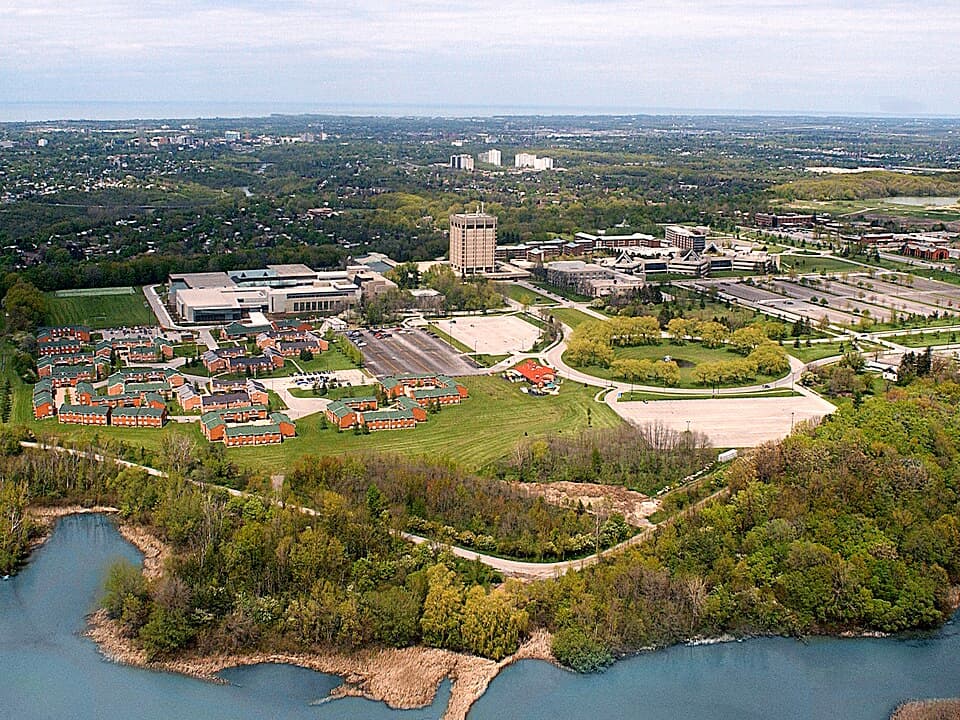
Brock University
St. Catharines, Ontario
Compare Brock University programs, admissions, costs, residence, student support, and career pathways in one source-reviewed guide. Jump to the decision section you need below.
Reviewed August 14, 2026 · Information checked against official university sources · How we review guides
Overview
Quick Facts
| Location | St. Catharines, Ontario |
|---|---|
| School Type | Comprehensive teaching and applied-program university |
| Directory Size | Large university |
| Campus Setting | Regional university city with a defined campus community |
| Ranking Signal | No QS World 2026 position listed in this guide |
| Program Strengths | Business, Education, Kinesiology, Science, Arts |
Start with campus and program fit, then verify official admissions, residence, and cost details before building the final application list.
Detailed application guides
Ontario University Application Deadlines
The 2027 OUAC timeline, offers, acceptance, and separate program deadlines.
OSAP 2026–2027 Application Guide
Open status, eligibility, residency, course load, grants, deadlines, and documents.
Ontario Universities With Co-op
Direct-entry and later-entry co-op models, work terms, fees, and questions to ask.
Admissions Planning
Fall 2027 application planning
Brock University admission requirements and current averages
Ontario applicants need an OSSD and six Grade 12 4U or 4M credits, including every prerequisite for the chosen program. Brock excludes co-op courses from the six-credit count and admission average. The general eligibility minimum is 70%, but many programs publish higher competitive levels and additional subject or evaluation requirements.
General minimum
70%
This is an eligibility floor, not a universal competitive or guaranteed admission average.
Ontario course count
Six 4U/M
Include all program prerequisites. Grade 12 co-op courses do not count in Brock's admission calculation.
Offer policy
One offer
Brock advises applicants to rank their preferred program first and may consider an admissible alternate when possible.
Fall 2027
Fall 2027 cycle status
Brock's live deadline page still publishes the 2026 cycle: a January 15, 2026 OUAC application deadline and a June 1, 2026 acceptance date. The admission criteria chart is labelled for a 2026 entry, and OUAC's own undergraduate key-dates page also still shows the January 15, May 28, and June 1, 2026 sequence. No Fall 2027 Brock or OUAC dates are published yet.
The January 15 Group A deadline recurs annually, so treat January 15, 2027 as the working planning date—but verify Brock's deadline page and OUAC once the Fall 2027 cycle is posted.
Brock University: Important admission deadlines (current cycle) · Verified August 14, 2026
University-published counts
Size and academic structure
Brock publishes more than 19,000 students across seven Faculties, over 100,000 graduates, and 600 faculty members including twelve 3M Teaching Fellowship winners and 13 Canada Research Chairs.
These are Brock's own marketing counts; treat them as directional rather than audited enrolment data.
Brock University: About Brock: size, faculties, and community · Verified August 14, 2026
Current campus context
St. Catharines and the Niagara region
Brock sits in St. Catharines in the Niagara region—about an hour from Toronto and just across the border from Buffalo. The university describes wine country, craft breweries, a thriving downtown St. Catharines arts scene, beaches, hiking and biking trails, and Niagara Falls as the surrounding context.
Brock University: Explore Niagara: St. Catharines and regional context · Verified August 14, 2026
Program prerequisites and published competitive levels
Brock currently publishes letter-grade planning levels. They are approximate, can change as the applicant pool changes, and do not guarantee an offer. The university has not yet published a replacement Fall 2027 criteria table, so verify every row before applying.
| Program | Required subjects | Published level | Planning note |
|---|---|---|---|
| Humanities and many Social Sciences programs | Senior English | B- | Program-specific exceptions and limited-enrolment programs can require more. |
| Business Administration (BBA) | Senior English and one Senior Math | B- regular / B co-op | The international double degree currently publishes A-. |
| Accounting (BAcc) | Senior English and two Senior Math courses | B regular / A- co-op | The co-op stream has a higher current planning range. |
| Computer Science (BSc) | Senior English and Senior Functions or Calculus, with at least B- in the math prerequisite | B- regular / B co-op | Computer Science and Mathematics has separate two-math requirements. |
| Integrated Engineering (BEng) | Senior English, Functions, Calculus, Chemistry, and Physics; at least B- in every prerequisite | A | This is the current direct-entry Integrated Engineering requirement. |
| Nursing (BScN) | Senior English, Biology, Chemistry, and Math; at least B in every prerequisite | A | This is a competitive program; the published level is not an offer guarantee. |
| Kinesiology (BKin) | Senior English, Biology, and Math | B | The combined BKin/MPK route currently publishes A+. |
| Medical Sciences (BSc) | Senior English, Biology, Math, and Chemistry; at least B- in Chemistry | B+ | Applicants should distinguish Medical Sciences from Nursing and Kinesiology. |
| Sport Management (BSM) | Senior English and Math | A- | Brock publishes a program-specific competitive level. |
| Concurrent Education | Senior English and Math, plus teachable- or major-specific subjects | A | Dramatic Arts and Visual Arts routes also use additional evaluation. |
| Game Programming | Senior English, Functions or Calculus with at least B-, and a successful Statement of Interest | A- | The live page lists February 1, 2026 for the current-cycle statement, not Fall 2027. |
| Applied Grape & Wine Science (BSc) | Senior Functions or Calculus and Senior Chemistry, each at least B-, plus two more senior sciences, math, or English | B- | Brock states it is the only university in Canada offering a grape and wine science degree; a co-op stream exists. |
Current-cycle warning
Brock and OUAC both still publish Fall 2026 dates
At this review, OUAC's live key-dates page and Brock's deadline page both still show the 2026 sequence. The timeline below maps the recurring annual pattern onto Fall 2027 with explicit verification checkpoints. Brock-specific application, document, supplementary, offer, and residence dates must be rechecked when Brock publishes its next cycle. A date printed as 2026 is not a Fall 2027 promise.
| Date | Status | Applicant action |
|---|---|---|
| August 2026 | OUAC annual OUInfo refresh | OUAC refreshes Ontario Universities' Info with new-cycle application material each August. Verify Fall 2027 Brock requirements and OUAC codes there and on Brock's program pages. |
| Late September 2026 | OUAC opening pattern — not yet posted | The Undergraduate application typically opens in late September, but OUAC's live key-dates page still shows the 2026 cycle. Confirm the 2027 application is live before starting the correct Brock choices. |
| January 15, 2027 | OUAC recurring Group A deadline — verify | January 15 is OUAC's recurring Group A deadline, but at this review OUAC still publishes January 15, 2026 and Brock has not replaced its current-cycle deadline page. Submit and pay well before the January date either way. |
| February 2027 | Brock pattern to recheck | Brock currently describes February as its first major Ontario offer round. Verify the Fall 2027 cycle and monitor the Brock portal. |
| May 28, 2027 | OUAC response pattern — verify | In the current published cycle, May 28 is the latest date Group A applicants can expect an offer, refusal, or deferral. Expect the same rhythm for Fall 2027 once OUAC posts the new dates. |
| June 1, 2027 | OUAC commitment pattern — verify | June 1 is the earliest date universities may require a response and financial commitment in the current published cycle. Follow the date in the actual offer; Brock's Fall 2027 residence-guarantee deadline is also unpublished. |
English-language test minimums
These are Brock's current general undergraduate minimums. Program-specific thresholds can be higher, and approved prior English-medium study or a Brock language pathway may satisfy the requirement in some cases.
| Test | Current general minimum |
|---|---|
| IELTS Academic | 6.5 overall; no band below 6.0 |
| TOEFL iBT | Brock's current page lists 88 overall and no band below 21, with a revised post-January 1, 2026 scale shown separately |
| Duolingo English Test | 110 |
| CAEL | 70 overall; no band below 60 |
| PTE Academic | 58 |
Current requirements
Ontario academic base
An OSSD plus six Grade 12 4U or 4M credits including program-specific prerequisites, with a minimum admission average of 70%. Co-op courses are not included in the six-credit count nor calculated into the admission average, and many programs require a higher average.
Brock University: Ontario secondary school requirements and offer rounds · Verified August 14, 2026
Current fee schedule
Application routes and fees
Ontario secondary students and anyone applying to multiple universities use OUAC with a January 15 deadline. Applicants applying to Brock only can use Brock's own application: $130 for full-time domestic and international applicants, $100 for part-time, upgrading, and Open Studies, and $75 for visiting Letter of Permission students. Winter entry (December 1) and Spring entry (April 1) exist for selected programs.
Brock University: Application types, entry terms, and application fees · Verified August 14, 2026
Current policy
One-offer policy
If admissible, Brock will only provide an offer to one program, so applicants should list the top-choice program first and others in order of preference. Offers may change during the year based on the most recent grades, and applicants who miss program criteria are automatically considered for an alternate program where possible.
Brock University: Admission criteria by program (2026 entry) · Verified August 14, 2026
2026 entry, latest available
Published competitive levels by program (2026 entry)
Brock publishes letter-grade competitive averages for 2026 entry: BBA B- (co-op B, international double degree A-), Accounting B (co-op A-), Computer Science B- (co-op B), Integrated Engineering A with a minimum B- in each of five prerequisites, Nursing A with a minimum B in each prerequisite, Sport Management A-, Concurrent Education A, Game Programming A- plus a Statement of Interest, and the combined Kinesiology BKin/MPK route A+.
Brock states these averages are approximate, change with the applicant pool, and that achieving the minimum requirements does not guarantee admission.
Brock University: Admission criteria by program (2026 entry) · Verified August 14, 2026
Current published pattern
Offer rounds and grade evidence
December early offers need six completed Grade 11 U/M credits plus registration in six Grade 12 U/M courses, with expected averages in the high 80s or 90s—competitive programs such as Nursing or Concurrent Education may not issue early offers. The first major Ontario round is in February using at least three first-semester 4U/M finals; the final round and automatic top-choice reassessment happen in May; final July grades are checked against offer conditions, with summer-school finals due August 14 and OSSD proof by August 21.
Brock University: Ontario secondary school requirements and offer rounds · Verified August 14, 2026
2026 cycle, latest available
Supplementary evaluation deadlines
The current cycle sets February 1, 2026 for the Visual Arts portfolio, the Game Design and Game Programming Statement of Interest, and the Accelerated Mathematics Studies personal statement and portfolio. The DART Invitational is mandatory for Dramatic Arts routes, and Music auditions run February through May.
These dates belong to the 2026 cycle; expect equivalent early-February deadlines for Fall 2027 and verify each program page when the next cycle posts.
Brock University: Important admission deadlines (current cycle) · Verified August 14, 2026
Current requirements
English-language evidence
General undergraduate minimums: IELTS Academic 6.5 with no band below 6.0, TOEFL iBT 88 with no band below 21 (after January 1, 2026 the revised scale is 4.5 overall with section minimums), Duolingo 110, CAEL 70 with no band below 60, PTE 58, and Cambridge C1/C2 at 176. Co-op Accounting publishes higher thresholds—IELTS 7.0 with no band below 6.5, TOEFL 100, Duolingo 120. Three years of full-time English-medium study or Brock's IELP Level 5 pathway can also satisfy the requirement.
Brock University: Undergraduate English proficiency requirements · Verified August 14, 2026
Application Checklist
| Academic Requirements | Verify prerequisite courses, minimum averages, and program-specific requirements on the official admissions pages. |
|---|---|
| Supplementary Review | Competitive programs may ask for essays, portfolios, interviews, experience profiles, or timed video responses. |
| International Applicants | Plan transcript evaluation, English-language proof if required, study permit timing, and proof-of-funds documentation. |
| Deadlines | Confirm application, document, scholarship, residence, and portfolio deadlines every cycle before submitting. |
| Stellar Coaching Use | Bring your target program, transcript, activities, and draft responses to a coaching session for school-specific planning. |
Programs and Pathways
Brock University programs and application routes
Choose the exact degree, stream, and co-op option—not only a broad subject. Regular and co-op streams can use different admission levels, and some arts, education, game, and professional routes add a portfolio, audition, invitational, or Statement of Interest.
Applied Health Sciences
Child Health, Kinesiology, Medical Sciences, Nursing, Physical Education, Public Health, Recreation, Sport Management, and Therapeutic Recreation.
Compare before applying: Compare science and math prerequisites, competitive level, professional placements, and whether a combined degree route changes admission.
Goodman School of Business
Accounting, Business Administration, co-op streams, and international double-degree options.
Compare before applying: Compare one-math versus two-math prerequisites, co-op entry, accreditation, degree structure, and international route requirements.
Education
Concurrent Education across BA, BSc, BPhEd, and Educational Studies pathways, plus Adult Education.
Compare before applying: Match the division and teachable subjects before choosing a code; some arts routes require an invitational, portfolio, or audition.
Humanities
English, History, Classics, Dramatic Arts, Music, Visual Arts, Game Design, Interactive Arts and Science, and Modern Languages.
Compare before applying: Check whether the program uses a portfolio, audition, invitational, or Statement of Interest in addition to academic review.
Mathematics and Science
Biochemistry, Biological Sciences, Biomedical Sciences, Computer Science, Data Sciences, Earth Sciences, Game Programming, Integrated Engineering, Mathematics, Neuroscience, and Physics.
Compare before applying: Map exact senior math and science prerequisites; regular, co-op, double-degree, and accelerated routes can publish different levels.
Social Sciences
Applied Linguistics, Business Economics, Child and Youth Studies, Critical Criminology, Economics, Film, Forensic Psychology, Geography, Media, Political Science, Psychology, Sociology, and Tourism.
Compare before applying: Compare BA versus BSc prerequisites, co-op availability, limited-enrolment routes, and graduate or professional-school preparation.
A safer program-shortlist method
- 1. Confirm the exact Brock degree and application code.
- 2. Match every senior prerequisite and its individual grade floor.
- 3. Compare the current regular, co-op, combined-degree, and international-route levels separately.
- 4. Record every supplementary evaluation and its cycle-specific deadline.
- 5. Recheck the official program finder after Brock publishes Fall 2027 criteria.
Current structure
Undergraduate faculties and program-level bars
Brock's admission criteria chart spans six undergraduate-admitting faculties: Applied Health Sciences, the Goodman School of Business, Education, Humanities, Mathematics and Science, and Social Sciences. The program and stream—regular, co-op, combined-degree, or international double degree—set the real bar, not the university-wide 70% floor.
Brock University: Admission criteria by program (2026 entry) · Verified August 14, 2026
Current program
Applied Grape and Wine Science: a national differentiator
Brock states it is the only university in Canada to offer a degree in grape and wine science. The BSc in Applied Grape and Wine Science has a co-op option, hands-on winemaking labs and viticulture fieldwork, and connects students with the Cool Climate Oenology and Viticulture Institute (CCOVI). Published 2026-entry level: B- with a minimum B- in senior Functions or Calculus and in Chemistry.
Brock University: Applied Grape and Wine Science program page · Verified August 14, 2026
2026 entry, latest available
Concurrent Education remains open for entry
Brock's 2026-entry chart lists concurrent BEd routes across BA, BSc, BPhEd, BRLS, Child and Youth Studies, and Educational Studies pathways in Primary-Junior, Junior-Intermediate, and Intermediate-Senior divisions, generally at an A competitive level (Interactive Arts and Digital Media at A-). Dramatic Arts requires the DART Invitational and Visual Arts a portfolio. Consecutive and technological teacher education routes also exist separately.
Teacher-education intakes can change; confirm the Fall 2027 chart still lists the intended division and teachable subjects before ordering OUAC choices.
Brock University: Admission criteria by program (2026 entry) · Verified August 14, 2026
2026 entry, latest available
Sport Management (BSM)
Sport Management requires senior English and one senior Math and currently publishes an A- competitive level—higher than most Brock arts routes. The fee schedule also prices Sport Management in its own domestic tuition band above other Arts and Science programs.
Brock University: Admission criteria by program (2026 entry) · Verified August 14, 2026
Official Brock program sources
Brock University Residence Fees, Meal Plans & Guarantee
Brock University residence fees, meal plans, and guarantee
Brock's published 2026–2027 room fees range from $8,920 for a Village double to $11,040 for selected semi-suite singles and Quarry View singles. Meal plans are mandatory and priced separately, so a room fee by itself is not the full residence cost.
| Style | Example | Room fee | Meal-plan rule |
|---|---|---|---|
| Traditional | DeCew double / single | $9,840 / $10,640 | 7-Day All-Access required |
| Semi-Suite | Earp, Lowenberger, Vallée, or Residence 8 | $10,240 double / $11,040 single | 7-Day All-Access required |
| Townhouse | Village double / single | $8,920 / $10,840 | 5-Day or 7-Day All-Access |
| Townhouse | Quarry View single | $11,040 | 5-Day or 7-Day All-Access |
7-Day All-Access
$6,590
Required in traditional and semi-suite residence and available in townhouse residence for 2026–2027.
5-Day All-Access
$6,205
Available only to Village and Quarry View townhouse residents for 2026–2027.
The Fall 2027 residence guarantee is not published yet
For September 2026, Brock guaranteed residence to full-time undergraduate students in any year who applied and paid the $500 fee by June 1, 2026; Brock Suites was excluded. That date has passed and cannot be reused as a Fall 2027 deadline. Recheck the next guarantee, application, payment, and room-assignment rules when published.
2026–2027
September 2026 residence guarantee
Brock guaranteed a residence space to full-time undergraduate students in any year of study who applied and paid the $500 application fee by June 1, 2026. Brock Suites is excluded and remains first-come, first-served, and later applicants are prioritized first-come, first-served. The $500 fee is applied to total residence fees for students who live in residence that year.
Brock University: New residence students: September 2026 guarantee and key dates · Verified August 14, 2026
Fall 2027
Fall 2027 residence guarantee and rates
Not yet published. The housing pages currently cover the September 2026 to April 2027 application cycle, with Fall move-in September 5–7, 2026 and Winter move-in January 3, 2027.
Budget with labelled 2026–2027 rates and recheck the guarantee, fee, and deadline rules when Brock opens the Fall 2027 housing cycle.
Brock University: New residence students: September 2026 guarantee and key dates · Verified August 14, 2026
2026–2027
2026–2027 room fees by building
Published 2026–27 room fees: DeCew traditional double $9,840 and single $10,640; semi-suite doubles in Earp, Lowenberger, and Vallée $10,240 and singles (including Residence 8) $11,040; Village townhouse double $8,920 and single $10,840; Quarry View townhouse single $11,040. Fees are billed 60% in September and 40% in January and include furnishings, utilities, and wireless. Residence closes over the Winter Break; approved stays cost $280 per week.
Brock University: Residence room fees for 2026–2027 by building · Verified August 14, 2026
2026–2027
Mandatory All-Access meal plans
Every residence student must buy an All-Access plan for 2026–2027: the 7-Day plan is $6,590 and required in traditional and semi-suite residences; the 5-Day plan is $6,205 and available only to townhouse residents. Both include $150 Meal Dollars and $50 Flex Dollars, are dine-in only at the DeCew and Lowenberger dining halls, and are optional for Brock Suites residents.
Brock University: 2026–2027 residence All-Access meal plans · Verified August 14, 2026
Student life in St. Catharines and the Niagara region
Housing fit includes city fit. These source-backed facts cover the community, mandatory transit pass, and health coverage that shape day-to-day life at Brock.
Current campus life
Clubs, intramurals, and Brock Badgers
Brock describes itself as a community with a variety of clubs, intramural athletic options, and extracurricular activities, and invites students to cheer on the Brock Badgers in a wide variety of sports.
Brock's public pages do not publish a specific club count; confirm a specific club is active on ExperienceBU before planning around it.
Brock University: About Brock: size, faculties, and community · Verified August 14, 2026
2026 fees
Mandatory regional transit pass
The BUSU Universal Transit Pass is $364.94 for 2026 and covers a mandatory eight-month pass valid on St. Catharines Transit, Welland Transit, and Niagara Transit for students taking 1.5 or more credits on the St. Catharines campus.
Brock University: 2026 Fall/Winter undergraduate tuition and fee schedule (subject to change) · Verified August 14, 2026
2026 fees
BUSU health and dental coverage
Students with 3.0 or more credits—and all international students regardless of course load—are charged $216.87 for the BUSU health plan and $161.63 for the dental plan in 2026. Students with comparable coverage can opt out through the student health plan site.
Brock University: 2026 Fall/Winter undergraduate tuition and fee schedule (subject to change) · Verified August 14, 2026
Official Brock residence and dining sources
Housing and Location Questions
| Campus Setting | Regional university city with a defined campus community |
|---|---|
| Residence | Check residence guarantee rules, first-year room styles, meal plans, deposit deadlines, and off-campus housing pressure. |
| City Fit | Students should compare transit, weather, cost of living, safety, and community feel in St. Catharines. |
| Commuting | If living off campus, map commute time to classes, labs, placements, and evening activities before committing. |
Tuition, Scholarships, and Aid
Brock University tuition and entrance scholarships
Brock does not have one accurate tuition figure for every undergraduate. Use the official 2026 Fall/Winter fee schedule and estimator with the exact program, course load, year, and domestic or international status, then add ancillary fees, health coverage, books, housing, meals, travel, and personal costs.
2026 domestic Brock Scholars Awards
These automatic values use the final admission average; Brock says it does not round. Full-time registration, renewal milestones, continued eligibility, and annual Board approval apply.
| Final average | Maximum | First year | Renewal |
|---|---|---|---|
| 95.0% and above | $7,000 | $5,500 | $500 at each eligible milestone |
| 90.0%–94.9% | $5,000 | $3,500 | $500 at each eligible milestone |
| 85.0%–89.9% | $3,000 | $1,500 | $500 at each eligible milestone |
2026 international Brock Scholars Awards
The international table has different thresholds and values from the domestic award. Treat these as 2026 evidence and recheck the Fall 2027 award page before relying on them.
| Final average | Maximum | First year | Renewal |
|---|---|---|---|
| 95.0% and above | $32,000 | $20,000 | $4,000 per eligible year |
| 90.0%–94.9% | $24,000 | $15,000 | $3,000 per eligible year |
| 85.0%–89.9% | $12,500 | $8,000 | $1,500 per eligible year |
| 80.0%–84.9% | $7,000 | $4,000 | $1,000 per eligible year |
Use OneApp for additional funding
Automatic Brock Scholars Awards are only one layer. Complete Brock's OneApp for donor awards and bursaries, then compare OSAP or other government aid, external scholarships, work options, and the full net cost after renewable conditions.
2026 Fall/Winter
Domestic 2026 Fall/Winter flat fees
Published Ontario-resident flat fees for the 2026 Fall/Winter year: Arts and Science $6,211.15, Sport Management $8,329.12, Computer Science $8,494.50, Business $10,552.70, and Integrated Engineering $11,424.00, plus per-credit ancillary fees of $116.89 (a $584.45 flat total). Out-of-province Canadians pay more—for example, $7,401.65 in Arts and Science.
Brock labels this schedule subject to change and pending Board of Trustees approval—treat every figure as planning evidence, not a quote.
Brock University: 2026 Fall/Winter undergraduate tuition and fee schedule (subject to change) · Verified August 14, 2026
2026 Fall/Winter
International 2026-entry flat fees and rate hold
For 2026 entry, international flat fees are $39,834.95 in Arts and Sciences, $40,740.85 in Engineering, and $41,645.60 in Sport Management, Computer Science, and Business, plus ancillary fees and the $750.00 Province of Ontario International Recovery Fee. Brock holds the entry-year rate for up to five academic years for a first degree, and U.S. residents pay a lower separate table (Arts and Sciences $29,876.20).
Brock University: 2026 Fall/Winter undergraduate tuition and fee schedule (subject to change) · Verified August 14, 2026
2027–28
2027–28 tuition status
Not yet published. Brock charges tuition per term under MCURES guidelines, and the 2026 Fall/Winter schedule is the latest posted—itself marked subject to change pending Board of Trustees approval. Use the undergraduate fees estimator with the exact program, year, and residency status.
Budget with the labelled 2026 Fall/Winter schedule and re-check the tuition overview page before treating any figure as a Fall 2027 quote.
Brock University: Undergraduate tuition and fees overview · Verified August 14, 2026
2026 entry
2026 domestic Brock Scholars Awards
Automatic with no application: a 95.0%+ final admission average earns up to $7,000 ($5,500 in year one), 90.0–94.9% up to $5,000 ($3,500), and 85.0–89.9% up to $3,000 ($1,500), each with $500 renewals at 5.0-credit milestones requiring an 80% milestone average. Domestic 2026 entry requires a minimum 85% final average, Brock does not round averages, and full-time registration (1.5 credits per term) is required.
Awards are subject to annual Board of Trustees approval; the 2027 award page was not yet published when verified.
Brock University: 2026 domestic Brock Scholars Awards and OneApp · Verified August 14, 2026
2026 entry
2026 international Brock Scholars Awards
The international table starts at an 80% final admission average: maximums of $32,000 (95.0%+, $20,000 in year one), $24,000 (90.0–94.9%), $12,500 (85.0–89.9%), and $7,000 (80.0–84.9%), with annual renewals of $1,000 to $4,000. U.S. applicants qualify only for the domestic amounts, and Brock's OneApp opens hundreds of additional awards and bursaries through one application.
Brock University: 2026 international scholarships and awards · Verified August 14, 2026
Official Brock tuition and scholarship sources
Cost Planning
| Tuition | Tuition depends on program, student status, and year. Verify domestic and international tuition on the official fee schedule. |
|---|---|
| Scholarships | Check automatic entrance awards, competitive major awards, faculty scholarships, and international-student awards. |
| Living Costs | Budget for residence or rent, food, books, transit, health insurance, winter clothing, and emergency funds. |
| Proof of Funds | International students should confirm current study-permit financial requirements and school-specific cost estimates. |
Student Life and Support
Fit Signals
| Community | Large university profile: compare class feel, access to professors, student clubs, and how easy it is to build community. |
|---|---|
| Student Supports | Review academic advising, accessibility services, mental health supports, international student services, and writing centres. |
| Clubs and Leadership | Look for discipline clubs, cultural groups, entrepreneurship programs, varsity/intramural sports, and volunteering. |
| First-Year Transition | Ask how orientation, peer mentorship, residence programming, and advising help students settle in. |
Co-op, Research, and Career Outcomes
Brock University co-op: entry, work terms, and eligibility
Brock co-op is a structured academic option with direct-entry and selected later-entry routes. The current model includes three four-month work terms of at least 420 hours each and the mandatory non-credit 0N90 preparation course, for at least 12 months of accumulated work experience.
High-school entry
Apply to a Brock co-op stream through the undergraduate university application. Co-op is a distinct choice rather than automatic access from every regular program.
Later entry
Selected programs accept applications after first year. The live 2026 page lists a March 2–June 1 window and says space can be limited.
Later-entry eligibility
Current students need full-time standing, no more than 5.0 credits, legal authorization to work, and Honours standing—typically 70% in major and 60% in non-major courses. Public Health lists 75%.
Work-term structure
Brock currently requires three four-month work terms, at least 420 hours each, plus the mandatory non-credit 0N90 professional preparation course.
Degree timing
Brock says the accelerated co-op sequence typically extends the corresponding regular degree by four months and provides at least 12 months of accumulated work experience.
Employment
Work terms are typically paid, but applicants should not interpret co-op admission as a job guarantee. Hiring still depends on applications, interviews, eligibility, and employer decisions.
Published 2026 co-op fees
Brock's 2026 program-related fee schedule lists a $917.89 entry fee, a $300.00 Co-op Student Support Fee, and $889.00 for the 0N90 course, with each work term charged as the applicable half-credit tuition fee. All co-op fees are non-refundable and subject to change.
Paid work is typical; placement is not guaranteed
Students still compete for roles through applications and interviews. Employer decisions, academic standing, work authorization, and the supply of suitable jobs all matter. The March 2–June 1 later-entry window shown on Brock's live page is for 2026 and must be rechecked for the next cycle.
Current program
How Brock currently describes its co-op program
Brock's co-op landing page invites students to build a career with 'one of Canada's most diverse co-op programs.' The program office reports that 98% of co-op employers rated students' work-term performance 'Good' and above and 90% of students rated their work-term satisfaction 8 or higher out of 10.
Brock's current first-party pages do not claim to be Ontario's largest co-op program—do not repeat that framing without a source.
Brock University: Co-op Education landing page (program positioning) · Verified August 14, 2026
Current program
Work-term structure and standing rules
Co-op students complete three four-month work terms of at least 420 hours each plus the mandatory non-credit 0N90 Professional Preparation course. The accelerated sequence typically extends the degree by four months and delivers at least 12 months of work experience. Students must maintain Honours standing—typically 70% in the major and 60% in non-major courses, with Public Health at 75%. Work terms are typically paid, but some industries may not offer pay.
Brock University: How co-op works: work terms, 0N90, and standing rules · Verified August 14, 2026
Current program
Direct entry and later entry
Direct entry happens through the university application from high school. Students who did not enter directly can apply after first year in listed programs—including Accounting, Business Administration, Public Health, Computer Science, most Mathematics and Science majors, and many Social Sciences majors—with applications available March 2 to June 1. Eligibility requires full-time standing, no more than 5.0 credits earned, Honours standing, and legal authorization to work in Canada; interviews run in June and space is limited.
Brock University: Apply to co-op: direct and later-entry routes · Verified August 14, 2026
2026 fees
2026 co-op fees
Brock's 2026 program-related fee schedule lists a co-op entry fee of $917.89, a Co-op Student Support Fee of $300.00, and $889.00 for the 0N90 Professional Preparation course. Each work term is charged as the applicable half-credit tuition fee rather than a separate administrative fee, and all co-op fees are non-refundable.
Fee amounts are marked subject to change; verify the schedule for the year you enter co-op.
Brock University: 2026 undergraduate program-related fees including co-op fees · Verified August 14, 2026
Official Brock co-op sources
Career Planning
| Experiential Learning | Check whether your target program offers co-op, internships, clinical placements, practicums, studios, field schools, or research terms. |
|---|---|
| Career Services | Compare job boards, employer partnerships, resume support, interview preparation, and alumni mentoring. |
| Research Access | For graduate-school or professional-school pathways, look for undergraduate research assistant roles and lab access. |
| Outcome Questions | Ask where graduates work or study next, and whether outcomes differ by program, co-op stream, or campus. |
Brock University applicants need to distinguish the 70% eligibility floor from program-specific competitive levels, match exact prerequisites and supplementary evaluations, separate confirmed OUAC dates from Brock's still-current 2026 pages, and compare co-op entry, net cost, scholarships, residence, meal plans, and English requirements. This guide keeps those decisions on one canonical, official-source-backed page.
Brock University admission requirements, averages, co-op, scholarships, tuition, and residence questions
Direct answers to Brock's 70% eligibility floor, six-course rule, current program levels and prerequisites, Fall 2027 OUAC timing, offer rounds, one-offer policy, co-op entry and work terms, tuition, domestic and international scholarships, residence fees, meal plans, housing guarantee, and English tests.
Official Sources and Next Steps
Stellar keeps this guide structured for comparison, but official university pages remain the source of truth for program requirements, tuition, residence, scholarships, deadlines, and policy changes.
Prepared by Stellar Advisers Editorial Team · Reviewed August 14, 2026 · Editorial, corrections, and source methodology
Related Canadian universities
Compare 3 other Ontario records, then continue through the national directory.