Explore guide
Related resources
Browse all resourcesOn this page
University of Guelph Acceptance Rate: What Official Data Shows
Guelph's Fact Book: 30,394 new Ontario high school applicants and 8,148 confirmations in 2024. Guelph’s Fact Book 2024-2025 counted 30,394 new Ontario high-school applicants and 8,148 confirmations in 2024. Those are Guelph’s newest official admissions counts. Guelph’s Office of Institutional Research and Planning “Fact Book” publishes raw applicant, confirmation, and registration counts. These cover new Ontario high-school applicants by year. A confirmation is a student who accepted an offer; it is not an offer made. Because the public table does not contain the total number of offers, it cannot calculate a true acceptance rate. This guide keeps the raw counts and does not turn them into a misleading admissions percentage.
The short answer
- Guelph's Fact Book 2024-2025 counted 30,394 new Ontario high-school applicants and 8,148 confirmations in 2024.
- A confirmation is a student who accepted an offer, not an offer made, so no true acceptance rate can be worked out.
- Guelph publishes Estimated Cut-off Ranges by program for Ontario applicants, such as 84-89% for Bachelor of Engineering.
- An average inside a range does not guarantee admission, and Guelph says co-op averages often run higher.
- The Doctor of Veterinary Medicine is not offered directly from secondary school.
Reviewed October 8, 2026 · Guelph revises published admission ranges between cycles, so always confirm the current range on the live program page before applying
Save this to your free account
Keep these dates where you'll see them. Free account; we email you before each saved date; unsubscribe any time. Your account’s email pause still applies. The calendar file needs no account.
- Guelph, current Ontario high-school applicantsJanuary 15, 2027
Free account. No card needed.
How we got these numbers
We did not calculate a percentage for Guelph. The counts in the opening answer are copied from page 21 of Guelph's Fact Book 2024-2025, published by its Office of Institutional Research and Planning. We re-read it on October 8, 2026, and it is still the newest edition.
| Count (2024) | What Guelph counts | What it is not |
|---|---|---|
| 30,394 applicants | New applicants direct from Ontario high schools in the current year | Not every applicant. Guelph says this group was 79.9% of new applicants in Fall 2024. |
| 8,148 confirmations | "All students who confirmed an offer" | Not offers made. Many students who get an offer choose another school. |
| 7,194 registrations | "All students who registered" | Not offers made, and not an acceptance rate. |
An acceptance rate needs the number of offers. Guelph's public table has no offer count, so we do not divide these numbers or print a percentage. Dividing confirmations by applicants would only show the share who came to Guelph, which is far lower than the share who got in.
Source: University of Guelph Fact Book 2024-2025, page 21, re-read October 8, 2026.
Official program-by-program admission ranges
For Ontario high-school applicants, Guelph publishes an “Estimated Cut-off Range” on each program’s requirements page. We re-read every one on October 8, 2026 and grouped programs that share a range. Guelph says the ranges are based on admission averages from previous years. Exact cut-offs depend on the number and strength of applications and the space available, and an average in the range does not guarantee admission.
| Degree / major group (Ontario applicants) | Estimated cut-off range |
|---|---|
| Bachelor of Applied Science: Applied Human Nutrition, Family Studies and Human Development | 75-80% |
| Bachelor of Applied Science: Child Studies | 80-85% |
| Bachelor of Arts (most majors) | 75-80% |
| Bachelor of Arts: Criminal Justice and Public Policy, Psychology | 80-86% |
| Bachelor of Arts and Sciences | 78-83% |
| Environmental Management; Food, Agricultural and Resource Economics | 75-80% |
| Bachelor of Commerce (all majors) | 80-86% |
| Bachelor of Computing: Computer Science, Software Engineering | 82-87% |
| Bachelor of Computing: Human-Centred Artificial Intelligence | 85-90% |
| Creative arts majors: Creative Writing, Music, Studio Art, Theatre Studies | 75-80% |
| Bachelor of Engineering (all majors) | 84-89% |
| Bachelor of Indigenous Environmental Science and Practice | 75-80% |
| Bachelor of Landscape Architecture | No range published; grades plus a Background Information Form |
| Mathematical Science | 78-83% |
| Bachelor of One Health | 80-85% |
| Bachelor of Science: biological sciences (most majors), Human Kinetics | 80-85% |
| Bachelor of Science: Animal Biology, Bio-Medical Science, Neuroscience | 86-92% |
| Bachelor of Science: physical sciences (Chemistry, Physics and related majors) | 78-83% |
| Bachelor of Science in Agriculture: Honours Agriculture, Animal Science, Crop Science, Horticulture | 75-80% |
| Environmental Sciences | 75-80% |
Source: University of Guelph program requirement pages for Ontario high school applicants, re-read October 8, 2026. Guelph says co-op averages will often exceed these ranges.
Applicants, confirmations, and registrations
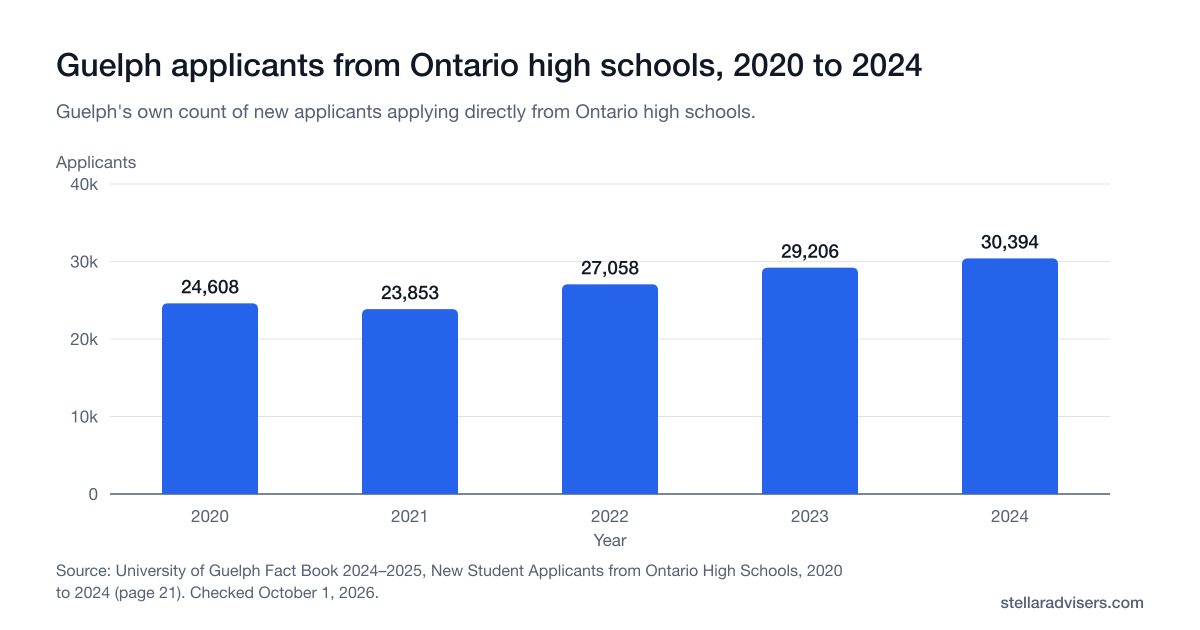
Guelph’s own Fact Book publishes a table, “New Student Applicants from Ontario High Schools,” every year. Confirmations are not offers made. Guelph defines a confirmation as a student who accepted an offer. Registrations are students who enrolled. The table keeps those measures separate so readers do not confuse either one with an acceptance rate.
Source: University of Guelph Fact Book 2024–2025, New Student Applicants from Ontario High Schools, 2020 to 2024 (page 21). Reviewed October 1, 2026. Guelph doesn't publish how many offers it made. This shows demand, not an acceptance rate.
Show the numbers
| Year | Applicants |
|---|---|
| 2020 | 24,608 |
| 2021 | 23,853 |
| 2022 | 27,058 |
| 2023 | 29,206 |
| 2024 | 30,394 |
| Year | Applicants | Confirmations | Registered |
|---|---|---|---|
| 2020 | 24,608 | 5,587 | 4,899 |
| 2021 | 23,853 | 5,018 | 4,555 |
| 2022 | 27,058 | 6,973 | 6,322 |
| 2023 | 29,206 | 5,702 | 5,196 |
| 2024 | 30,394 | 8,148 | 7,194 |
Source: University of Guelph Fact Book 2024-2025, Office of Institutional Research and Planning, page 21, re-read October 8, 2026. This table covers new applicants direct from Ontario high schools only. Guelph’s Fall 2024 breakdown shows this group was 79.9% of new applicants. Other Canadian secondary schools, other semester 1/first-year applicants, and transfer applicants made up the rest. Guelph’s real-time admissions dashboards are marked “restricted” and redirect to Microsoft sign-on. The current province-wide Common University Data Ontario (CUDO) landing page is public, but it does not supply the total offers made needed for a true acceptance rate. Neither source contributes a percentage to this page.
What actually determines Guelph admission
The ranges above are estimates, not guaranteed cut-offs. Guelph reviews the required prerequisite courses within the admission average, and offers an optional Student Profile Form that lets applicants add context such as an explained repeated course. Co-op admission normally requires at least an 80% university-level average for consideration. Actual cut-offs usually run higher and depend on demand and available places. Applicants not admitted to co-op are normally considered for the regular program instead. Engineering is the exception because applicants enter directly through the co-op stream.
Guelph also publishes named automatic alternate-offer routes for some competitive choices. These include co-op to the comparable regular stream except Engineering, Criminal Justice and Public Policy to Justice and Legal Studies, Psychology to Sociology, and Animal Biology to Zoology. Bio-Medical Science or Human Kinetics may lead to Biological Science. The Doctor of Veterinary Medicine (DVM) is a separate case: it is not offered directly from secondary school, so no Guelph bachelor degree is a guaranteed pre-vet route.
For deadlines, the Student Profile Form, co-op entry, tuition, and residence, see the complete University of Guelph admissions guide.
Official sources
Every figure on this page links back to the Guelph source it came from.
- Ontario admission requirements by program
Guelph's requirement finder for Ontario applicants. It links to one page per program, such as uoguelph.ca/programs/undergraduate/requirements/high-school/ontario/computer-science, each listing an "Estimated Cut-off Range." Every range in our table was re-read on those program pages October 8, 2026. None is labelled an acceptance or admission rate.
- Fact Book 2024-2025
Guelph's Office of Institutional Research and Planning publication. Page 21 supplies every Ontario high-school applicant, confirmation, and registration count on this page. Confirmations are students who accepted an offer, not the total offers made. Re-read October 8, 2026.
- Institutional Research and Planning: Fact Book index
Guelph's landing page, which still lists the 2024-2025 Fact Book above as the newest edition, with prior editions back to 2017-2018. Re-read October 8, 2026.
- uoguelph.ca/iar (redirects to Institutional Research and Planning)
This legacy institutional-research URL redirects to irp.uoguelph.ca, Guelph's current data and statistics home. Checked October 8, 2026.
- Common University Data Ontario at Guelph
Guelph's own CUDO landing page, still listing annual reports through 2023 when re-checked October 8, 2026. CUDO's admission table counts applicants and registrants, not offers.
- Admissions dashboards (restricted)
Guelph's own data-insights index labels this page "restricted." On October 8, 2026 it still redirected to a Microsoft sign-in, so the real-time admissions dashboards are not public.
- Common University Data Ontario (provincial portal)
Ontario Universities' public CUDO landing page, reachable October 8, 2026. It describes enrolment and entering-average data but does not provide the total Guelph offers made needed for a true acceptance rate.
- Co-op admission requirements
Guelph's 80% or higher average in university-level high school courses for degree co-op, re-read October 8, 2026. Guelph says cut-offs vary and may be higher than 80%.
- Alternate offers of admission
Guelph's automatic alternate-offer routes, including co-op to the regular program except the Bachelor of Engineering, "which is co-op admission only." Re-read October 8, 2026.
- Ontario Veterinary College DVM application route
Guelph's rule that DVM applicants need at least two years (minimum of 4 semesters) of full-time undergraduate study first. Re-read October 8, 2026.
Frequently asked questions
Direct answers about Guelph's applicant, confirmation, and registration counts, and why none of them is a published university-wide acceptance rate.
Planning a Guelph application?
A peer adviser who has been through Guelph admissions can help you plan your program choice and application. Guelph is the only official source for admission decisions.