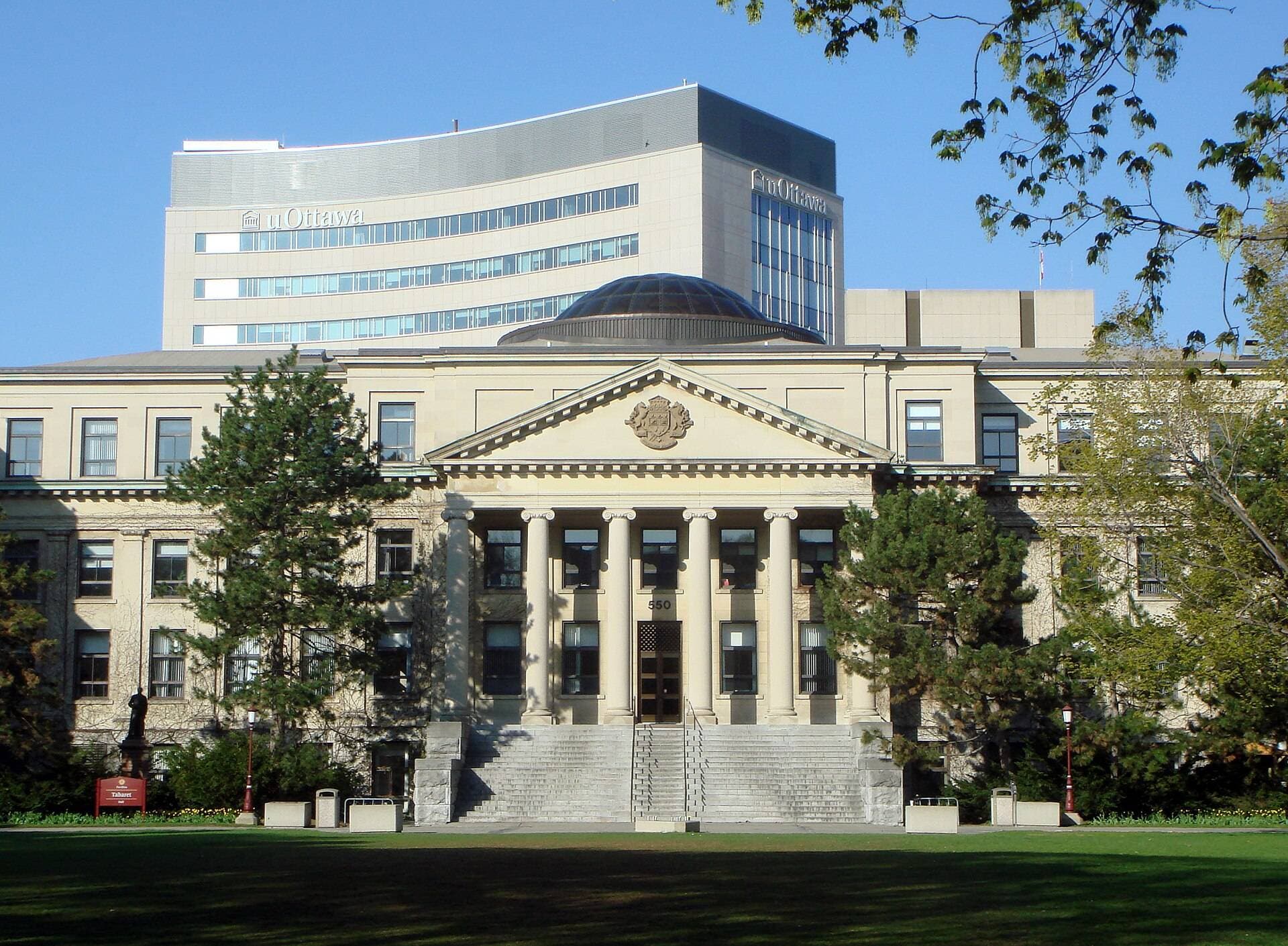

University of Ottawa Programs & Pathways
Ottawa, Ontario
Program strengths and how to compare pathways. This focused guide keeps the detailed tables, official sources, and practical next steps in one manageable reading path.
The short answer
- More than 350 undergraduate programs are taught in English and French at the University of Ottawa.
- Apply through OUAC, the Ontario Universities' Application Centre (Ontario's university application site), for Arts, Engineering, Health Sciences, Science, Social Sciences, and Telfer.
- French Immersion is offered in more than 80 programs across six direct-entry faculties.
- The entry test costs $33.00 for tests taken on or after February 12, 2026, and failing it only removes the immersion option.
- Co-op appears in more than 90 programs, with about 16 months of paid experience when eligible.
Reviewed August 14, 2026 · Official university sources · How we review guides
Current undergraduate program map
uOttawa programs, faculties, and degree structures
The University of Ottawa lists more than 350 undergraduate programs in English and French. To choose among them, you compare the exact degree structure, teaching language, faculty, first-year course sequence, and experiential option. You do not compare just a program name. Most honours paths are 120 units. But combinations, professional routes, and the point when a minor or second major can be added vary.
Undergraduate choice
350+ programs
The official undergraduate finder covers flexible English- and French-language paths.
University structure
10 faculties
The full university also has Education, Common Law, and Medicine. They use separate entry routes.
Bilingual study
80+ French Immersion
Eligible students complete about one-third of their courses in French while earning the main degree.
Work experience
90+ co-op programs
Eligible routes can include about 16 months of paid experience. The timing and admission rules are set by program.
The bilingual difference: French Immersion for anglophone applicants
For English-speaking Caribbean and Canadian applicants, uOttawa's clearest differentiator is the French Immersion Stream. It adds graded French-taught content courses to an English program. It does not require fluency at entry. The entry test never puts the underlying program offer at risk.
French Immersion Stream availability
Current program · Published for this period
The French Immersion Stream is offered in more than 80 undergraduate programs. These programs are in the six direct-entry faculties: Arts, Engineering, Health Sciences, Science, Social Sciences, and Telfer. It is for Anglophone and Allophone students. These students studied French as a second language in high school. Immersion students take one-third of their courses taught in French. They earn the same degree.
Applies to: All applicants
uOttawa Undergraduate Studies: French Immersion Stream overview · Verified August 14, 2026
How French Immersion entry works
Current process · Published for this period
On the OUAC (Ontario's university application site) program-details screen, applicants select the French Immersion option. After receiving an offer that includes immersion, they pass the compulsory online Immersion Entry Test. Failing the test removes only the immersion option. It does not affect admission to the underlying program. Students can retake it after two months. They can join later through French-as-a-second-language courses.
The test currently carries a $33.00 non-refundable fee. You pay it through the university's eStore. This fee is for tests taken on or after February 12, 2026.
Applies to: Ontario high school, Other Canadian, International
uOttawa Undergraduate Studies: Become a French Immersion student: eligibility and entry test · Verified August 14, 2026
Compare uOttawa faculties and application routes
This table keeps the usual undergraduate program choice apart from Civil Law. It also keeps it apart from later professional entry. Always verify the current program finder, catalogue, and faculty rules. Use the ones for the student's application cycle.
| Faculty or route | Example program areas | Degree or entry structure | Selection note |
|---|---|---|---|
| Arts | Communication, Digital Journalism, Environmental Studies, languages, Translation, Music, Theatre, and Visual Arts | Offers honours bachelor, major, minor, microprogram, and interdisciplinary combinations. Some BA with Major students choose their final path after first year. | Check language, portfolio, audition, or course-sequence requirements for the exact program. Do not treat every Arts route as the same. |
| Engineering and Computer Science | Chemical, Civil, Computer, Electrical, Mechanical, Software, Biomedical Mechanical, Multidisciplinary Design, and Computer Science | Applicants select a specific program. They do not enter a university-wide Engineering common first year. Computer Science leads to a BSc. Engineering programs lead to a BASc. | Multidisciplinary Design has its own portfolio, Kira video, and written submission. Co-op availability depends on the program. Whether co-op is mandatory also depends on the program. |
| Health Sciences | Health Sciences, Human Kinetics, Nursing, Food Sciences, and Nutrition and Dietetics | Programs use distinct degrees and prescribed course sequences, including BHSc, BScHK or BHK, BScN, and food or nutrition credentials. | Compare prerequisites, language, placements, accreditation, and co-op or practicum timing for the exact route. |
| Science | Biology, Biomedical Science, Biochemistry, Chemistry, Geology, Mathematics, Statistics, Physics, and Data Science | Honours, major, minor, French Immersion, co-op, and selected dual fast-track combinations can create different course maps. | Start with the official course sequence. Keep the first-year prerequisites you need for your intended specialization or combined degree. |
| Social Sciences | Political Science, Economics, Public Administration, Criminology, Psychology, Sociology, and International Development | Offers honours bachelor, joint honours, major, minor, integrated, French Immersion, and co-op configurations. | Compare the exact discipline, degree structure, language, and experiential-learning option. A broad faculty label does not describe the full pathway. |
| Telfer School of Management | Accounting, Finance, Marketing, Business Analytics, Human Resources, International Management, and other BCom options | The 120-unit BCom combines a common business core with one or two options. It can also combine an option and minor, an option and microprogram, or the Accounting specialization. | Telfer currently lists ten BCom options. Check the live course sequence, option rules, language, and co-op entry for the chosen combination. |
| Civil Law | Licentiate in Law and Civil Law combinations | Civil Law is a French-language undergraduate destination. You can apply through the main full-time OUAC application route. | Do not confuse Civil Law with the Common Law JD. Verify language, prerequisite, and application requirements on the Civil Law faculty page. |
| Education, Common Law, and Medicine | Teacher Education, JD programs, and the undergraduate medical education program | These use their own professional application services or faculty processes. They do not use the usual high-school program-selection route. | Education, Common Law, and Medicine usually need prior postsecondary study or a completed degree. Check TEAS, OLSAS, OMSAS, and faculty rules on their own. |
uOttawa degree structures
| Structure | Typical size | How it works |
|---|---|---|
| Honours bachelor with specialization | Usually 120 units | At least 54 units in one discipline. The specialization is selected at admission and normally cannot be combined with a minor or option. |
| Honours bachelor with major and minor | Usually 120 units | You pick the main program when you apply. You can normally add an eligible 30-unit minor after you finish at least 24 units. |
| Honours bachelor with option | Usually 120 units | It adds a set focus in an interdisciplinary or professional area. When you choose it depends on the option and the program. |
| Joint honours bachelor | Usually 120 units | A pre-established two-discipline combination selected as a program at admission. |
| Honours bachelor with double major | Usually 120 units | You enter the home faculty for the first major. You can normally add the second major after you finish 24 units. |
| Double degree | Program-specific | A pre-established combination leads to two credentials. It is selected at admission using one application. |
| Dual fast-track degree | Program-specific | It combines two compatible degrees and shares requirements. This lets you finish up to about one year sooner than earning them separately. |
| General bachelor | 90 units / about 3 years | This is a shorter degree structure. uOttawa warns that it does not give you entry to graduate-level studies. So you should confirm what comes after. |
| Microprogram | 9–21 units | It is a small, focused credential. It is added to the main undergraduate program when the rules allow it. |
The uOttawa GPA scale
Once enrolled, uOttawa grades every course on its own alphanumeric scale under Academic Regulation A-3. It does not use the Ontario high-school percentage average used for admission above. The cumulative grade point average (CGPA) is the sum of all grade points divided by the sum of all course units taken.
| Letter grade | 10-point value | Percentage value |
|---|---|---|
| A+ | 10 | 90-100 |
| A | 9 | 85-89 |
| A- | 8 | 80-84 |
| B+ | 7 | 75-79 |
| B | 6 | 70-74 |
| C+ | 5 | 65-69 |
| C | 4 | 60-64 |
| D+ | 3 | 55-59 |
| D | 2 | 50-54 |
| E | 1 | 40-49* |
| F | 0 | 0-39 |
*E (1 point, 40-49%) carries the right to a supplemental examination in certain faculties; this does not apply to graduate studies. Reviewed August 25, 2026 against uOttawa's official Academic Regulation A-3.
Program-choice checklist
- 1.Choose the exact program and degree, not only the faculty name.
- 2.Confirm whether the program is taught in English, French, or both.
- 3.Map the official course sequence and the prerequisites needed for a later option, minor, co-op stream, or professional goal.
- 4.Check whether the application is ordinary OUAC undergraduate entry, French-language Civil Law, or a separate professional route.
- 5.Compare co-op, French Immersion, clinical, portfolio, audition, and accreditation requirements program by program.
- 6.Recheck the live catalogue and faculty page before applying or registering because structures and requirements can change.
Undergraduate program scale
Current catalogue · Published for this period
uOttawa publishes more than 350 flexible undergraduate programs in English and French. High-school applicants use the main full-time OUAC route into Arts, Civil Law (French-language), Engineering, Health Sciences, Science, Social Sciences, and the Telfer School of Management; Education, Common Law, and Medicine use separate professional application services.
Applies to: All applicants
uOttawa Undergraduate Studies: Undergraduate programs and degree structures · Verified August 14, 2026
Telfer BCom structure
Current structure · Published for this period
The 120-unit Honours BCom begins with a common business core. It ends with one business option, two options, an option plus an out-of-faculty minor, an option plus a microprogram, or the Specialization in Accounting. The BCom/JD double degree runs 183 units across Telfer and Common Law.
Applies to: All applicants
Telfer School of Management: Honours BCom program structure · Verified August 14, 2026
Official uOttawa and Telfer sources
- uOttawa undergraduate programs and degree structures
- Official uOttawa academic catalogue
- uOttawa faculties and schools
- Undergraduate application forms and entry routes
- Professional undergraduate programs
- French Immersion studies
- uOttawa co-operative education
- Dual fast-track degrees
- Faculty of Arts undergraduate programs
- Faculty of Engineering undergraduate programs
- Faculty of Health Sciences course sequences
- Faculty of Science undergraduate programs
- Faculty of Social Sciences programs at a glance
- Telfer BCom program structure
- Computer-field degree comparison
- Academic Regulation A-3 - Grading System
Official Sources and Next Steps
Stellar keeps this guide structured for comparison, but official university pages remain the source of truth for program requirements, tuition, residence, scholarships, deadlines, and policy changes.
Prepared by Stellar Advisers Editorial Team · Reviewed August 14, 2026 · Editorial, corrections, and source methodology