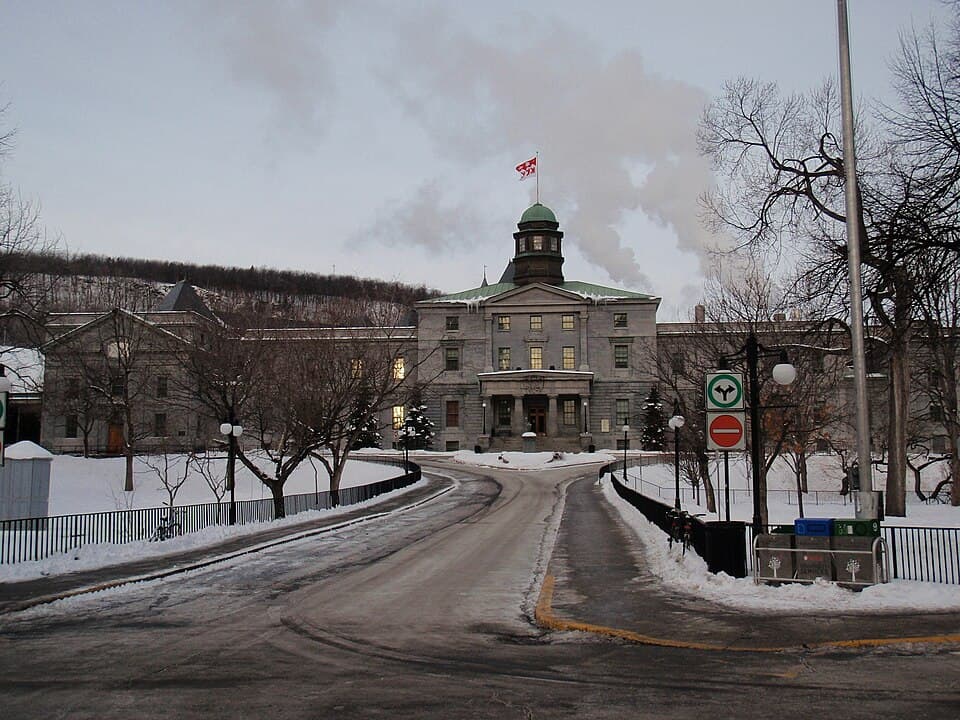

McGill Majors & Undergraduate Programs
Montreal, Quebec
Separate the admission group you choose as an applicant from the major or program stream you declare later, then use McGill's current Course Catalogue for exact requirements.
The short answer
- Human Nutrition (Dietetics), Nursing, and Physical & Occupational Therapy require documented French at B2 or level 6 on the Échelle québécoise.
- Nursing and Rehabilitation Science applicants need B2 in all four written and oral components.
- Nursing's typical Ontario range is the low 80s for the Top 6 and for math and science, but French is also required.
- Physical Therapy had the highest rehabilitation R-score minimum for September 2026, at 34.0 overall.
- Macdonald Campus programs are taught in Sainte-Anne-de-Bellevue, not downtown, and cost about $15,153.17 for a 30-credit year.
Reviewed August 16, 2026 · Official university sources · How we review guides
McGill programs, U0 versus U1, and the routes that differ
Eleven faculties and fifteen schools sit behind one application, but the entry structures are not equivalent. A CEGEP student usually enters at U1 with 30 credits of advanced standing and finishes in three years. An Ontario or international student usually enters at U0, completes a 30-credit freshman year, and finishes in four. That single difference changes the total price of the degree.
How McGill majors work
The admission group on your application is not always your final major. It determines the options you can choose after entering. Use McGill's current Course Catalogue to verify the exact program, credit, prerequisite, and declaration rules.
Apply
Choose a faculty or admission group
Your application choice controls the programs available later. In Science, the selected Program Group limits which majors and streams you can declare.
Enter U0 or U1
Complete Foundation requirements when needed
U0 Science students complete the Foundation Program before declaring a stream. U1 students can select a stream and declare programs within their admission group.
Choose the program structure
Major, Honours, Joint Major, Liberal, or Minor
A Major is the main specialized area. Honours is usually more specialized. It can require research, higher standing, prerequisites, and departmental approval. A Minor is secondary.
Verify the exact requirements
Use the current Course Catalogue
McGill's Course Catalogue replaced the eCalendar as the source of truth. Search the faculty or academic unit, open its Programs list, and confirm the current credit and declaration rules.
Arts, B.A. & Sc., and Social Work
The Faculty of Arts covers humanities and social sciences. The interfaculty B.A. & Sc. combines both. Social Work runs its own written submission.
Selection: McGill's typical Ontario range is high 80s to low 90s for Arts and for the B.A. & Sc., whose English or French range is the mid to high 80s.
Science
McGill splits Science admission into groupings. It does not use one BSc entry point. One grouping is Biological, Biomedical and Life Sciences. Another is Bio-Physical-Computational. Another is Physical, Environmental, Math and Computer. Another is Neuroscience. Earth, Geographic, and Climate Sciences is new for Fall 2027.
Selection: The grouping you choose changes the bar: September 2026 R-score minimums ran from 28.0 to 34.1, and the Ontario ranges from the low 90s to the low to mid 90s.
Management (B.Com.)
The Desautels Bachelor of Commerce is a deregulated-tuition program with its own mathematics prerequisite.
Selection: McGill's typical Ontario range is the mid 90s Top 6 with the low to mid 90s in mathematics; the September 2026 CEGEP minimum was 29.69.
Engineering
Ten entry routes are published. They are Bioengineering, Chemical, Civil, Computer, and Electrical Engineering. They also include Global, Materials, Mechanical, Mining, and Software Engineering.
Selection: Typical Ontario Top 6 ranges run from the high 80s to low 90s (Materials) to the mid to high 90s (Bioengineering, Electrical, Mechanical), so treat 'Engineering' as ten different competitive bars, not one.
Nursing and rehabilitation sciences
Nursing runs as the B.Sc.(N.) and the B.N. Integrated (including an online B.N. Integrated); Occupational and Physical Therapy share the B.Sc. Rehab.Sc. route.
Selection: These programs require documented French proficiency at B2 as well as competitive academic results, and Physical Therapy had the highest rehabilitation R-score minimum for September 2026, at 34.0 overall.
Agricultural and Environmental Sciences (Macdonald Campus)
Food Science, Nutritional Science, Bioresource Engineering, and the B.Sc.(Ag.Env.Sc.) run from the Macdonald Campus in Sainte-Anne-de-Bellevue, not downtown.
Selection: These carry McGill's most accessible published ranges: the mid to high 70s for the Ontario Top 6, or a 25.0 R-score minimum.
Three programs require documented French
Human Nutrition (Dietetics), Nursing, and Physical & Occupational Therapy include a mandatory stage in a hospital, clinic, social service centre, or school. McGill therefore expects B2 or higher — level 6 on the Échelle québécoise. Nursing and Rehabilitation Science applicants need B2 in all four components of written and oral expression and comprehension. Everywhere else, McGill requires proof of English proficiency and no French at all.
Freshman year
U0 = 30 credits
Non-CEGEP entrants complete a 30-credit freshman year and finish in a minimum of four years, roughly 120 to 140 credits.
Advanced standing
Up to 30 credits
CEGEP, IB, French Baccalauréat, AP, A-Level and AS-Level results, or prior university work can count, subject to faculty rules.
Second campus
Macdonald Campus
Food Science, Nutritional Science, Bioresource Engineering, and the B.Sc.(Ag.Env.Sc.) are taught in Sainte-Anne-de-Bellevue, not downtown.
U0 versus U1 changes the length of the degree
Current academic structure · Published for this period
McGill defines U0 as the freshman level. Students from Canadian provinces outside the CEGEP system or from other countries may enter at U0. They complete a 30-credit freshman year and finish in at least four years with roughly 120 to 140 credits. Most CEGEP students enter U1 after a two-year DEC with about 30 advanced-standing credits. Roughly 90 to 110 credits, or three years of full-time study, remain. Students entering with 24 or more advanced-standing credits may also begin at U1.
An Ontario student and a CEGEP student admitted to the same McGill program are usually not doing the same-length degree. Price the extra U0 year into any tuition comparison.
Applies to: All applicants, Ontario high school, International
McGill University: Academic terminology: U0, U1, advanced standing, program length · Verified August 16, 2026
The 30-credit advanced-standing ceiling
Current academic structure · Published for this period
Applicants from CEGEP, IB, the French Baccalauréat, AP, and A-Level or AS-Level systems may be eligible for advanced standing. Prior university study can also qualify. McGill caps the credit awarded for completed university-level work at 30 credits, subject to faculty and course rules.
Applies to: All applicants, International, Transfer
McGill University: Academic terminology: U0, U1, advanced standing, program length · Verified August 16, 2026
Engineering is ten separate admission decisions
Latest ranges; September 2026 R-scores · Latest published information; newer cycle not yet confirmed
McGill's Ontario range table lists Bioengineering, Chemical, Civil, Computer, Electrical, Global, Materials, Mechanical, Mining, and Software Engineering as distinct entries. Typical Top 6 ranges run from the high 80s to low 90s for Materials Engineering to the mid to high 90s for Bioengineering, Electrical and Mechanical. September 2026 R-score minimums run from 29.1 (Mining) to 34.4 (Mechanical). Global Engineering publishes no range; its review is handled jointly by both partner universities and includes a personal statement.
Global Engineering is one of the programs McGill lists as requiring additional supporting documents.
Applies to: Ontario high school, Other Canadian
McGill University: Ontario high-school requirements and previous lowest grades · Verified October 1, 2026
Science admission is split into competitive groupings
Latest ranges; September 2026 R-scores · Latest published information; newer cycle not yet confirmed
McGill has no single Bachelor of Science entry bar. It publishes separate references for the Biological, Biomedical and Life Sciences, Bio-Physical-Computational, and Physical, Environmental, Math and Computer Sciences groups. A new Earth, Geographic, and Climate Sciences Group starts in Fall 2027 with no values yet. The CEGEP table also lists Neuroscience. Ontario ranges run from the low 90s (Physical, Environmental, Math and Computer) to the low to mid 90s, and September 2026 R-score minimums from 28.0 to 34.1.
Applies to: Ontario high school, Other Canadian
McGill University: Quebec CEGEP requirements and previous lowest R-scores · Verified October 1, 2026
What Desautels Management actually asks for
Latest ranges; September 2026 R-scores · Latest published information; newer cycle not yet confirmed
An Ontario applicant to the Bachelor of Commerce needs 4U English or French plus Calculus and Vectors. McGill's typical range is the mid 90s for the Top 6, the low to mid 90s in the mathematics course, and the high 80s to low 90s in English or French. On the CEGEP side, the September 2026 minimum was 29.69 overall and in core mathematics, with 26.0 in core English or French. B.Com. also carries a higher Duolingo English requirement of 130.
Applies to: Ontario high school, Other Canadian, International
McGill University: Ontario high-school requirements and previous lowest grades · Verified October 1, 2026
Nursing and rehabilitation sciences run multiple routes
Latest ranges; September 2026 R-scores · Latest published information; newer cycle not yet confirmed
McGill's Quebec table separates the B.Sc.(N.) at a 28.0 R-score, the B.N. Integrated at 26.0, and an online B.N. Integrated at 25.8, alongside Occupational Therapy at 32.0 overall and core and Physical Therapy at 34.0 overall with a 34.7 core (September 2026 minimums). Ontario applicants to Nursing see a typical range in the low 80s for both the Top 6 and mathematics/science.
These same programs carry McGill's French proficiency requirement, so an Ontario average in the low 80s is only half the entry condition.
Applies to: Ontario high school, Other Canadian
McGill University: Quebec CEGEP requirements and previous lowest R-scores · Verified October 1, 2026
Three programs require documented French
Current requirements · Published for this period
McGill requires French for Human Nutrition Dietetics, Nursing, and Physical and Occupational Therapy. Those degrees include a mandatory stage in a hospital, clinic, social service centre, or school. Students are expected to reach B2 or level 6 on the Échelle québécoise. Nursing and Rehabilitation Science applicants must reach B2 in all four written and oral components. Accepted evidence includes DELF/DALF, TCF, TEF, TEFaQ, TEF Canada, and McGill's Certificate of Proficiency in French.
Exemptions exist — Nursing lists seven pathways including Quebec secondary schooling in French and passing the CEGEP épreuve uniforme de français — but an Ontario or Caribbean applicant should assume the requirement applies and plan the test.
Applies to: All applicants, Ontario high school, International
McGill University: French language proficiency: which programs require B2 · Verified August 16, 2026
The Macdonald Campus route is the most accessible entry
Latest ranges; September 2026 R-scores; 2026-2027 fees · Latest published information; newer cycle not yet confirmed
Food Science, Nutritional Science, Bioresource Engineering, and the B.Sc.(Ag.Env.Sc.) publish McGill's most accessible ranges. The Ontario Top 6 range is the mid to high 70s, or high 70s to low 80s for Nutrition. September 2026 CEGEP R-score minimums run from 25.0 to 27.0. These programs also had the lowest Canadian out-of-province total compared here: about $15,153.17 for a 30-credit year.
These programs are taught at the Macdonald Campus in Sainte-Anne-de-Bellevue, not downtown, which is a genuine lifestyle difference rather than a technicality.
Applies to: Ontario high school, Other Canadian
McGill University: Ontario high-school requirements and previous lowest grades · Verified October 1, 2026
Official McGill program sources
- Course Catalogue: McGill's academic source of truth
- Official 2026–2027 McGill Course Catalogue
- Faculty of Science: program groups, streams, majors, and honours
- Academic terminology: U0, U1, and advanced standing
- Quick Facts: faculties, schools, and enrolment
- French language proficiency requirements by program
- Ontario program prerequisites and reference cut-offs
- Quebec program prerequisites and reference R-scores
Official Sources and Next Steps
Stellar keeps this guide structured for comparison, but official university pages remain the source of truth for program requirements, tuition, residence, scholarships, deadlines, and policy changes.
Prepared by Stellar Advisers Editorial Team · Reviewed August 16, 2026 · Editorial, corrections, and source methodology