McGill University Admission Requirements & Prerequisites 2027
For Fall 2027, Ontario students apply directly to McGill by February 1, 2027, with an OSSD and a Top 6 of 4U, DU or 4M courses that includes 4U English or French and every prerequisite. McGill's typical minimum Top 6 ranges run from the mid to high 70s (Macdonald campus programs) to the mid to high 90s (Bioengineering, Electrical and Mechanical Engineering). Quebec R-score, IB, CAPE, A-Level and U.S. rules follow below.
Reviewed October 1, 2026 · Ontario program table checked November 4, 2026 · Published ranges are not admission guarantees · Published by Stellar Advisers
Direct answer
McGill requirements depend on your curriculum and program
McGill University does not use one admission average, GPA, or prerequisite list. Ontario applicants generally need an OSSD, at least six eligible Grade 12 U/M courses, 4U English or French, and every program prerequisite. Quebec applicants are reviewed using a pre-university DEC, overall R-score, and applicable core R-score. McGill separately evaluates IB, A-Level, CAPE, U.S., and other credentials.
McGill is in Montreal, Quebec, not Ontario, so undergraduate applicants apply directly to McGill rather than through OUAC. McGill's published grade ranges and R-score minimums are useful planning evidence, but McGill explicitly says they do not guarantee admission in a later cycle.
McGill admission requirements at a glance
Ontario calculation
Six eligible 4U/M courses
At least four must be 4U or DU, all prerequisites are included, and no more than two eligible 4M courses can count.
Application route
Apply directly to McGill
The current fee is $140.16 CAD. One paid application can include a second program choice for the same term and level at no extra application fee.
Fall 2027 timing
February 1, 2027
For Ontario and other Canadian high schools outside Quebec. Overseas and U.S. applicants apply by January 15, 2027.
McGill Ontario prerequisites and typical admission ranges
Ontario high school applicants need an OSSD before classes begin and at least six eligible Grade 12 courses. Four or more must be 4U or DU, including every prerequisite; up to two eligible 4M courses may complete the Top 6. All programs require 4U core English or French. English as a Second Language and French as a Second Language do not satisfy that core-language prerequisite.
Required mathematics and science courses normally must have been completed within the past five years. Most applied courses are excluded. McGill lists limited exceptions for specified Grade 12 technology courses, PSK4U, and 4M performing arts courses.
McGill programs for Ontario students: prerequisites and Top 6 ranges
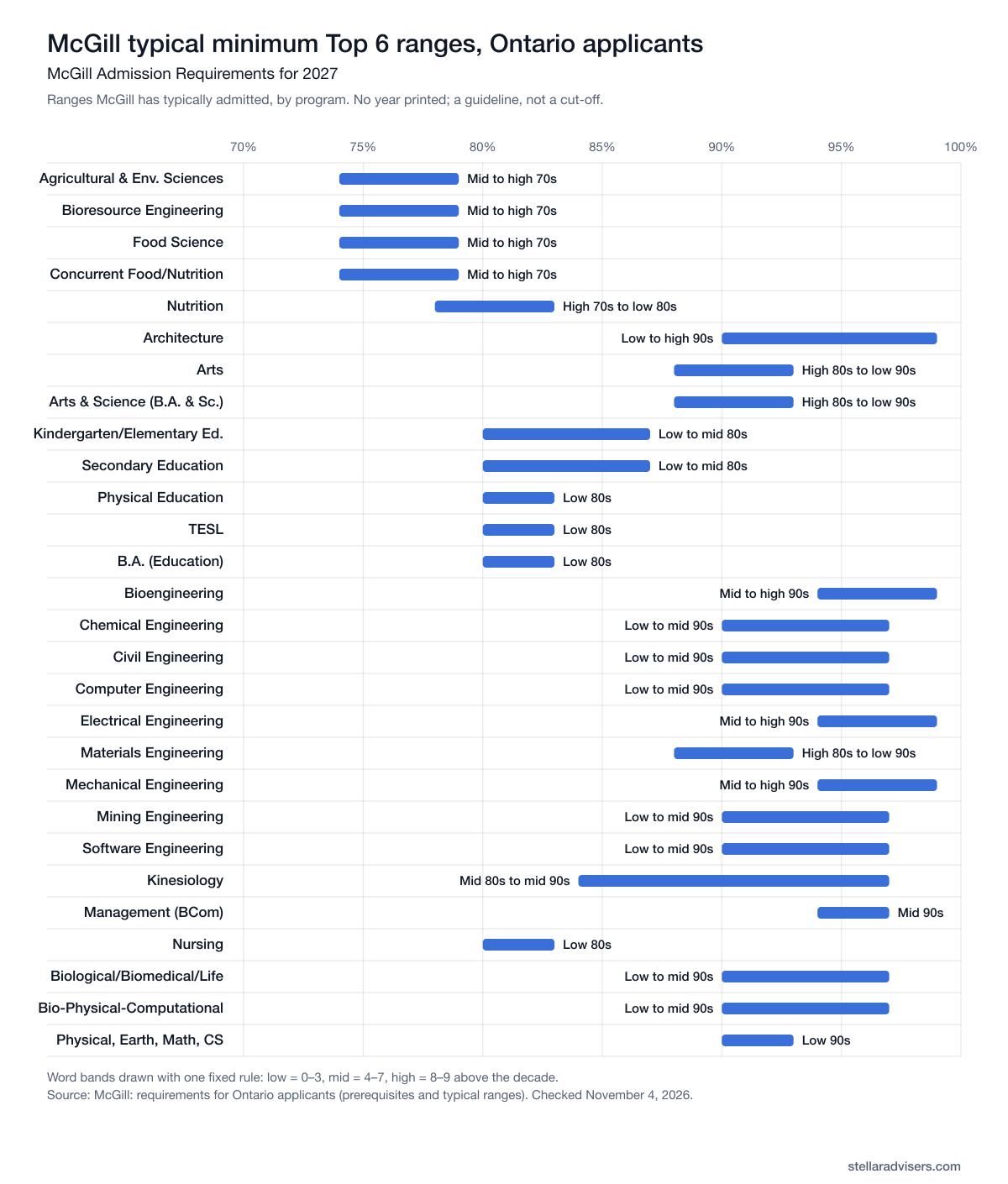
McGill publishes ranges, not exact cut-offs. Its Ontario page lists every program's 4U prerequisites and the minimum grade ranges it has typically admitted, as a Top 6 range and a range for the math, science or language courses. McGill prints no year on them. Its Science table is headed "last year's cut-offs", and one new Science stream shows "TBD" for Fall 2027.
McGill says these values are a guideline only and may not match next year's requirements. Grades at or above a range don't guarantee admission.
Every row was checked against the school's own pages on November 4, 2026.
McGill typical minimum Top 6 ranges, Ontario applicants
Ranges McGill has typically admitted, by program. No year printed; a guideline, not a cut-off.
Bars convert published bands with one fixed rule: low = 0–3, mid = 4–7 and high = 8–9 above the decade (low 90s = 90–93, mid 80s = 84–87, high 80s = 88–89). A minimum is one point. Programs that print no figure are in the table only.
Source: McGill: requirements for Ontario applicants (prerequisites and typical ranges) (checked November 4, 2026).
| Program | Prerequisites | Typical minimum range (Top 6, then subjects) | Extra step |
|---|---|---|---|
| Agricultural and Environmental Sciences (all B.Sc.(Ag.Env.Sc.) programs)Macdonald campus | 4U English or French, 4U Calculus and Vectors, two of 4U Biology, Chemistry or Physics | Mid to high 70s Top 6; mid to high 70s in math and science | None listed |
| Bioresource EngineeringMacdonald campus | 4U English or French, 4U Calculus and Vectors, two of 4U Biology, Chemistry or Physics | Mid to high 70s Top 6; mid to high 70s in math and science | None listed |
| Food ScienceMacdonald campus | 4U English or French, 4U Calculus and Vectors, two of 4U Biology, Chemistry or Physics | Mid to high 70s Top 6; mid to high 70s in math and science | None listed |
| Concurrent Food Science and Nutritional ScienceMacdonald campus | 4U English or French, 4U Calculus and Vectors, two of 4U Biology, Chemistry or Physics | Mid to high 70s Top 6; mid to high 70s in math and science | None listed |
| Human Nutrition (Nutrition)Macdonald campus | 4U English or French, 4U Calculus and Vectors, two of 4U Biology, Chemistry or Physics | High 70s to low 80s Top 6; high 70s to low 80s in math and science | None listed |
| Architecture | 4U English or French, 4U Calculus and Vectors (MCV4U), 4U Physics | Low to high 90s Top 6; low to high 90s in math and science | None listed |
| Arts | 4U English or French | High 80s to low 90s Top 6; high 80s to low 90s in English or French | B.A. Population & Global Health (with extra documents) and B.A. Psychology need a separate application |
| Bachelor of Arts and Science (B.A. & Sc.) | 4U English or French, 4U Calculus and Vectors, two of 4U Biology, Chemistry or Physics | High 80s to low 90s Top 6; high 80s to low 90s in math and science; mid to high 80s in English or French | None listed |
| Education: Kindergarten/Elementary | 4U English or French (Kindergarten/Elementary French immersion needs a French test) | Low to mid 80s Top 6; low 80s in English or French (McGill's first Education row) | Language test for the French immersion option |
| Education: Secondary | 4U English or French; Secondary Mathematics adds 4U Calculus and Vectors; Secondary Science & Technology adds Calculus and two of 4U Biology, Chemistry or Physics | Low to mid 80s Top 6; low 80s in English or French | None listed |
| Education: Physical Education | 4U English or French | Low 80s Top 6; low 80s in English or French | None listed |
| Education: TESL | 4U English or French | Low 80s Top 6; low 80s in English or French | English test (Greek test for TESL Greek Language and Culture) |
| Education: B.A. (Education); Education Global Contexts | 4U English or French | Low 80s Top 6; low 80s in English or French | None listed |
| Bioengineering | 4U English or French, 4U Calculus and Vectors, 4U Physics, 4U Chemistry | Mid to high 90s Top 6; mid 90s in math and science | None listed |
| Chemical Engineering | 4U English or French, 4U Calculus and Vectors, 4U Physics, 4U Chemistry | Low to mid 90s Top 6; low 90s in math and science | None listed |
| Civil Engineering | 4U English or French, 4U Calculus and Vectors, 4U Physics, 4U Chemistry | Low to mid 90s Top 6; low 90s in math and science | None listed |
| Computer Engineering | 4U English or French, 4U Calculus and Vectors, 4U Physics, 4U Chemistry | Low to mid 90s Top 6; low 90s in math and science | None listed |
| Electrical Engineering | 4U English or French, 4U Calculus and Vectors, 4U Physics, 4U Chemistry | Mid to high 90s Top 6; mid 90s in math and science | None listed |
| Global Engineering | 4U English or French, 4U Calculus and Vectors, 4U Physics, 4U Chemistry | N/A: no range printed | Personal statement; both partner universities review the application jointly |
| Materials Engineering | 4U English or French, 4U Calculus and Vectors, 4U Physics, 4U Chemistry | High 80s to low 90s Top 6; high 80s to low 90s in math and science | None listed |
| Mechanical Engineering | 4U English or French, 4U Calculus and Vectors, 4U Physics, 4U Chemistry | Mid to high 90s Top 6; mid 90s in math and science | None listed |
| Mining Engineering | 4U English or French, 4U Calculus and Vectors, 4U Physics, 4U Chemistry | Low to mid 90s Top 6; high 80s to mid 90s in math and science | None listed |
| Software Engineering | 4U English or French, 4U Calculus and Vectors, 4U Physics, 4U Chemistry | Low to mid 90s Top 6; low to mid 90s in math and science | None listed |
| Kinesiology | 4U English or French, 4U Calculus and Vectors, two of 4U Biology, Chemistry or Physics | Mid 80s to mid 90s Top 6; mid 80s to low 90s in math and science | None listed |
| Management (BCom) | 4U English or French, 4U Calculus and Vectors | Mid 90s Top 6; low to mid 90s in math; high 80s to low 90s in the English or French course | None listed |
| Nursing | 4U English or French, 4U Calculus and Vectors, two of 4U Biology, Chemistry or Physics, plus proof of French proficiency | Low 80s Top 6; low 80s in math and science | Proof of French proficiency and other supporting documents |
| Science: Biological, Biomedical and Life Sciences Group | 4U English or French, 4U Calculus and Vectors, two of 4U Biology, Chemistry or Physics | Low to mid 90s Top 6; low 90s in math and science (last year's cut-offs) | None listed |
| Science: Bio-Physical-Computational Sciences Group | 4U English or French, 4U Calculus and Vectors, two of 4U Biology, Chemistry or Physics | Low to mid 90s Top 6; low to mid 90s in math and science (last year's cut-offs) | None listed |
| Science: Earth, Geographic, and Climate Sciences Group | 4U English or French, 4U Calculus and Vectors, two of 4U Biology, Chemistry or Physics | TBD: a new stream for Fall 2027 | None listed |
| Science: Physical, Earth, Math and Computer Sciences Group | 4U English or French, 4U Calculus and Vectors, two of 4U Biology, Chemistry or Physics | Low 90s Top 6; high 80s to low 90s in math and science (last year's cut-offs) | None listed |
| Music | See the Schulich School of Music's own requirements | Not printed on the Ontario page | Application and documents due January 15 |
What McGill's ranges mean for you
Engineering, Architecture and Management sit highest: most Engineering programs are low to mid 90s or higher, Architecture is low to high 90s and Management is mid 90s. The Macdonald campus programs start in the mid to high 70s. Pick a range that fits your marks, but remember McGill's minimums move from year to year with space and demand.
Your prerequisites must be 4U or DU courses and are always part of your Top 6. For programs that need math or science, those courses must have been taken within the last five years.
McGill decides in two rounds, and it may give preference to applicants who finish their file early when a program fills up. Send your documents and self-report your grades on time.
Ontario note: you must earn your OSSD before classes start. McGill counts six 4U, DU or 4M courses, with at least four at the 4U or DU level, and you self-report your grades in two periods (February 1 to March 1 optional, April 1 to May 15 mandatory).
Official sources for the requirements table
McGill Commerce admission requirements
For Ontario students, the Desautels Bachelor of Commerce requires 4U English or French and Calculus and Vectors. McGill's typical minimum range is the mid 90s for the Top 6 average and the low to mid 90s in mathematics. For Quebec CEGEP applicants, the September 2026 minimum was 29.69 for both the overall and core mathematics R-scores, plus 26.0 in core English or French.
McGill's standard BCom is not on the current list of programs requiring extra supporting documents. Do not upload an unsolicited personal statement as a substitute for a requested item; follow the Applicant Portal checklist. Students comparing business programs can also use the Canadian business and commerce comparison.
McGill R-score requirements for Quebec CEGEP applicants
Quebec applicants normally need a pre-university DEC before classes begin. McGill reviews the overall R-score and, where a program has prerequisites, a core R-score calculated from the required mathematics, science, or language courses. The university uses the overall R-score—not a program R-score—and can consider failures and repeated courses. Quebec Secondary V by itself is not a direct-entry credential.
McGill R-score requirements for Quebec CEGEP applicants
| Program or group | September 2026 R-score minimum |
|---|---|
| Arts | 27.5 overall; 26.0 core English or French |
| Management (BCom) | 29.69 overall and core mathematics; 26.0 core English or French |
| Biological, Biomedical and Life Sciences Group | 30.4 overall and core mathematics/science |
| Physical, Earth, Math and Computer Sciences Group | 28.0 overall and core mathematics/science |
| Architecture | 32.0 overall and core mathematics/science |
| Mechanical Engineering | 34.4 overall and core mathematics/science |
These are McGill's R-score minimums for September 2026 admission. McGill says they do not represent the R-score required for future admission. Check both the overall and core requirement for the exact program before interpreting an R-score.
IB, A-Level, CAPE, U.S., and SAT requirements
International Baccalaureate
McGill reviews the transcript plus predicted or final IB results. A complete diploma with at least 5 in each HL and SL subject is the minimum expectation, but competitive programs can require much more. Acceptable mathematics prerequisites are HL or SL Analysis and Approaches and HL Applications and Interpretation; SL Applications and Interpretation is not accepted when mathematics is required.
A-Levels and Caribbean CAPE
Advanced Level applicants generally need at least three A-Level-equivalent subjects and all program prerequisites. Caribbean applicants are reviewed using CSEC, CAPE Unit 1, CAPE Unit 2 predicted or final results, and school grades. Depending on faculty and courses, McGill may grant up to 30 advanced standing credits.
U.S. applicants and SAT policy
Submitting SAT or ACT scores is optional for Fall 2027 applicants to most programs, including Arts, Science, Engineering and Management. McGill says opting out may affect timing but won't otherwise disadvantage you. Typical ranges vary by program: for example SAT 670 to 700 in Evidence-Based Reading and Writing and 610 to 640 in Math for Arts, and between 680 and 720 in each section for Engineering. Program-specific grades and prerequisites still matter.
Applicants who do not meet McGill's English-language exemption rules must arrange an accepted proficiency result by the applicable document deadline. The international student guide covers language testing, study permits, and financial planning; the Caribbean pathways guide adds regional curriculum context.
Current McGill deadlines and admission decision dates
McGill's Important Dates calendar confirms February 1, 2027 for Canadian high schools outside Quebec and January 15, 2027 for overseas and U.S. applicants. The requirement pages print other dates without a year, and the decision windows below are from September 2026 entry because McGill hasn't posted Fall 2027 windows yet. Ontario students self-report grades from February 1 to March 1 (optional) and April 1 to May 15 (required). Music, Nursing, scholarships, financial aid, and other special cases can use different dates. Checked October 1, 2026.
Current McGill deadlines and admission decision dates
| Applicant background | Fall 2027 application deadline | Document deadline | Decision window |
|---|---|---|---|
| Ontario high school | February 1, 2027 | May 4 | Mid-February to end of May (September 2026 entry) |
| Quebec CEGEP | March 1 (no year shown) | April 15 | End of February to mid-May (September 2026 entry) |
| Canadian high school outside Ontario and Quebec | February 1, 2027 | May 4 | Mid-January to mid-May (September 2026 entry) |
| International Baccalaureate outside Canada and the U.S. | January 15, 2027 | March 1 | Mid-November to mid-May (September 2026 entry) |
How to apply to McGill University
- 1.Select the exact program and your educational background in McGill's requirements tool; record every prerequisite and document.
- 2.Apply directly to McGill rather than through OUAC. The first paid application can include a second program choice for the same term and level at no extra application fee.
- 3.After payment, open the Applicant Portal and use its personalized checklist for transcripts, self-reported grades, language results, and program documents.
- 4.Submit only requested materials by the deadline for your applicant background; optional uploads do not replace a required item.
- 5.Monitor the Applicant Portal and email through the decision window, then verify every condition attached to an offer.
Which McGill portal should you use?
Keep the application checklist separate from McGill's broader student systems. Access and available menu options depend on whether McGill currently recognizes you as an applicant, guest, or student.
Portal guidance reviewed September 11, 2026.
Applicant Portal
After submitting an application
Use the personalized checklist to upload requested materials, check document and application status, and review the conditions attached to a decision.
Follow the Applicant Portal instructions McGill provides after the application is submitted.
Read McGill's official guidancemyMcGill and Minerva
Applicant and student administration
myMcGill provides direct links to McGill systems. Minerva is the student information system used for records and, according to the access available for your relationship with McGill, registration and account information.
Applicants and guests without a valid McGill username and password use a McGill ID and PIN in Minerva. Students with a valid McGill username use that account and two-factor authentication.
Read McGill's official guidanceMcGill's official new-student account guide explains how myMcGill links to Minerva and other services. It does not replace the Applicant Portal checklist for an active application.
Official McGill sources
Admissions requirements reviewed October 1, 2026; portal guidance reviewed September 11, 2026. McGill's live requirements selector and Applicant Portal are authoritative for an individual application.
- Admission requirements by educational background
- Ontario high school requirements and typical ranges
- Other Canadian high school requirements and dates
- Quebec CEGEP requirements and September 2026 R-score minimums
- International Baccalaureate requirements
- A-Level and CAPE requirements
- Fall 2027 deadline for Canadian high schools outside Quebec
- Fall 2027 deadline for overseas and U.S. applicants
- U.S. high school requirements and Fall 2027 test policy
- How to apply and use the Applicant Portal
- Current admission decision dates
- myMcGill and Minerva account information
- Current Minerva access routes
Frequently asked questions
Use the official requirements page and your Applicant Portal checklist before submitting.
Build a balanced McGill application plan
Use the exact requirements for your curriculum, compare the previous competitive evidence with your grades, and keep realistic alternatives on your Canadian university list.