
Redeemer University
Hamilton, Ontario
Compare Redeemer University programs, admissions, costs, residence, student support, and career pathways in one source-reviewed guide. Jump to the decision section you need below.
The short answer
- Ontario high-school applicants need Grade 12 U English, five more U/M courses (Grade 12 university or university/college preparation courses) and a 70% average.
- Health Sciences and Kinesiology each need an 80% average. Each program also lists its own science and math courses.
- International applicants need a 70% Ontario-equivalent average. They also need English proof, such as IELTS 6.5 or TOEFL iBT 86.
- The international deadline is unclear. One page says April 1, another says May 1 for study-permit applicants.
- Fall 2027 tuition, residence rates and orientation dates are pending. The 2026–27 figures are the latest published.
Reviewed August 16, 2026 · Official university sources · How we review guides
Save this to your free account
Keep these dates where you'll see them. Free account; we email you before each saved date; unsubscribe any time. Your account’s email pause still applies. The calendar file needs no account.
- OUAC Group A deadline (Ontario high-school students)January 15, 2027
Free account. No card needed.
Overview
Quick Facts
| Location | Hamilton, Ontario |
|---|---|
| School Type | Smaller undergraduate-focused environment |
| Directory Size | Small university |
| Campus Setting | Smaller campus or close-knit community setting |
| Ranking Signal | No QS World 2026 position listed in this guide |
| Program Strengths | Arts, Business, Education, Science, Kinesiology |
Start with campus and program fit. Then check official admissions, residence and cost details before you build the final application list.
Detailed application guides
Ontario University Application Deadlines 2027
OUAC's January 15, 2027 deadline and each university's own dates in one table.
OUAC 101 vs 105: Group A or Group B
Which OUAC group you're in, and which deadline applies to you.
OSAP 2026–2027 Application Guide
Open status, eligibility, residency, course load, grants, deadlines, and documents.
Ontario Universities With Co-op
Direct-entry and later-entry co-op models, work terms, fees, and questions to ask.
Admissions Planning
Fall 2027 admission planning
Start with the 70% general route, then audit the program
Ontario applicants currently need Grade 12 U English, five additional U/M courses and a 70% average. Health Sciences, Kinesiology, Mathematics and other programs add prerequisites or higher published thresholds. Every applicant also enters Redeemer’s Christian community through a statement-of-faith requirement.
General Ontario minimum
70%
English plus the best five eligible Grade 12 U/M courses; co-op courses do not count.
BHSc and BKin
80%
Both publish higher minima and credential-specific science or mathematics prerequisites.
Published 2027 visits
January 29 to March 17
Three explicit 2027 campus visit days are live; the Fall 2027 class start is not.
International deadline conflict
Official pages publish April 1 and May 1
The international route says applications close April 1 of the entry year. The undergraduate FAQ says May 1 for applicants who need a study permit. Plan to April 1 and ask Admissions to confirm the operative Fall 2027 date in writing.
Admission route audit
| Route | Published requirement | Planning boundary |
|---|---|---|
| Ontario high-school applicant | Grade 12 U English, five more Grade 12 U/M courses and a minimum 70% average. O-level and co-op courses cannot be used in the calculation. | The average uses English plus the best five eligible U/M courses. Program prerequisites and higher published averages still apply. |
| Other Canadian high-school applicant | Meet the province-specific English and academic-course pattern. You need a 70% minimum. Québec applicants need two 603/604 English courses. They also need one year of general CÉGEP (a Quebec college most Quebec students attend before university). | The current page publishes a separate pattern for each province and territory. It does not publish one universal course list. |
| International applicant | A high-school diploma or equivalent. A 70% Ontario-equivalent average. A statement of faith. English evidence when required. | Current English options include TOEFL iBT 86, IELTS 6.5, CAEL 70, PTE 56 or Duolingo 110. International entry is normally fall only. |
| University transfer | The current admission standing is C- or 60%. Transferable courses must be relevant. They normally carry at least C-. | Applicants with fewer than eight post-secondary courses can be assessed. The school uses both post-secondary and high-school work. |
| College or Bible-college transfer | The current overall minimum is B- or 70%. Course equivalency and credit depend on program fit. They also depend on grades, accreditation and submitted syllabi. | Redeemer publishes a maximum of 30 transferred courses. This is toward a 40-course general program. But individual evaluations are not guaranteed. |
| Mature applicant | You are normally age 21 or older. You have no university or college study. You have no full-time high school for at least two years. You show evidence of academic potential. | Admission can include probation or an Admissions Committee interview. Mature status does not create an automatic offer. |
| Health Sciences or Kinesiology | BHSc and BKin publish an 80% minimum with named Grade 12 U science and math prerequisites; BSc versions publish their own course patterns. | Check the exact credential. BHSc, BKin and related BSc pathways do not use the same prerequisites. |
| Bachelor of Education | This route is a consecutive second-degree route. It requires a completed undergraduate degree. It also requires program-specific teaching-subject evidence. | It is not a direct-entry undergraduate teaching degree. Campus housing is not provided for BEd students. |
Deadline audit
Application opening
August 1
This is the current undergraduate timeline. The live page does not explicitly label the opening as Fall 2027.
Textbook-credit application date
December 15
Current timeline for direct-from-high-school applicants; confirm that the incentive renews for Fall 2027.
North American free-application date
January 31
The current page says a $50 fee applies after this date; Fall 2027 cycle labelling remains pending.
Financial aid and Christian Leadership priority
February 28
Standing maximum-consideration date, not yet separately labelled for Fall 2027.
International application
April 1 or May 1
Official-source conflict: the international page says April 1. The undergraduate FAQ says May 1 for applicants needing a study permit.
Acceptance and deposit for early registration
April 30
Current standing timeline; reconfirm the deposit amount and Fall 2027 terms in the offer.
Housing form
June 1
The 2026–27 guarantee uses June 1, 2026; no Fall 2027 guarantee date is published yet.
Fall 2027 visit days
January 29, February 12 and March 17, 2027
Explicitly listed as upcoming undergraduate campus visits on the live admission page.
Fall 2027 orientation and classes
Pending
The academic schedule currently ends with the 2026–27 year and does not publish the Fall 2027 start.
Ontario general admission minimum
Current published information · Published for this period
Grade 12 U English, five additional Grade 12 U/M courses and a minimum 70% average.
Applies to: Ontario high school
Redeemer University: Ontario high-school admission requirements · Verified August 16, 2026
Ontario average uses six eligible courses
Current published information · Published for this period
Grade 12 U English plus the best five Grade 12 U/M courses; O-level and co-op courses cannot be used.
Applies to: Ontario high school
Redeemer University: Ontario high-school admission requirements · Verified August 16, 2026
Other Canadian routes generally publish 70%
Current published information · Published for this period
The course pattern varies by province or territory and includes a named English requirement.
Applies to: Other Canadian
Redeemer University: Other Canadian provincial requirements · Verified August 16, 2026
International general admission minimum
Current published information · Published for this period
You need a high-school diploma or equal. You need a 70% Ontario-equivalent average. You also need the right documents and program requirements.
Applies to: International
Redeemer University: International requirements, English tests and April deadline · Verified August 16, 2026
Current undergraduate English-test options
Current published information · Latest published information; newer cycle not yet confirmed
TOEFL iBT 86, IELTS 6.5, CAEL 70, PTE/PTE Online 56 or Duolingo 110, subject to published exemptions.
Applies to: International
Redeemer University: International requirements, English tests and April deadline · Verified August 16, 2026
Official pages conflict on the international deadline
Official-source conflict · Current published information
The international page says April 1 of the entry year. The undergraduate FAQ says May 1 for applicants who need a study permit.
Plan for the earlier date, April 1. Before you submit, confirm the Fall 2027 deadline directly with Redeemer Admissions.
Applies to: International
Redeemer University: International requirements, English tests and April deadline · Verified August 16, 2026
University-transfer admission minimum
Current published information · Published for this period
C- overall, published as 60% or 4.0 on Redeemer’s 12-point scale.
Applies to: Transfer
Redeemer University: Transfer admission, credit and award rules · Verified August 16, 2026
College and Bible-college transfer minimum
Current published information · Published for this period
B- overall, published as 70% or 7.0 on Redeemer’s 12-point scale.
Applies to: Transfer
Redeemer University: Transfer admission, credit and award rules · Verified August 16, 2026
Bachelor of Health Sciences minimum
Current published information · Published for this period
80% with Grade 12 U Biology, Chemistry and Mathematics.
Applies to: Ontario high school
Redeemer University: Health Sciences credentials and admission requirements · Verified August 16, 2026
Bachelor of Kinesiology minimum
Current published information · Published for this period
80% with Grade 12 U Biology and Mathematics; Chemistry and Exercise Science are recommended.
Applies to: Ontario high school
Redeemer University: Kinesiology degrees, labs and admission requirements · Verified August 16, 2026
Fall 2027-cycle campus visit dates are published
Fall 2027 planning · Published for this period
January 29, February 12 and March 17, 2027 appear as upcoming undergraduate visit days.
Applies to: All applicants
Redeemer University: Undergraduate application timeline and housing FAQ · Verified August 16, 2026
Fall 2027 general admission timeline remains unlabelled
2027 pending · Fall 2027
The live page lists these milestones: August 1, December 15, January 31, February 28, April 30 and June 1. It does not label them with a Fall 2027 cycle.
Confirm which incentives, application fees, deposit rules and housing milestones apply to Fall 2027. Do this before you rely on the standing timeline.
Applies to: All applicants
Redeemer University: Undergraduate application timeline and housing FAQ · Verified August 16, 2026
Fall 2027 orientation and class dates are pending
2027 pending · Fall 2027
Redeemer’s academic schedule currently covers Fall 2026 and Winter 2027 only.
Check the academic calendar again for Fall 2027 dates. These include orientation, move-in, first class, add/drop and assessment dates.
Applies to: All applicants
Redeemer University: 2026–27 academic schedule and calendar · Verified August 16, 2026
Programs and Pathways
Degrees, majors and Christian Core
Match the credential, prerequisites and experiential form
Redeemer publishes BA, BBA, BSc, BHSc, BKin, BCoMS and consecutive BEd study. These cover more than 35 programs and streams. Traditional undergraduate degrees include a ten-course Christ-centred Core. But program prerequisites, degree maps, internships and co-op eligibility stay credential-specific.
BA, BBA, BSc, BHSc, BKin and BCoMS
Redeemer's live inventory covers more than 35 majors, streams and credentials. These span liberal arts, sciences, business, health and media.
Distinction: Use the degree designation on the program page. A related major or stream is not interchangeable with a different credential.
Christ-centred Core Curriculum
Traditional undergraduate degrees include a ten-course interdisciplinary Core woven across the four-year program.
Distinction: The Core is a university-wide academic feature. It is not a standalone major or an optional faith add-on.
Health Sciences
Redeemer offers BHSc and BSc Health Sciences pathways. These have distinct admission prerequisites, scientific breadth and research or internship options.
Distinction: The program page does not recommend the general BSc major. It does not recommend it for graduate study or employment in Health Sciences.
Kinesiology
Students can pursue a BKin or a BSc Kinesiology pathway with labs, research and named human-movement coursework.
Distinction: Both publish an 80% minimum, but the prerequisite course lists differ by degree.
School of Business
The inventory includes BBA majors in Accounting, Finance, Management and Marketing plus a BA General Business route.
Distinction: Co-op is listed for Accounting, Management, Marketing and Not-for-Profit Management. It is not listed for every business or university program.
Media Production and BCoMS
Media Production combines academic study with production facilities, project work and internship possibilities.
Distinction: The BCoMS designation and the Media Production major are their own things. You should not group them into a generic communications degree.
Mission and Ministry
The BA route combines biblical, theological and practical ministry study. It is one of the areas currently named for co-op.
Distinction: Mission and Ministry co-op availability does not imply universal paid ministry placement.
Social Work
The BA Social Work stream includes discipline-specific study. It also includes field or internship learning within the Applied Social Sciences context.
Distinction: Program-level placements are distinct from Redeemer’s formal co-op streams.
Consecutive Bachelor of Education
A two-year, four-term, 60-credit second degree offers Primary/Junior and Junior/Intermediate qualification routes.
Distinction: Applicants need an undergraduate degree first. BEd tuition, awards and housing rules differ. They are not the same as traditional undergraduate study.
Credential boundary
BHSc and BSc Health Sciences do not share identical prerequisites or degree maps. BKin and BSc Kinesiology are also distinct. The BEd is a second degree after undergraduate study. Media Production uses the BCoMS family rather than a generic communications label.
Current inventory exceeds 35 programs and streams
Current published information · Latest published information; newer cycle not yet confirmed
The list includes degrees, majors, minors, a liberal-arts certificate, professional certificates and microcredentials.
Applies to: All applicants
Redeemer University: Current degrees, majors, minors and credentials · Verified August 16, 2026
Traditional undergraduate study includes a ten-course Core
Current published information · Published for this period
Redeemer describes it as interdisciplinary and Christ-centred, woven through the student’s degree.
Applies to: All applicants
Redeemer University: Christ-centred Core Curriculum · Verified August 16, 2026
Health Sciences has distinct BHSc and BSc structures
Current published information · Published for this period
The degree maps, scientific breadth and admission prerequisites differ by credential.
Applies to: All applicants
Redeemer University: Health Sciences credentials and admission requirements · Verified August 16, 2026
The general BSc Health Sciences major carries a published caveat
Current published information · Published for this period
Redeemer says it is not recommended for students planning graduate study or employment in Health Sciences.
Applies to: All applicants
Redeemer University: Health Sciences credentials and admission requirements · Verified August 16, 2026
Kinesiology is offered as BKin and BSc study
Current published information · Published for this period
The program includes labs, research opportunities and distinct degree requirements.
Applies to: All applicants
Redeemer University: Kinesiology degrees, labs and admission requirements · Verified August 16, 2026
BSc Mathematics requires Calculus and Vectors
Current published information · Published for this period
The general admission pattern is required. Grade 12 U Data Management or Grade 12 U Geometry is also recommended.
Applies to: All applicants
Redeemer University: Mathematics requirements and research learning · Verified August 16, 2026
Business includes BBA and BA routes
Current published information · Published for this period
The current inventory names BBA Accounting, Finance, Management and Marketing plus BA General Business.
Applies to: All applicants
Redeemer University: Current degrees, majors, minors and credentials · Verified August 16, 2026
Marketing BBA has CIMMO accreditation
Current published information · Published for this period
Redeemer’s accreditation page identifies the Chartered Institute of Marketing Management of Ontario.
Applies to: All applicants
Redeemer University: Degree authority and institutional accreditation · Verified August 16, 2026
Media Production uses the BCoMS degree family
Current published information · Published for this period
The current inventory distinguishes Media Production from the Media and Communication Studies minor.
Applies to: All applicants
Redeemer University: Current degrees, majors, minors and credentials · Verified August 16, 2026
Mission and Ministry is a BA program
Current published information · Published for this period
The program mixes biblical, theological and practical ministry study. It is named in current co-op information.
Applies to: All applicants
Redeemer University: Mission and Ministry degree and experiential route · Verified August 16, 2026
Social Work is a BA pathway
Current published information · Published for this period
It sits within Redeemer’s Applied Social Sciences context and includes program-specific experiential learning.
Applies to: All applicants
Redeemer University: Social Work program and placement route · Verified August 16, 2026
The BEd is a consecutive second degree
Current published information · Published for this period
Applicants must hold an undergraduate degree; the program runs four terms and 60 credits over two years.
Applies to: All applicants
Redeemer University: Consecutive BEd structure, accreditation and costs · Verified August 16, 2026
BEd offers Primary/Junior and Junior/Intermediate routes
Current published information · Published for this period
For Junior/Intermediate, you need six courses in an intermediate teaching subject. You also need the published level distribution.
Applies to: All applicants
Redeemer University: Consecutive BEd structure, accreditation and costs · Verified August 16, 2026
Fall 2027 program and course availability is pending
2027 pending · Fall 2027
The live catalogue establishes program structures, but course offerings can change by academic year.
Check the Fall 2027 intake, degree designation, prerequisites, course sequence, co-op or internship option and any capacity limit. Do this on the selected program page and offer.
Applies to: All applicants
Redeemer University: Current degrees, majors, minors and credentials · Verified August 16, 2026
Official program sources
Official campus and student-life sources
Residence and Campus Fit
Ancaster housing audit
Separate the current 2026–27 guarantee from Fall 2027
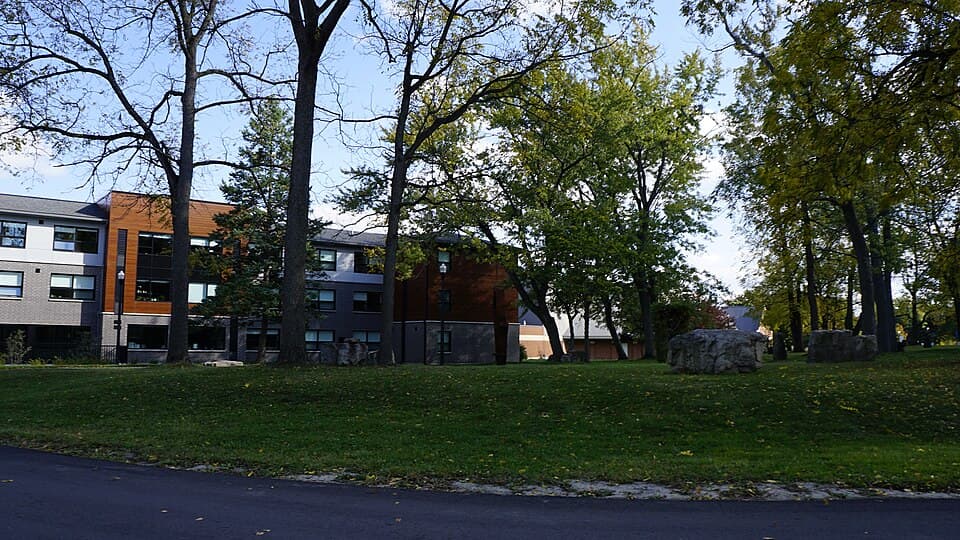
Redeemer owns a communal residence system of townhouses, Charis, Augustine Hall and Luther Court. For 2026–27, first- and second-year traditional undergraduates were generally required to live on campus and guaranteed a place after an on-time form. Those dates and terms do not yet establish the Fall 2027 guarantee.
Townhouse residences
$4,224–$4,352 per term
Forty-three townhouses hold eight students each. They are available from first year and are the typical community model for incoming students.
Charis Live & Learn Centre
$4,670–$4,860 per term
Thirty-four units for second year and above, with two, four, six or eight beds depending on the unit.
Augustine Hall
$4,352 per term
Fifteen apartment units for second year and above, generally housing six students.
Luther Court Apartments
$4,670 per term
Fifteen one- or two-bedroom apartments for third year and above, with two or three students per unit.
First- and second-year housing rule
Required in 2026–27
Traditional undergraduates in first or second year must live on campus. This rule does not apply if a published parent/guardian, age or marriage exception applies.
2026–27 guarantee
June 1, 2026 housing form
The current guarantee covers required first- and second-year students who submit on time. It does not yet set Fall 2027 terms.
International guarantee boundary
Conditional
The current page guarantees housing for valid study-permit holders. They must be age 20 or under at entry. Mature and second-degree international housing is still subject to availability.
First- and second-year meal plans
$3,414–$3,914
Light, Regular and Premium residence plans are mandatory for students living in first- or second-year dorms.
Fall 2027 residence
Pending
Recheck 2027–28 room rates, meal plans, exemptions, international conditions and the housing-form deadline.
Guarantee and meal-plan limits
The 2026–27 international guarantee covers valid study-permit holders age 20 or under at entry. Mature and second-degree students remain subject to availability. BEd students do not receive campus housing. First- and second-year dorm residents must also budget for a current $3,414 to $3,914 residence meal plan.
Current townhouse rate
Current published information · Latest published information; newer cycle not yet confirmed
$4,224–$4,352 per term for eight-student townhouses available from first year.
Applies to: All applicants
Redeemer University: Current residence buildings and room rates · Verified August 16, 2026
Current Charis rate
Current published information · Latest published information; newer cycle not yet confirmed
$4,670–$4,860 per term for units available from second year.
Applies to: All applicants
Redeemer University: Current residence buildings and room rates · Verified August 16, 2026
Current Augustine Hall rate
Current published information · Latest published information; newer cycle not yet confirmed
$4,352 per term for units available from second year.
Applies to: All applicants
Redeemer University: Current residence buildings and room rates · Verified August 16, 2026
Current Luther Court rate
Current published information · Latest published information; newer cycle not yet confirmed
$4,670 per term for apartments available from third year.
Applies to: All applicants
Redeemer University: Current residence buildings and room rates · Verified August 16, 2026
First- and second-year housing is required in 2026–27
2026–27 · Latest published information; newer cycle not yet confirmed
Traditional undergraduates must live on campus. This is unless a published exception applies. The exception may be parent/guardian, age or marriage.
Applies to: All applicants
Redeemer University: 2026–27 residence requirement and guarantee terms · Verified August 16, 2026
2026–27 required-student housing guarantee
2026–27 · Latest published information; newer cycle not yet confirmed
First- and second-year students covered by the requirement were guaranteed a place if the form was submitted by June 1, 2026.
Applies to: All applicants
Redeemer University: 2026–27 residence requirement and guarantee terms · Verified August 16, 2026
International housing guarantee is conditional
Current published information · Latest published information; newer cycle not yet confirmed
The current guarantee covers valid study-permit holders. It covers those age 20 or under at entry. Mature and second-degree applicants still depend on availability.
Applies to: International
Redeemer University: 2026–27 residence requirement and guarantee terms · Verified August 16, 2026
Campus housing is not provided for BEd students
Current published information · Published for this period
Regular housing is reserved for traditional undergraduates and the liberal arts certificate under the current policy.
Applies to: All applicants
Redeemer University: 2026–27 residence requirement and guarantee terms · Verified August 16, 2026
First- and second-year dorm meal plans are mandatory
Current published information · Latest published information; newer cycle not yet confirmed
Current Light, Regular and Premium plans cost $3,414, $3,664 and $3,914 respectively.
Applies to: All applicants
Redeemer University: Current residence and commuter meal plans · Verified August 16, 2026
Senior on-campus housing is subject to availability
Current published information · Published for this period
Third-year and later students may apply; Redeemer also lists off-campus opportunities for senior students.
Applies to: All applicants
Redeemer University: 2026–27 residence requirement and guarantee terms · Verified August 16, 2026
Fall 2027 housing rates and guarantee terms are pending
2027 pending · Fall 2027
Current requirement and guarantee language is explicitly 2026–27.
Check the 2027–28 room and meal-plan rates again. Also check the required years, exemptions, international age and permit terms, BEd rules, and the housing-form deadline.
Applies to: All applicants
Redeemer University: 2026–27 residence requirement and guarantee terms · Verified August 16, 2026
Official residence sources
Housing and Location Questions
| Campus Setting | Smaller campus or close-knit community setting |
|---|---|
| Residence | Check the residence guarantee rules and first-year room styles. Check meal plans, deposit deadlines, and off-campus housing pressure. |
| City Fit | Students should compare transit, weather, cost of living, safety, and community feel in Hamilton. |
| Commuting | If you live off campus, map your commute time before you commit. Include classes, labs, placements, and evening activities. |
Tuition, Scholarships, and Aid
2026–27 tuition and current awards
Build the budget beyond the published tuition headline
Ten-course tuition is $9,987 domestic and $23,588.07 international for 2026–27. A new first-year ten-course illustration adds $2,024.30 in published mandatory fees. This is before residence, meals, books and program-specific charges. Government aid remains conditional on the student and eligible degree.
| Category | Published value | Scope |
|---|---|---|
| Domestic undergraduate tuition | $9,987.00 for ten courses | Published for 2026–27. Redeemer separately confirmed this is the third consecutive year without a domestic tuition increase. |
| International undergraduate tuition | $23,588.07 for ten courses | Published for 2026–27 before mandatory student fees, housing, food, books and personal costs. |
| New first-year mandatory-fee illustration | $2,024.30 | The arithmetic is for ten courses and two terms. It includes per-course Redeemer, ombudsman and senate fees. It includes two term-based success, learning and security fees. It also includes full-year transit, OneCard, and first-year orientation. |
| Domestic first-year academic subtotal | $12,011.30 | Tuition is $9,987.00. The mandatory-fee example is $2,024.30. This does not include program materials, residence, food, books or personal costs. |
| International first-year academic subtotal | $25,612.37 | Tuition is $23,588.07, plus the same published fee example of $2,024.30. Check any insurance or immigration costs for you separately. |
| Lab, studio or production course | $217.42 per applicable course | Applied only to courses using specified lab, studio or production supplies and equipment. |
| Co-op program fees | $100 + $700 + $1,110 + $1,110 | These are the current fees for the application, the preparation course, Work Term I and Work Term II. The application fee and accepted work-term fees have non-refund rules. |
| Bachelor of Education tuition | $35,785.04 over the two-year program | Published for new 2026–27 BEd students completing in 2027–28, excluding other applicable fees. |
| Fall 2027 traditional undergraduate costs | Pending | The current detailed undergraduate schedule is 2026–27. Replace it only when Redeemer publishes 2027–28 tuition and fees. |
Scholarship evidence
Academic Achievement Scholarship
$2,000
Current incoming threshold is a 95%+ admission average or U.S. GPA 4.00+; BEd students are excluded.
Board of Governors Scholarship
$1,000
Current incoming threshold is 90%–94.99% or U.S. GPA 3.90–3.99; BEd students are excluded.
Ann Bergshoeff Memorial Award
$1,000
One incoming and one returning full-time Health Sciences major. The threshold is 85% for incoming or 9.00 for returning, with published preference rules.
Albert de Jong Memorial Bursary
Up to $1,500 or more
For an incoming full-time student meeting the church-membership, pastoral-confirmation and financial-need criteria.
Christian University Bursary
Variable
Needs-based; North American residents must apply for government financial aid to qualify.
Financial-aid inventory
100+ awards and $7.2M
Redeemer now reports more than 100 scholarships and bursaries. It reports $7.2 million through various programs and organizations.
Government student aid
Eligibility varies
Redeemer says you may qualify if you are in an eligible degree. Access still depends on program eligibility and your province or country.
Full-ride scholarship
Not offered
The current awards FAQ says clearly that Redeemer does not offer full-ride scholarships. It also says awards are not guaranteed.
Fall 2027 award cycle
Pending
Recheck the automatic thresholds and the inventory. Recheck the funding-dependent values and the February 28 priority date for the Fall 2027 cycle.
Fall 2027 costs pending
Redeemer's detailed traditional undergraduate schedule is still 2026–27. Current automatic scholarships publish $2,000 at 95%+ and $1,000 at 90%–94.99%. But values depend on available funds. The Fall 2027 thresholds and February priority date must be reconfirmed. No full-ride scholarship is offered.
2026–27 domestic undergraduate tuition
2026–27 · Latest published information; newer cycle not yet confirmed
$9,987.00 for ten courses or $998.70 per full course.
Applies to: Ontario high school, Other Canadian, Transfer
Redeemer University: 2026–27 undergraduate tuition, fees and co-op fees · Verified August 16, 2026
2026–27 international undergraduate tuition
2026–27 · Latest published information; newer cycle not yet confirmed
$23,588.07 for ten courses or $2,358.81 per full course.
Applies to: International
Redeemer University: 2026–27 undergraduate tuition, fees and co-op fees · Verified August 16, 2026
New first-year mandatory-fee illustration
2026–27 · Latest published information; newer cycle not yet confirmed
$2,024.30 for ten courses and two terms after summing the published per-course, term, transit, OneCard and orientation charges.
Applies to: All applicants
Redeemer University: 2026–27 undergraduate tuition, fees and co-op fees · Verified August 16, 2026
Domestic first-year academic subtotal
2026–27 · Latest published information; newer cycle not yet confirmed
$12,011.30: $9,987.00 tuition plus $2,024.30 in illustrated mandatory fees, before housing, food, books and program charges.
Applies to: Ontario high school, Other Canadian
Redeemer University: 2026–27 undergraduate tuition, fees and co-op fees · Verified August 16, 2026
International first-year academic subtotal
2026–27 · Latest published information; newer cycle not yet confirmed
$25,612.37: $23,588.07 tuition plus $2,024.30 in illustrated mandatory fees, before living and student-specific costs.
Applies to: International
Redeemer University: 2026–27 undergraduate tuition, fees and co-op fees · Verified August 16, 2026
Lab, studio and production materials fee
2026–27 · Latest published information; newer cycle not yet confirmed
$217.42 per applicable course in 2026–27.
Applies to: All applicants
Redeemer University: 2026–27 undergraduate tuition, fees and co-op fees · Verified August 16, 2026
Current co-op program fees
Current published information · Latest published information; newer cycle not yet confirmed
$100 application fee, $700 preparation course and $1,110 for each of Work Terms I and II.
Applies to: All applicants
Redeemer University: 2026–27 undergraduate tuition, fees and co-op fees · Verified August 16, 2026
Published two-year BEd tuition
2026–28 BEd cohort · Latest published information; newer cycle not yet confirmed
$35,785.04 for new 2026–27 BEd students completing in 2027–28, excluding other applicable fees.
Applies to: All applicants
Redeemer University: Consecutive BEd structure, accreditation and costs · Verified August 16, 2026
Academic Achievement Scholarship
Current published information · Latest published information; newer cycle not yet confirmed
$2,000 at a current incoming threshold of 95%+ or U.S. GPA 4.00+; BEd students are excluded.
Applies to: All applicants
Redeemer University: Current scholarships, bursaries and award rules · Verified August 16, 2026
Board of Governors Scholarship
Current published information · Latest published information; newer cycle not yet confirmed
$1,000 at a current incoming threshold of 90%–94.99% or U.S. GPA 3.90–3.99; BEd students are excluded.
Applies to: All applicants
Redeemer University: Current scholarships, bursaries and award rules · Verified August 16, 2026
Ann Bergshoeff Memorial Award
Current published information · Latest published information; newer cycle not yet confirmed
$1,000 for one incoming and one returning Health Sciences student. The student must meet the published academic and preference rules.
Applies to: All applicants
Redeemer University: Current scholarships, bursaries and award rules · Verified August 16, 2026
Redeemer reports 100+ scholarships and bursaries
Current published information · Latest published information; newer cycle not yet confirmed
The financial-aid page also reports $7.2 million available through various programs and organizations.
Applies to: All applicants
Redeemer University: Financial-aid inventory and participation figures · Verified August 16, 2026
Redeemer does not offer full-ride scholarships
Current published information · Published for this period
The live award FAQ also says applicants are not guaranteed every award. This applies even if they qualify or apply for it.
Applies to: All applicants
Redeemer University: Current scholarships, bursaries and award rules · Verified August 16, 2026
Government aid eligibility is conditional
Current published information · Published for this period
Redeemer says a student in an eligible degree may qualify; program, jurisdiction and individual eligibility still govern assistance.
Applies to: All applicants
Redeemer University: Conditional government student-aid eligibility · Verified August 16, 2026
Fall 2027 tuition and award terms are pending
2027 pending · Fall 2027
Traditional undergraduate tuition and mandatory fees are published for 2026–27; award values depend on available funds.
Recheck 2027–28 domestic and international tuition, mandatory and program fees, automatic scholarship thresholds, award values and the February priority date.
Applies to: All applicants
Redeemer University: 2026–27 undergraduate tuition, fees and co-op fees · Verified August 16, 2026
Official tuition and award sources
Cost Planning
| Tuition | Tuition depends on your program, student status, and year. Check domestic and international tuition on the official fee schedule. |
|---|---|
| Scholarships | Check automatic entrance awards, competitive major awards, faculty scholarships, and international-student awards. |
| Living Costs | Budget for residence or rent, food, books, and transit. Also budget for health insurance, winter clothing, and emergency funds. |
| Proof of Funds | International students should confirm current study-permit financial requirements and school-specific cost estimates. |
Student Life and Support
Fit Signals
| Community | Small university profile: compare class feel and access to professors. Also compare student clubs and how easy it is to build community. |
|---|---|
| Student Supports | Review academic advising, accessibility services, mental health supports, international student services, and writing centres. |
| Clubs and Leadership | Look for discipline clubs, cultural groups, entrepreneurship programs, varsity/intramural sports, and volunteering. |
| First-Year Transition | Ask how orientation, peer mentorship, residence programming, and advising help students settle in. |
Co-op, Research, and Career Outcomes
Co-op, internships, practicums and career support
Co-op belongs to six named study areas, not every program
Redeemer currently names Accounting, Marketing, Management, Not-for-Profit Management, Kinesiology and Mission & Ministry for co-op. Other students may use academic internships, Education practicums, research, off-campus study and Career Centre support, but those experiences do not automatically create a co-op designation.
Named co-op programs
Redeemer currently names Accounting, Marketing, Management, Not-for-Profit Management, Kinesiology and Mission & Ministry for co-operative education.
Two eight-month work terms
Co-op students prepare through career-development and job-search learning before two supervised eight-month work terms.
CEWIL accreditation
Redeemer states that its co-operative education programs are accredited by Co-operative Education and Work-Integrated Learning Canada.
Competitive placement boundary
Career Centre job posting and employer connection support do not promise a job. They also do not promise an employer match or successful work-term completion.
Academic internships
Internships normally require at least 120 workplace hours in one term. They can be paid or unpaid. They include faculty-approved academic requirements.
Internship eligibility
Optional 380 and 480 internships publish departmental GPA (grade point average) rules. They also publish instructor-permission rules. This is unless the program requires the internship.
Education practicums
BEd practicums progress from classroom observation toward guided responsibility for teaching, management, assessment and instruction.
Career Centre
It provides one-on-one career guidance and job-search support. It offers workshops, employer connections and job fairs. This covers co-op and non-co-op study.
Fall 2027 experiential inventory
The program structures are live. But Fall 2027 employers, placements, recruiting dates, pay and course availability are not fully published.
Placement and compensation boundary
Co-op uses two supervised eight-month work terms. Academic internships normally need at least 120 hours in one term. They can be paid or unpaid. Career Centre job postings and employer support do not guarantee a placement, a pay level or a successful work term. The complete Fall 2027 employer inventory is not published.
Co-op is limited to named programs
Current published information · Published for this period
Accounting, Marketing, Management, Not-for-Profit Management, Kinesiology and Mission & Ministry are currently listed.
Applies to: All applicants
Redeemer University: Co-op, internships, practicums and off-campus study · Verified August 16, 2026
Co-op uses two eight-month work terms
Current published information · Published for this period
The first runs through winter and spring of third year; the second runs through summer and fall before fourth year.
Applies to: All applicants
Redeemer University: Co-op work-term sequence and 120-hour internships · Verified August 16, 2026
Co-op includes career and job-search preparation
Current published information · Published for this period
Students prepare before their work-integrated terms and receive Career Centre support.
Applies to: All applicants
Redeemer University: Co-op, internships, practicums and off-campus study · Verified August 16, 2026
Redeemer states its co-op is CEWIL-accredited
Current published information · Published for this period
The current co-op page identifies Co-operative Education and Work-Integrated Learning Canada accreditation.
Applies to: All applicants
Redeemer University: CEWIL-accredited co-operative education · Verified August 16, 2026
Co-op is not universal across Redeemer
Current published information · Published for this period
Internships, practicums, research and off-campus study are separate experiential forms. They do not create a co-op designation.
Applies to: All applicants
Redeemer University: Co-op, internships, practicums and off-campus study · Verified August 16, 2026
Career support does not guarantee a co-op placement
Current published information · Published for this period
Job posting and employer connection services help with applications. No first-party source promises every student an offer.
Applies to: All applicants
Redeemer University: Career advising, job fairs and employer connections · Verified August 16, 2026
Internships normally require at least 120 workplace hours
Current published information · Published for this period
They are academic courses. You complete them in one term. They have approved responsibilities and extra academic work.
Applies to: All applicants
Redeemer University: Academic internship structure and eligibility · Verified August 16, 2026
Internships can be paid or unpaid
Current published information · Published for this period
Redeemer’s employer page distinguishes the 120-hour internship model from full-time co-op work terms.
Applies to: All applicants
Redeemer University: Co-op work-term sequence and 120-hour internships · Verified August 16, 2026
Optional internships have academic eligibility rules
Current published information · Published for this period
The current 380 and 480 routes publish departmental GPA rules and instructor-permission rules. This is unless the program requires the internship.
Applies to: All applicants
Redeemer University: Academic internship structure and eligibility · Verified August 16, 2026
BEd practicums build guided classroom responsibility
Current published information · Published for this period
The structure progresses from observation toward teaching, management, assessment and instruction.
Applies to: All applicants
Redeemer University: Co-op, internships, practicums and off-campus study · Verified August 16, 2026
Career Centre support extends beyond co-op
Current published information · Published for this period
Services include individualized guidance, workshops, job-search preparation, employer connections and job fairs.
Applies to: All applicants
Redeemer University: Career advising, job fairs and employer connections · Verified August 16, 2026
Redeemer recognized both co-op and internship students in 2026
Winter 2026 · Latest published information; newer cycle not yet confirmed
The April report describes separate Co-op Student and Internship Student of the Year awards.
Applies to: All applicants
Redeemer University: 2026 co-op and internship student awards · Verified August 16, 2026
Employer-facing pages preserve program boundaries
Current published information · Published for this period
They name specific co-op areas and a broader, changing list of departments offering internships.
Applies to: All applicants
Redeemer University: Current employer-facing co-op and internship programs · Verified August 16, 2026
Fall 2027 employers and placements are pending
2027 pending · Fall 2027
Current pages establish the co-op and internship structures but not a complete Fall 2027 inventory.
For Fall 2027, confirm program admission. Confirm preparation courses. Confirm the work-term sequence. Confirm the internship course. Confirm the employer. Confirm compensation. Confirm credit. Confirm recruiting dates. Confirm placement status.
Applies to: All applicants
Redeemer University: Career advising, job fairs and employer connections · Verified August 16, 2026
Official co-op and experiential sources
Career Planning
| Experiential Learning | Check if your target program offers co-op or internships. Check for clinical placements or practicums. Check for studios, field schools, or research terms. |
|---|---|
| Career Services | Compare job boards, employer partnerships, resume support, interview preparation, and alumni mentoring. |
| Research Access | For graduate-school or professional-school pathways, look for undergraduate research assistant roles and lab access. |
| Outcome Questions | Ask where graduates work or study next, and whether outcomes differ by program, co-op stream, or campus. |
Redeemer University applicants should start with the current 70% general admission route. Then check the exact credential and prerequisites. BHSc and BKin publish 80% minima. Transfer standards differ by institution type. The consecutive BEd requires a prior degree. Redeemer's Christ-centred Core, Ancaster residence community, scholarships and experiential learning are university-owned. Current 2026–27 tuition, fees, residence rates and guarantee conditions are published. The Fall 2027 academic start, cycle-labelled milestones, 2027–28 costs and housing, award terms and employer inventory remain pending. Co-op is limited to six named study areas. Internships, practicums, research and Career Centre support are distinct and do not guarantee a placement.
Redeemer University admission, programs, tuition, residence, scholarships and co-op FAQs
Current answers for Fall 2027 applicants covering admission minima, Christian program distinctions, 2026–27 costs, Ancaster housing, automatic awards, conditional government aid, co-op, internships and practicums.
Official Sources and Next Steps
Stellar keeps this guide structured for comparison. But official university pages remain the source of truth. This covers program requirements, tuition, and residence. It also covers scholarships, deadlines, and policy changes.
Prepared by Stellar Advisers Editorial Team · Reviewed August 16, 2026 · Editorial, corrections, and source methodology
Related Canadian universities
Compare 3 other Ontario records, then continue through the national directory.