
Concordia University of Edmonton
Edmonton, Alberta
Compare Concordia University of Edmonton programs, admissions, costs, residence, student support, and career pathways in one source-reviewed guide. Jump to the decision section you need below.
The short answer
- Apply to Concordia University of Edmonton through ApplyAlberta, not OUAC, the Ontario Universities' Application Centre. Fall 2027 applications open October 1, 2026.
- Minimum averages for 2026/2027: 60% for Arts and Science, 65% for Management and dual degrees. Meeting the minimum does not guarantee admission.
- For Ontario students, MHF4U equals Alberta Math 30-1. MDM4U does not replace required math for Management or Science.
- 2026–27 tuition is $1,157.32 for one 3-credit course, or $5,944.30 for 15 credits in one term. International students pay $382 per credit extra.
- Residence is first-come, first-served. A shared double room plus meal plan costs $4,565 per term; a private single plus meal plan costs $5,713 per term.
Reviewed August 15, 2026 · Official university sources · How we review guides
Save this to your free account
Track Concordia University of Edmonton with a checklist for how you apply. Free account. Add your dates in the tracker to request reminder emails; unsubscribe any time.
Free account. No card needed.
Overview
Entity answer
CUE is the independent Concordia in Edmonton
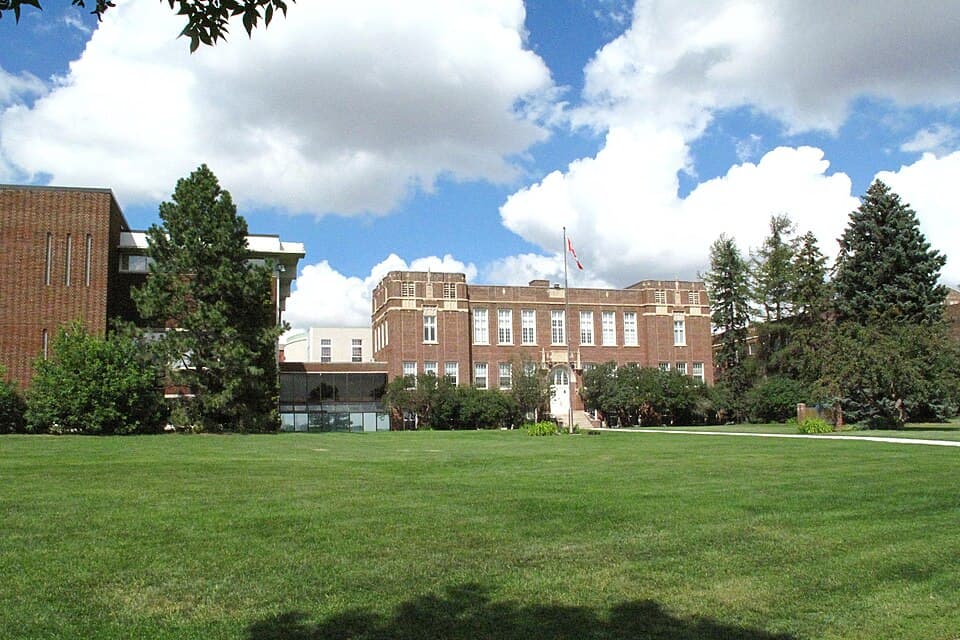
Concordia University of Edmonton is an independent university in Edmonton, Alberta—not Concordia University in Montréal. CUE traces its founding to 1921 as Concordia College, gained degree-granting status in 1987, and took its current name in 2015. It publishes five faculties, a compact Virginia Park campus steps from Edmonton's river valley, more than 45 majors and minors, and an average first-year class size of 30.
60%
Arts and Science minimum
65%
Management and dual-degree minimum
30
Average first-year class size
45+
Majors and minors published
Check the domain before using a result
CUE's official domain is concordia.ab.ca. Search results for “Concordia admission” often mix the Edmonton and Montréal institutions, but their programs, prerequisites, fees, awards, and application systems are not interchangeable. If you meant the Quebec university, use the Concordia University in Montréal guide. Every source cited on this page is a concordia.ab.ca page.
CUE is not Concordia University in Montréal
Current entity check · Published for this period
Concordia University of Edmonton publishes everything on concordia.ab.ca and brands itself as CUE, “Edmonton's University.” Concordia University in Montréal is a separate institution on concordia.ca with its own application, prerequisites, fees, awards, and deadlines. Nothing on this page is sourced from the Montréal institution, and no CUE figure below transfers to it.
Search results for “Concordia admission” routinely mix the two universities. Confirm the domain on every page before copying a requirement into a plan.
Applies to: All applicants
Concordia University of Edmonton: CUE homepage: published majors, class size, and employment figure · Verified August 15, 2026
Founding and degree-granting history
University-published history · Published for this period
CUE says it was founded in 1921 as Concordia College. The Lutheran Church–Missouri Synod started it to prepare young men for preaching and teaching ministries. It opened to women and general academic programs in 1939. It gained degree-granting status in 1987. It was renamed Concordia University College of Alberta in 1995. It took the name Concordia University of Edmonton in 2015. It marked its centennial in 2021.
Applies to: All applicants
Concordia University of Edmonton: CUE history: 1921 founding through the 2015 renaming · Verified August 15, 2026
Published scale figures
University-published counts · Published for this period
CUE's homepage publishes three numbers: “45+ Majors and minors to choose from,” a “94% Graduate employment rate,” and a “30 Average first-year class size.” The admissions hub repeats “over 45 Arts, Science, and Management majors and minors” and describes a “small campus environment.”
These are CUE's own marketing figures. The 94% graduate employment rate carries no published cohort year, survey, or methodology on any first-party page, so treat it as directional rather than audited.
Applies to: All applicants
Concordia University of Edmonton: CUE homepage: published majors, class size, and employment figure · Verified August 15, 2026
Current total enrolment and countries represented
2027 pending · Current
Not currently published. CUE's “Who we are” page, its homepage, and its international-students landing page all describe scale qualitatively—“small enough that every student is essential but large enough to make real differences”—without a live headcount or a count of countries represented.
Older third-party and archived CUE pages circulate a “nearly 3,000 students” figure. It is not on a current first-party page, so do not plan around it; ask Student & Enrolment Services if the exact size matters to your decision.
Applies to: All applicants
Concordia University of Edmonton: Who we are: faculties, campus, and institutional character · Verified August 15, 2026
Five faculties and named research centres
Current structure · Published for this period
CUE lists five academic divisions: the Faculty of Arts, Faculty of Science, Faculty of Management (the Mihalcheon School of Management), Faculty of Education, and Faculty of Graduate Studies. It highlights the Centre for Applied Artificial Intelligence, the BMO Centre for Innovation & Research, and the Indigenous Knowledge & Research Centre.
Applies to: All applicants
Concordia University of Edmonton: Who we are: faculties, campus, and institutional character · Verified August 15, 2026
Official CUE identity sources
Admissions Planning
CUE Ontario requirements and Fall 2027 timing
CUE calculates admission from five required Grade 12 subjects. The Ontario mapping matters. MHF4U is equivalent to Alberta Mathematics 30-1. MDM4U appears only as an additional Group C course. It does not replace required algebra for Management or Science.
Apply through ApplyAlberta, not OUAC
CUE processes undergraduate applications through ApplyAlberta. There you create an Alberta.ca account and complete the application. CUE requests transcripts on your behalf for Alberta Grade 12. It also does this for participating Alberta post-secondary study. So Ontario and international transcripts must be arranged separately. Processing typically takes four to six weeks. CUE asks for at least two Grade 12 course grades for early admission consideration.
| Direct-entry program | Published minimum | Ontario course pattern |
|---|---|---|
| Bachelor of Arts | 60% across the five admission subjects | ENG4U or ETS4U plus four accepted Grade 12 subjects from CUE's Ontario equivalency chart. No more than two Group B fine-arts courses and one Group D option may be used. Mathematics is required for Political Economy and a Computing Science, Mathematics, or Physics minor, and is strongly recommended for Psychology, Sociology, and future BEd plans. |
| Bachelor of Management | 65% across the five admission subjects | ENG4U or ETS4U, MHF4U, and three accepted Grade 12 subjects. No more than one Group B fine-arts course and one Group D option may be used. |
| Bachelor of Science | 60% across the five admission subjects | ENG4U or ETS4U, MHF4U, two accepted Group C science courses, and one other accepted Grade 12 subject. Chemistry is recommended for Chemistry; Biology and Chemistry are recommended for Biology and Environmental Science. |
| Management + BSc dual degree | 65% across the five admission subjects | ENG4U or ETS4U, MHF4U, two accepted Group C science courses, and one other accepted Grade 12 subject. The current planning material includes Chemistry and Information Technology dual-degree routes. |
Fall 2027 deadlines are not yet published
CUE confirms that Fall 2027 applications open October 1, 2026, but the latest official deadline table is still the 2026–27 edition. The dates below are current planning benchmarks—not confirmed Fall 2027 dates. Recheck the entry term, applicant type, program, and document columns before submitting. A deadline falling on a weekend or holiday extends to the end of the next business day.
| Applicant or program | Current Fall benchmark | Other current terms |
|---|---|---|
| Domestic — regular Arts, Management, Science, and dual degrees | June 30 application; August 1 interim documents; September 1 final documents | Winter: November 1 / December 1 / January 7. Spring or Summer: March 1 / April 1 / April 26. |
| International — regular undergraduate programs | June 30 application; July 15 interim documents; August 1 final documents | Winter: October 1 application and October 15 final documents. |
| Psychology, Applied Emphasis | March 1 application and interim documents; August 1 final documents | The current table lists Fall entry only. |
| Bachelor of Education after degree | Domestic: May 1 / May 15 / June 15. International: February 1 / February 15 / June 15. | This is an after-degree program, not direct high-school entry. |
| Environmental Health after degree | August 1 application and interim documents; August 15 final documents | Spring: April 1 application and interim documents; April 15 final documents. |
Minimums are not an acceptance rate
CUE does not publish one overall undergraduate acceptance rate. Its calendar attaches the same sentence to every direct-entry program: admission is competitive, and meeting the minimum admission average requirement does not guarantee admission. The after-degree section adds that admission is competitive because each program has limited capacity.
English-language evidence
- IELTS Academic: 6.0 overall, with no band below 5.5
- Duolingo English Test: 120
- CAEL: 60 overall; 50 in listening, reading, and speaking; 60 in writing
- PTE Academic: 54
- Cambridge C1 Advanced: 175 overall, with no band below 165
- TOEFL iBT: 80 overall for tests taken until January 20, 2026. From January 21, 2026 the revised scale applies at 4.0 overall. No band may be below 3.5.
- Recency: Results must come from a test taken within the two years before admission. Every applicant must show proficiency. This applies no matter your citizenship.
For a broader prerequisite workflow, use the Canadian university academic-requirements guide. Applicants with prior postsecondary study can also review the credential-evaluation guide.
Application route: ApplyAlberta, not OUAC
Current process · Published for this period
CUE states that undergraduate “applications are processed through ApplyAlberta,” where applicants create an Alberta.ca account and complete the application. CUE requests transcripts on an applicant's behalf through ApplyAlberta's transcript service for Alberta Grade 12 and participating Alberta post-secondary study. Processing typically takes four to six weeks, and CUE asks applicants to list at least two Grade 12 course grades—in progress or completed—for early admission consideration.
Ontario applicants do not use OUAC (Ontario's university application site) for CUE. Transcripts from out of province and from other countries are not pulled automatically. Arrange those yourself.
Applies to: All applicants
Concordia University of Edmonton: How to apply (undergraduate): ApplyAlberta and processing time · Verified August 15, 2026
Fall 2027 cycle status
2027 pending · Fall 2027
CUE's deadlines page confirms that applications for the Fall 2027 term open October 1, 2026. But it publishes no Fall 2027 date table. It sends applicants to the academic calendar. There, the live undergraduate deadline table is still labelled 2026/2027. No Fall 2027 application, interim-document, or final-document date is published yet.
The June 30 Fall deadline comes back every year. So treat June 30, 2027 as a working planning date only. Verify the 2027/2028 calendar table once CUE posts it. CUE also notes that a deadline falling on a weekend or holiday extends to the end of the next business day.
Applies to: All applicants
Concordia University of Edmonton: Admissions deadlines page and Fall 2027 application opening · Verified August 15, 2026
Published 2026/2027 deadline table
2026/2027, latest available · Latest published information; newer cycle not yet confirmed
Domestic Bachelor of Arts, Management, Science, and dual degrees: Fall June 30 application, August 1 interim documents, September 1 final documents. Winter November 1 / December 1 / January 7. Spring or Summer March 1 / April 1 / April 26. International applicants in those programs: Fall June 30 / July 15 / August 1 and Winter October 1 / October 15. Psychology (Applied Emphasis) is March 1 / March 1 / August 1 for both domestic and international applicants. Entry is Fall only. The Bachelor of Education after degree is May 1 / May 15 / June 15 domestic. It is February 1 / February 15 / June 15 international. Environmental Health after degree is August 1 / August 1 / August 15 for Fall. It is April 1 / April 1 / April 15 for Spring. Open Studies is ongoing until two weeks before the term.
CUE warns that Winter and Spring/Summer intake and course selection are limited and advises applying early. These dates belong to the 2026/2027 cycle—use them as benchmarks, not as confirmed Fall 2027 dates.
Applies to: All applicants
Concordia University of Edmonton: Table 3.1.1.A application deadlines for undergraduate admission · Verified August 15, 2026
Published minimum admission averages
2026/2027 requirements · Published for this period
The 2026/2027 calendar sets a minimum admission average of 60% for the Bachelor of Arts, 65% for the Bachelor of Management, 60% for the Bachelor of Science, and 65% for both the Management and Science in Chemistry and the Management and Science in Information Technology dual degrees. The average is calculated on “the best five Grade 12 subjects required for admission to the degree program,” and every program requires English Language Arts 30-1 or its equivalent.
Applies to: All applicants
Concordia University of Edmonton: 3.2.1 High school student admission: minimums and subject groups · Verified August 15, 2026
Every direct-entry program is labelled competitive
2026/2027 policy · Published for this period
Each direct-entry program in the calendar carries the same sentence: “Admission to Concordia University of Edmonton's [program] is competitive; meeting the minimum admission average requirement does not guarantee admission to the program.” The after-degree section adds that admission “is competitive due to the limited capacity of each program.” CUE publishes no overall undergraduate acceptance-rate percentage on any first-party page.
Do not read the 60% and 65% floors as an admission standard. CUE does not publish an admitted-student average either, so build the plan on prerequisites and timing rather than on an unofficial rate.
Applies to: All applicants
Concordia University of Edmonton: 3.2.1 High school student admission: minimums and subject groups · Verified August 15, 2026
Ontario equivalency mapping
2026/2027 chart · Published for this period
Table 3.2.1.F maps English Language Arts 30-1 to ENG4U or ETS4U. It maps Mathematics 30-1 to MHF4U (Advanced Functions). It maps Mathematics 31 to MCV4U (Calculus and Vectors). It maps Biology 30, Chemistry 30, and Physics 30 to Biology 12U, Chemistry 12U, and Physics 12U. MDM4U appears only in the Ontario list of other Group C subjects, not as the Mathematics 30-1 equivalent.
An Ontario applicant has MDM4U instead of MHF4U. That applicant does not meet the required mathematics. This applies to Management, Science, or either dual degree.
Applies to: Ontario high school
Concordia University of Edmonton: Table 3.2.1.F out-of-province high school equivalence chart · Verified August 15, 2026
Subject-group limits on the five admission subjects
2026/2027 requirements · Published for this period
Arts applicants may present at most two Group B subjects and one Group D subject alongside English. Management applicants may present at most one Group B and one Group D subject and must include Mathematics 30-1 (MHF4U). Science applicants must include two Group C subjects. Chemistry is recommended for Chemistry majors, and Biology plus Chemistry for Biology and Environmental Science.
Applies to: Ontario high school, Other Canadian, International
Concordia University of Edmonton: 3.2.1 High school student admission: minimums and subject groups · Verified August 15, 2026
English-language proficiency evidence
2026/2027 requirements · Published for this period
CUE requires proof of English proficiency from every applicant regardless of citizenship or country of origin, with test results taken within two years. Published minimums: IELTS Academic 6.0 overall with no band below 5.5, Duolingo English Test 120, CAEL 60 overall with 50 or higher in listening, reading, and speaking and 60 in writing, PTE Academic 54, Cambridge C1 Advanced 175 with no band below 165, and TOEFL iBT 80 for tests taken until January 20, 2026 or 4.0 overall with no band below 3.5 on the revised scale from January 21, 2026.
Exemption routes include these. Three years of Canadian secondary or post-secondary study with 50% or higher in English Language Arts 30-1. One year of Canadian study with 60% or higher in English 30 or equivalent. An Alberta Grade 12 equivalent with English as the principal language of instruction for three or more years. A degree from a recognized English-language institution.
Applies to: International, Ontario high school, Other Canadian
Concordia University of Edmonton: 3.1 General admission requirements: English proficiency and transfer credit · Verified August 15, 2026
AP, IB, and university transfer credit
2026/2027 policy · Published for this period
CUE converts IB (the International Baccalaureate diploma) grades to percentages for the admission average. A 7 equals 98%, a 5 equals 82%, and a 3 equals 55%. CUE converts AP (Advanced Placement courses and exams) grades the same way. A 5 equals 96%, a 4 equals 86%, and a 3 equals 76%. If you present both a Grade 12 subject and the matching IB or AP course, the higher grade is used. Transfer credit may be awarded for IB grades of 5 or higher and AP grades of 4 or 5. University-level transfer credit excludes practica, internships, and work experiences. It must have been earned in the seven years before the transfer-credit evaluation.
Applies to: All applicants
Concordia University of Edmonton: 3.1 General admission requirements: English proficiency and transfer credit · Verified August 15, 2026
Programs and Pathways
Concordia University of Edmonton programs
CUE's direct-entry portfolio centres on Arts, Management, Science, Information Technology, Psychology Applied, and Management plus Science dual degrees. Education and Environmental Health are after-degree routes, so they should not appear on a high-school plan as direct-entry bachelor's programs.
Arts and social sciences
Three- and four-year Arts routes include English, Music, Philosophy, Psychology, Religious Studies, and Sociology. Three-year concentrations also include Drama, French, History, and Political Economy. Psychology has a competitive four-year Applied Emphasis with a full-year field placement.
Management
The Bachelor of Management offers emphases in Accounting, Conflict Management, Cybersecurity, Data Management, Finance, Human Resource Management, Leadership, and Marketing, plus a mandatory internship.
Science and technology
Three- and four-year BSc routes include Biology, Chemistry, Environmental Science, and Mathematics. The four-year Bachelor of Science in Information Technology includes a mandatory internship or field placement.
Dual degrees
Five-year dual-degree planning routes combine Management with a BSc in Chemistry or Information Technology. Applicants should confirm the active planner and admission pattern for their entry year.
After-degree professional programs
The Bachelor of Education is a two-year after-degree program. The Bachelor of Environmental Health is a 15-month after-degree program. Neither is direct entry from high school.
Compare CUE's Management options with the Canadian business-program guide. Or compare Information Technology with the Canadian computer-science and technology guide.
Small-university direct-entry inventory
Current catalogue · Published for this period
The Faculty of Arts publishes BA routes in Drama, English, French, History, Music, Philosophy, Political Economy, Psychology, Religious Studies, and Sociology. These have three-year concentrations and four-year majors. This depends on the discipline. It also has minors including Economics, Political Science, and Canadian Studies. The Faculty of Science publishes BSc routes in Biology, Chemistry, Environmental Science, Information Technology, and Mathematics. Its minors include Biochemistry and Physics. The Faculty of Management publishes the four-year Bachelor of Management.
This is a genuinely small inventory. If a discipline is not on this list, CUE does not offer it—check the all-programs page before assuming a major exists.
Applies to: All applicants
Concordia University of Edmonton: All programs by faculty · Verified August 15, 2026
Bachelor of Management emphases
Current catalogue · Published for this period
The four-year Bachelor of Management is delivered by the Mihalcheon School of Management. It publishes emphases in Accounting, Conflict Management, Cybersecurity, Data Management, Finance, Human Resource Management, Leadership, and Marketing. It also offers a Business minor. Graduate management offerings include the Master of Information Systems Assurance Management. They also include the Master of Information Systems Security Management. They also include graduate diplomas in Information Assurance and Information Security.
Applies to: All applicants
Concordia University of Edmonton: All programs by faculty · Verified August 15, 2026
Information technology and information-security depth
Current program · Published for this period
The four-year BSc in Information Technology sits in the Department of Mathematics & Information Technology and publishes core coursework in computer systems and platforms, web design, networking and advanced networking, information security and advanced cybersecurity, database systems and database administration, and a senior project capstone with work experience. CUE names network administrator, systems analyst, cybersecurity specialist, database administrator, web developer, and IT consultant as target roles, and continues the stack into a 16-month Master of Science in Information Technology and the two information-security master's degrees.
CUE does not publish any employment statistics or graduate-outcome data for this program. The career list describes target roles. It is not an outcome claim.
Applies to: All applicants
Concordia University of Edmonton: Bachelor of Science in Information Technology · Verified August 15, 2026
Five-year Management and Science dual degrees
2026-2027 planners · Published for this period
The 2026-2027 program planners publish two dual degrees: Bachelor of Management with a Bachelor of Science in Chemistry, and Bachelor of Management with a Bachelor of Science in Information Technology. Both are listed in the calendar's high-school admission section at a 65% minimum admission average using the Science course pattern.
CUE's all-programs page and its work-integrated-learning page name only the Chemistry dual degree. The planners and the calendar both publish the Information Technology route. Before you rank it first, check its status for your entry year with the Office of the Registrar.
Applies to: All applicants
Concordia University of Edmonton: 2026-2027 program planners · Verified August 15, 2026
Psychology Applied Emphasis is a separate, earlier route
2026/2027 requirements · Published for this period
CUE offers a three-year Psychology concentration, a four-year Psychology major, and a four-year major with an Applied Emphasis. The Applied Emphasis includes “at least one full year field placement (8 hours per week, September to April)” at community agencies such as recreation programs for people with major mental illness, programs for homeless youth, preschool intervention programs, and corrections programs. It has its own March 1 application deadline and its own program-specific documents under calendar section 3.3, including confidential assessment forms.
The Applied Emphasis deadline is roughly four months earlier than the general June 30 deadline. Missing March 1 means the general Psychology route, not the applied one.
Applies to: All applicants
Concordia University of Edmonton: BA Psychology and the Applied Emphasis field placement · Verified August 15, 2026
Education and Environmental Health are after-degree only
2026/2027 requirements · Published for this period
The Bachelor of Education is a two-year after degree in Elementary Education, and the Bachelor of Environmental Health is a 15-month after degree. Neither is direct entry from high school, and CUE states that admission to its after-degree programs “is competitive due to the limited capacity of each program.” The Faculty of Education also publishes minors in Early Childhood Education, Education, and Physical Education and Sport Studies that an undergraduate can take alongside a first degree.
A high-school student who plans to teach must first complete an eligible bachelor's degree. They must also choose courses that preserve future teachable subjects.
Applies to: All applicants
Concordia University of Edmonton: 3.4 Admission to after-degree programs · Verified August 15, 2026
Concordia University of Edmonton Residence Costs & Availability
CUE residence costs and availability
Residence is first-come, first-served rather than guaranteed. Only admitted students can apply. CUE says there is no fixed residence deadline, so waiting for a late admission decision can reduce availability. For the current cycle, applications opened February 2, 2026 for the full year or Fall 2026 and October 5, 2026 for Winter 2027 only. CUE does not publish building names, floor plans, or a bed count, so ask Housing Services how many single rooms exist before assuming one is available.
| 2026–27 option | Per term | Two terms | What the figure includes |
|---|---|---|---|
| Shared double room + mandatory meal plan | $4,565 | $9,130 | $2,382 room plus the $2,183 meal plan; programming and laundry are additional. |
| Private single room + mandatory meal plan | $5,713 | $11,426 | $3,530 room plus the $2,183 meal plan; programming and laundry are additional. |
| Additional residence charges | $165 | $330 | $75 programming and $90 laundry per term, plus a $500 residence experience deposit. |
2026-2027 room rates
2026-2027 · Latest published information; newer cycle not yet confirmed
CUE publishes two room types for 2026-2027: a private single room at $3,530.00 per semester and a shared double room at $2,382.00 per semester.
Applies to: All applicants
Concordia University of Edmonton: 2026-2027 residence fees, meal plan, and deposits · Verified August 15, 2026
Mandatory declining-balance meal plan
2026-2027 · Latest published information; newer cycle not yet confirmed
The declining-balance meal plan costs $2,183.00 per semester at minimum. This amount is non-refundable and is mandatory for students living in undergraduate residence halls. Unused Fall funds carry into the Winter semester. They expire at the end of Winter.
A single room plus the meal plan costs $5,713.00 per semester. A shared room plus the meal plan costs $4,565.00 per semester. These prices are before programming, laundry, and the deposit.
Applies to: All applicants
Concordia University of Edmonton: 2026-2027 residence fees, meal plan, and deposits · Verified August 15, 2026
Deposit and additional residence charges
2026-2027 · Latest published information; newer cycle not yet confirmed
Beyond room and meals, CUE charges a residence programming fee of $75.00 per semester and a laundry fee of $90.00 per semester. The laundry fee is $180.00 per two terms. There is also a $500.00 Residence Experience Deposit. Partial refunds of $200 to $300 are available if a cancellation arrives by the stated deadlines. Published incidental charges include $100 for a room change and $25 for a lock-out. Early move-in or move-out costs $35 per day.
Applies to: All applicants
Concordia University of Edmonton: 2026-2027 residence fees, meal plan, and deposits · Verified August 15, 2026
Residence is first-come, first-served and not guaranteed
2026-2027 · Latest published information; newer cycle not yet confirmed
Only students already admitted to CUE may apply for student housing, and applications run “first-come, first-served” with no set deadline. For the current cycle, applications opened February 2, 2026 for the full 2026/2027 year or the Fall 2026 term and October 5, 2026 for Winter 2027 only. Applicants apply through Online Services, receive a tentative acceptance, then pay the deposit and sign the contract by a stated date. Move-in is two days before Fall New Student Orientation and one day before Winter orientation.
There is no residence guarantee at CUE. Waiting for a late admission decision directly reduces the chance of a room.
Applies to: All applicants
Concordia University of Edmonton: Residence application: first-come, first-served mechanics · Verified August 15, 2026
Building names, bed counts, and room inventory
2027 pending · Current
Not published. CUE's residence overview markets the experience—rooms “steps away from classes, your faculty, student support services, catered meals,” 24/7 on-site security, and residence programming—but does not publish building names, a bed count, floor plans, or a room-type inventory beyond the single and double rates.
Ask Housing Services directly for building details and accessibility. Also ask how many single rooms exist. Do this before you assume a single is available.
Applies to: All applicants
Concordia University of Edmonton: Student residence overview · Verified August 15, 2026
2027-2028 residence rates and application opening
2027 pending · 2027-2028
Not yet published. The live residence fee page is labelled 2026-2027 and the application page covers the 2026/2027 cycle only.
Budget with the labelled 2026-2027 rates and re-check the fee and application pages when CUE opens the 2027/2028 housing cycle.
Applies to: All applicants
Concordia University of Edmonton: 2026-2027 residence fees, meal plan, and deposits · Verified August 15, 2026
Official residence sources
Tuition, Scholarships, and Aid
2026–27 tuition, fees, and entrance scholarships
CUE publishes tuition by term and course load. The amounts below preserve that official grain instead of turning one semester into a universal annual estimate.
| Course load | Published amount | Scope |
|---|---|---|
| One 3-credit course | $1,157.32 | $996 tuition plus $161.32 in listed mandatory fees for a regular Arts, Science, Management, dual-degree, or Open Studies course. |
| 9 credits in one term | $3,839.98 | Official 2026–27 regular-program estimate; the published total includes the student benefit plan. |
| 12 credits in one term | $4,892.14 | Official 2026–27 regular-program estimate. |
| 15 credits in one term | $5,944.30 | Official 2026–27 regular-program estimate. The Education after-degree estimate is $6,484.30 for 15 credits. |
| International supplements | $382 per credit + $2,658 at 9+ credits | The 2026–27 page adds $1,329 when taking fewer than 9 credits, plus applicable insurance and repatriation charges. These amounts sit on top of regular tuition and fees. |
University Entrance Scholarship
Direct high-school entrants, domestic and international, are automatically considered. There is no separate application. The published consideration deadlines are April 1 for September entry and August 1 for January entry. For CUE Thunder athletes, the dates are June 15 and November 1. The award average uses English plus the four highest eligible courses. The award requires at least 80% of a full course load, which is 12 credits, per semester. Renewal needs a 3.2 GPA (grade point average) for awards under $3,750. Renewal needs a 3.5 GPA for awards of $3,750 and above. CUE runs a separate competition of more than 50 awards worth $350 to $3,000. You apply through one online application. The student deadline is January 15 and the referee-letter deadline is January 22.
| Admission average | Annual value | Four-year maximum |
|---|---|---|
| 95%+ | $5,000 | $20,000 |
| 90–94.9% | $3,750 | $15,000 |
| 85–89.9% | $2,000 | $8,000 |
| 80–84.9% | $1,500 | $6,000 |
| 75–79.9% | $1,000 | $4,000 |
Application and offer deposits
The current non-refundable application fee is $75 domestic or $100 international. It is charged on every application for admission or readmission. New domestic undergraduates pay a $200 registration deposit. New after-degree and graduate-degree students pay $400. Full-time international students pay $2,500 after they accept an offer. Deposits are non-refundable and non-transferable. They count toward the Education Fee.
2026-27 undergraduate tuition by course load
2026-27 · Latest published information; newer cycle not yet confirmed
For Arts, Science, Management, and Open Studies, CUE publishes tuition of $996.00 per three-credit course. CUE also publishes per-term totals that include mandatory fees. The totals are $1,157.32 for 3 credits, $3,839.98 for 9 credits, $4,892.14 for 12 credits, and $5,944.30 for 15 credits. Base mandatory fees are $161.32 per three credits.
CUE publishes tuition per term and per course load rather than as one annual figure. Two 15-credit terms is the closest equivalent to a full-time year.
Applies to: Ontario high school, Other Canadian, Transfer, Mature
Concordia University of Edmonton: 2026-27 tuition and fees · Verified August 15, 2026
After-degree Education and graduate rates
2026-27 · Latest published information; newer cycle not yet confirmed
The Education after degree is priced higher at $1,104.00 per three credits, with per-term totals of $1,265.32 for 3 credits, $4,163.98 for 9 credits, and $6,484.30 for 15 credits. Graduate programs such as the M.Ed. are $2,313.00 per three credits, with $2,494.65 for 3 credits and $12,222.27 for 15 credits.
Applies to: All applicants
Concordia University of Edmonton: 2026-27 tuition and fees · Verified August 15, 2026
International supplementary fees
2026-27 · Latest published information; newer cycle not yet confirmed
International students pay a supplementary fee of $382 per credit. This is on top of regular tuition and fees. They also pay $2,658.00 if they are registered in 9 or more credits.
Insurance and repatriation charges are billed separately from these amounts.
Applies to: International
Concordia University of Edmonton: 2026-27 tuition and fees · Verified August 15, 2026
Application fee and registration deposits
2026/2027 fee schedule · Published for this period
The application processing fee is non-refundable. It is $75.00 for Canadian citizens and permanent residents. It is $100.00 for international applicants. It is charged for each application for admission or readmission. Registration deposits are $200.00 for new domestic undergraduates. They are $400.00 for new after-degree or graduate-degree students. They are $200.00 for new graduate certificate and diploma students. They are $2,500.00 for full-time international students in any program. Deposits are non-refundable and non-transferable payments toward the Education Fee.
The $2,500 international deposit is due when you accept an offer. It is the largest single up-front commitment in a CUE plan. Budget for it before the offer arrives.
Applies to: All applicants
Concordia University of Edmonton: 5.3 Registration deposits · Verified August 15, 2026
University Entrance Scholarship bands
Current award · Published for this period
The renewable University Entrance Scholarship pays $5,000 a year ($20,000 over four years) at a 95%+ award average. It pays $3,750 ($15,000) at 90–94.9%. It pays $2,000 ($8,000) at 85–89.9%. It pays $1,500 ($6,000) at 80–84.9%. It pays $1,000 ($4,000) at 75–79.9%. There is no separate application. CUE identifies eligible candidates from the admission file. Applicants must enter first year directly from high school. They must be in Arts, Management, or Science. They must carry at least 80% of a full course load (12 credits) per semester. The award average uses English plus the four highest eligible courses.
CUE states that all students, domestic and international, entering directly from high school are eligible. Renewal requires a 3.2 GPA for awards under $3,750. It requires a 3.5 GPA for awards of $3,750 and above. It also requires the 12-credit load.
Applies to: Ontario high school, Other Canadian, International
Concordia University of Edmonton: University Entrance Scholarship bands and renewal rules · Verified August 15, 2026
Award consideration deadlines
Current cycle · Published for this period
For the entrance scholarship, you must send your admission application and final transcripts by April 1 for September entry. The deadline is August 1 for January entry. For CUE Thunder athletes, the dates are June 15 and November 1. CUE has a separate scholarships and awards competition. It has more than 50 awards, from $350 to $3,000. You use one online application through Online Services. The student deadline is January 15. The referee-letter deadline is January 22. It is open to full-time domestic and international undergraduates. You must be registered in both fall and winter terms.
Part-time, Open Studies, and graduate students are excluded from the 50+ award competition.
Applies to: All applicants
Concordia University of Edmonton: CUE scholarships and awards application · Verified August 15, 2026
2027-28 tuition status
2027 pending · 2027-28
Not yet published. CUE's tuition and fees page is labelled for the 2026-27 academic year, and the fee sections of the academic calendar are the 2026/2027 edition. No 2027-28 rate, deposit, or supplementary-fee figure exists on a first-party page.
Budget with the labelled 2026-27 per-term figures. Re-check the tuition page and the 2027/2028 calendar before you treat any amount as a Fall 2027 quote.
Applies to: All applicants
Concordia University of Edmonton: 2026-27 tuition and fees · Verified August 15, 2026
Official cost and award sources
Student Life and Support
Small-campus Edmonton fit
CUE's clearest differentiator is scale. The average first-year class size is 30. The campus is single and compact, in the historic Virginia Park neighbourhood. It is steps from Edmonton's river valley. That can suit applicants who want smaller introductory classes and a walkable campus. They also live in a major Alberta city. CUE does not currently publish a live enrolment count on its public pages. So judge fit by class size and program list, not by a headcount.
Representation and clubs
All undergraduates are automatically members of the Concordia Students' Association. After-degree Education and Environmental Health students are members too. The CSA advocates with the administration and all levels of government. It is affiliated with ASEC, a provincial body representing 16 institutions. Graduate students have a separate GSA. The CSA hosts Club's Day each September. CUE publishes no club directory. So confirm a club is still active before planning around it.
Thunder athletics and fees
CUE competes as the Thunder. It publishes a Thunder Athletic Scholarship of variable value. It requires full-time enrolment, a minimum 2.0 term GPA, and a head-coach nomination. Conference and roster detail lives on a separate athletics site, not on concordia.ab.ca. Budget also for the CSA Benefit Plan at $310 a year. Budget for Virtual Doctor at $40 and the Legal Plan at $18. All are opt-out available.
International planning
CUE requires a $2,500 international registration deposit after an offer and normally treats 9 credits per term as a 60% full-time undergraduate course load. Study-permit, work, and insurance questions should be checked against the current international office guidance before enrolment.
Academic planning
If you may study Education later, plan an eligible first degree and teachable subjects from the start. If you study Psychology, know the general major from the competitive Applied Emphasis. The Applied Emphasis has a field-placement sequence.
Virginia Park campus and the river valley
Current campus context · Published for this period
CUE describes its campus as being in the historic Virginia Park neighbourhood, “steps from Edmonton's river valley.” The university acknowledges that it sits on Treaty No. 6 territory and the homeland of the Métis Nation (District 9), and that the North Saskatchewan River has been significant to the Blackfoot, Dene, Nakoda Sioux, Cree, Saulteaux, and Métis peoples since time immemorial.
This is a compact single-site campus in a residential Edmonton neighbourhood. It is not a large multi-campus university. Think about your commute and city fit with that in mind.
Applies to: All applicants
Concordia University of Edmonton: Neighbourhood relations: Virginia Park and the river valley · Verified August 15, 2026
CSA and GSA representation
Current · Published for this period
All undergraduate students are members of the Concordia Students' Association. This happens automatically. Students in the Education and Environmental Health after-degree programs are members too. The CSA hears student needs and concerns. It speaks up for student rights. It does this with the university administration. It also does this with all levels of government. The CSA is affiliated with ASEC. ASEC is a provincial lobby organization. It represents 16 post-secondary institutions. Graduate students are represented separately. The Graduate Students' Association does this.
Applies to: All applicants
Concordia University of Edmonton: Student groups, the CSA, and the GSA · Verified August 15, 2026
Club directory and count
2027 pending · Current
Not published. CUE states that the CSA hosts Club's Day every September. Students can discover their passion and get involved. CUE states that the CSA plans events including an annual Halloween party, graduation, and a reading-week trip. But the CSA publishes no club directory or total club count on its student-groups page.
Confirm with the CSA that a specific club is still active before planning around it. At CUE's scale, a club can lapse in a single year.
Applies to: All applicants
Concordia University of Edmonton: Student groups, the CSA, and the GSA · Verified August 15, 2026
Thunder Athletic Scholarship terms
Current award · Published for this period
CUE competes as the Thunder. It publishes a Thunder Athletic Scholarship of variable annual value with a variable deadline. Recipients must be members of a designated CUE Thunder athletic team. They must be enrolled full time in an undergraduate or graduate program. They must be in satisfactory academic standing with a minimum 2.0 term GPA on a full-time course load. They must be nominated by the head coach. Spring and Summer courses are excluded from the GPA calculation. The University Entrance Scholarship also sets separate June 15 and November 1 dates for CUE Thunder athletes.
Applies to: All applicants
Concordia University of Edmonton: Thunder Athletic Scholarship terms · Verified August 15, 2026
Conference, sport list, and roster size
2027 pending · Current
This is not published on concordia.ab.ca. CUE's own /athletics/ URL redirects to a separate Thunder athletics website. So the university's first-party domain does not keep conference affiliation. It does not keep the current list of sanctioned sports. It does not keep roster sizes. It does not keep schedules.
A recruited athlete should confirm the sport, conference, and roster spot with the head coach and the Thunder athletics site. Do not rely on a university page.
Applies to: All applicants
Concordia University of Edmonton: Thunder Athletic Scholarship terms · Verified August 15, 2026
Student benefit plan and ancillary fees
2026-27 · Latest published information; newer cycle not yet confirmed
On top of tuition and the $161.32 base mandatory fees per three credits, CUE bills a CSA Benefit Plan for health and dental at $310.00 per year, a Virtual Doctor fee of $40.00 per year, and a Legal Plan fee of $18.00 per year. CUE marks these as opt-out available.
Opt-out normally requires proof of comparable coverage. It also has its own window. Check with the CSA at the start of the Fall term.
Applies to: All applicants
Concordia University of Edmonton: 2026-27 tuition and fees · Verified August 15, 2026
International student support
Current services · Published for this period
CUE's international-students page publishes an average class size of 30, describes the university as having “a strong sense of community and a big heart,” and lists international orientation, advising appointments, immigration guidance covering study permits, work placements, and post-graduation work permits, health insurance information, housing assistance, airport welcome, and academic-integrity resources.
Applies to: International
Concordia University of Edmonton: International students: support services and class size · Verified August 15, 2026
CUE Internships, Field Placements & Career Experience
CUE internships and field placements
CUE does not present every undergraduate program as co-op. It embeds mandatory work-integrated learning in eight named programs. These are the three-year BA in Drama and BA Psychology (Applied Emphasis). They also include the Bachelor of Education after degree and the Bachelor of Management. The list also has the Management and BSc Chemistry dual degree. It has the BSc in Information Technology and the MSc in Information Technology. The PsyD in Clinical Psychology is on the list too. So applicants should compare the exact placement format. They should not search for one university-wide co-op rule.
Bachelor of Management
A mandatory 3-credit internship, normally completed for at least 13 weeks from May to August between third and fourth year. A placement may be paid or volunteer.
BSc Information Technology
A mandatory internship or field placement built into the degree.
BA Psychology, Applied Emphasis
A full-year field placement of about eight hours per week from September through April.
International placement guidance changed in 2026
CUE's international-office page says a co-op work permit is no longer required for a mandatory placement as of April 1, 2026. Some program pages still keep older permit language. Confirm the live rule with CUE International before you begin a placement.
Applicants seeking broader rotating work terms can compare the Canadian and Ontario co-op guide.
CUE publishes work-integrated learning, not a universal co-op
Current programs · Published for this period
CUE names eight programs with mandatory work-integrated learning. These are the three-year BA in Drama and the BA Psychology (Applied Emphasis). They also include the Bachelor of Education after degree and the Bachelor of Management. The list also has the Management and BSc Chemistry dual degree. It has the BSc in Information Technology and the Master of Science in Information Technology. The PsyD in Clinical Psychology is named too. There is no university-wide rotating co-op system on any first-party CUE page.
Do not compare CUE to a Waterloo- or Brock-style co-op university. Compare the specific placement attached to the specific degree.
Applies to: All applicants
Concordia University of Edmonton: Work-integrated learning: the eight programs with mandatory WIL · Verified August 15, 2026
Bachelor of Management internship
Current program · Published for this period
The Bachelor of Management internship is worth 3 credits toward the degree. It runs for a minimum period of 13 weeks. It is normally completed in the May-to-August intersession between third and fourth year. It can be a paid or volunteer internship. Students are encouraged to seek out their own internships. The Mihalcheon School of Management gives help and support. The search begins in February and March. Applications and interviews happen before classes end in April.
CUE publishes no GPA threshold for the internship and does not guarantee a placement—the search is student-led with school support.
Applies to: All applicants
Concordia University of Edmonton: Bachelor of Management internship requirement · Verified August 15, 2026
BSc Information Technology internship or field placement
Current program · Published for this period
The BSc in Information Technology is a four-year program. It includes a mandatory internship or field placement. It is backed by senior project capstone and work-experience coursework.
Applies to: All applicants
Concordia University of Edmonton: Bachelor of Science in Information Technology · Verified August 15, 2026
Psychology Applied Emphasis field placement
Current program · Published for this period
The BA Psychology Applied Emphasis includes at least one full-year field placement. It is 8 hours per week from September to April. It takes place in community agencies. These include recreation programs for people with major mental illness, programs for homeless youth, preschool intervention programs, and corrections programs.
Applies to: All applicants
Concordia University of Edmonton: BA Psychology and the Applied Emphasis field placement · Verified August 15, 2026
Co-op work permit guidance conflicts across CUE pages
Official-source conflict · Current guidance
CUE's International Office page, updated in April 2026, states that “as of April 1, 2026, co-op work permits are no longer required for international students participating in mandatory work placements,” and that IRCC will withdraw eligible pending applications. The Bachelor of Management internship page and the BSc Information Technology program page still instruct international students to apply for a co-op work permit at least six months in advance and warn that a student “will not be able to complete the internship/field placement without a co-op work permit.”
The International Office page is the newer of the two. It is the immigration-specific source. But the program pages have not been updated. Confirm the live rule with CUE International before a placement. Some students need written confirmation that a placement is mandatory. CUE asks them to email registrar@concordia.ab.ca. They must include their name, student ID, program, and request.
Applies to: International
Concordia University of Edmonton: International office guidance on co-op work permits (April 2026) · Verified August 15, 2026
Career Services and the Career Connections job board
Current services · Published for this period
Career Services offers appointments. They cover career exploration and educational and career planning. They also cover job-search strategy, resumes and cover letters. Portfolio development and LinkedIn branding are covered too. So are interview preparation, job-offer negotiation, and networking. Postings run through Career Connections. You reach it from Online Services under the Resources menu. It lists on-campus and community jobs. These are for current students and recent graduates. For employers, CUE offers job-board postings. It also offers volunteer and career fairs, information booths and sessions, and on-campus interviews.
CUE publishes no employment statistics, graduate-outcome data, or placement rates on its Career Services pages. The homepage's 94% figure is the only employment number. It is unsourced.
Applies to: All applicants
Concordia University of Edmonton: Career Services for students and alumni · Verified August 15, 2026
If you apply to Concordia University of Edmonton, you need to tell CUE apart from Concordia Montréal. You must match ENG4U or ETS4U and MHF4U to the correct Arts, Management, Science, or dual-degree pattern. Treat 60% and 65% as eligibility minimums, not as an acceptance rate. Do not call the current 2026–27 deadlines confirmed for Fall 2027. You should also compare program-specific tuition, scholarships, residence, English evidence, internships, and transfer credit. This guide keeps those decisions on one page. The page uses official sources.
Concordia University of Edmonton requirements, averages, deadlines, programs, tuition, scholarships, residence, and internship questions
Direct answers to CUE's ENG4U or ETS4U, MHF4U, science, 60% and 65% Ontario requirements; acceptance-rate evidence; Fall 2027 deadline status; programs; after-degree Education; 2026–27 tuition; application fees; scholarships; residence; English tests; internships; AP, IB, and transfer credit.
Official Sources and Next Steps
Stellar keeps this guide structured so you can compare programs. But official university pages are still the source of truth. They are the source for program requirements, tuition, residence, scholarships, deadlines, and policy changes.
Prepared by Stellar Advisers Editorial Team · Reviewed August 15, 2026 · Editorial, corrections, and source methodology
Related Canadian universities
Compare 3 other Alberta records, then continue through the national directory.