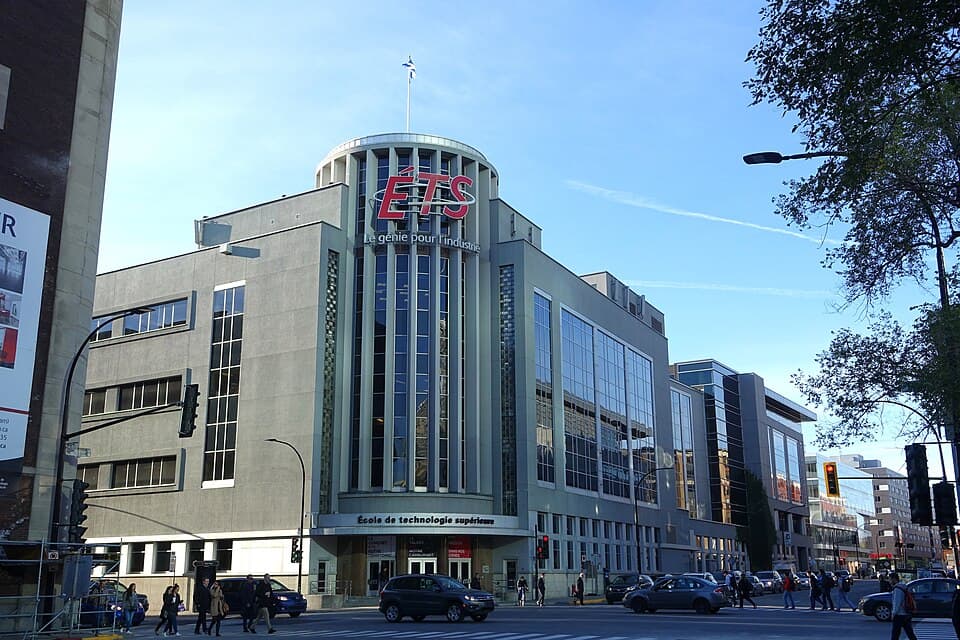

Ecole de technologie superieure
Montreal, Quebec
Compare Ecole de technologie superieure programs, admissions, costs, residence, student support, and career pathways in one source-reviewed guide. Jump to the decision section you need below.
The short answer
- For Fall 2027, international applicants must apply by March 1, 2027, and Canadian applicants by August 1, 2027.
- Undergraduate teaching is in French. A TFI score of 800 or higher meets the language rule; 700–799 needs an ÉTS French course.
- Engineering bachelors are about 120 credits over four years and include three mandatory paid stages.
- Current residence rates for 2026–27 start at $574 per person for a four-person apartment.
- Fall 2027 tuition rates and the preparatory-year deadline are not yet published.
Reviewed August 16, 2026 · Official university sources · How we review guides
Save this to your free account
Track Ecole de technologie superieure with a checklist for how you apply. Free account. Add your dates in the tracker to request reminder emails; unsubscribe any time.
Free account. No card needed.
Overview
Quick Facts
| Location | Montreal, Quebec |
|---|---|
| School Type | Comprehensive teaching and applied-program university |
| Directory Size | Mid-size university |
| Campus Setting | Major-city campus environment |
| Ranking Signal | No QS World 2026 position listed in this guide |
| Program Strengths | Engineering, Technology, Computer Science, Science |
Start with campus and program fit, then verify official admissions, residence, and cost details before building the final application list.
Admissions Planning
Fall 2027 admissions planning
ÉTS admission requirements
ÉTS does not publish one universal entrance average. Eligibility depends on the bachelor and the applicant’s route: a Québec technical or pre-university DEC, another Canadian technical diploma, an international credential, relevant adult experience, or a defined preparatory pathway. Undergraduate teaching is in French.
International deadline
March 1, 2027
Confirmed in ÉTS’s official 2027 university calendar.
Canadian deadline
August 1, 2027
Confirmed in the same calendar; special-program dates can differ.
Classes begin
September 1, 2027
New-student registration runs February 15 through August 13.
Applicant routes are not interchangeable
| Route | Published basis | Planning note |
|---|---|---|
| Québec technical DEC | Hold an eligible technical DEC for the selected bachelor or an equivalent recognized by the admission committee. | The eligible DEC list is program-specific; ÉTS normally retrieves Québec records rather than asking for a transcript upload. |
| Québec pre-university DEC | An eligible Sciences de la nature or other listed pre-university DEC plus the science preparation shown on the program page. | Do not treat every pre-university DEC as direct entry to every engineering bachelor. |
| Other Canadian college | A qualifying technical diploma from a Canadian community college, assessed against the chosen program. | ÉTS names examples including CCNB, La Cité and Northern College; equivalency remains program-specific. |
| French or international credential | A qualifying credential and the mathematics, physics, chemistry or technical preparation specified for that route. | Upload diplomas and transcripts; provide a certified French translation when documents are not in French or English. |
| Experience basis | Be at least 21 with at least 30 college-level technical units and two years of relevant technical work experience. | The admission committee evaluates the relevance of both prior learning and employment. |
| Preparatory pathways | Use the 31-credit preparatory year or Cheminement universitaire en technologie only when the applicant's prior credential fits that route. | These are distinct pathways, not a universal first year; the Fall 2027 preparatory-year deadline is pending. |
Fall 2027 evidence status
| Checkpoint | Date | Evidence |
|---|---|---|
| Fall 2027 international admission deadline | March 1, 2027 | Confirmed in the official 2027 calendar. |
| Fall 2027 Canadian admission deadline | August 1, 2027 | Confirmed in the official 2027 calendar. |
| Fall 2027 new-student registration | February 15–August 13, 2027 | Confirmed in the official 2027 calendar. |
| Fall 2027 classes begin | September 1, 2027 | Confirmed in the official 2027 calendar. |
| Fall 2027 tuition payment | October 15, 2027 | Confirmed in the official 2027 calendar. |
| Fall 2027 UX and preparatory-year deadlines | Not cycle-published | Current pages display older intake dates; do not reuse them for Fall 2027. |
Undergraduate French evidence
ÉTS’s undergraduate directive accepts several prior-study pathways. When a test is needed, it must be recent; the graduate thresholds are different and should not be reused here.
TFI
800 or higher
Conditional route: 700–799 plus an ÉTS French course.
TCF
C1 or C2
Conditional route: B2 plus an ÉTS French course.
DELF / DALF
DALF C1 or C2
Conditional route: DELF B2 plus an ÉTS French course.
Québec study
A qualifying French-language Québec DEC or another pathway listed in the undergraduate directive
Conditional route: Depends on the exact anglophone DEC and French-course record.
Special-program Fall 2027 dates remain pending
The UX Design and preparatory-year pages show older cycle dates. Do not carry them into Fall 2027. Aerospace and UX also require supplemental files, so their live program pages control.
Experience-based admission
Current requirements · Published for this period
The experience basis requires an applicant to be at least 21, have at least 30 technical college units and have at least two years of relevant technical work experience.
Applies to: Mature
École de technologie supérieure: Admission routes and standing deadlines · Verified August 16, 2026
Fall 2027 preparatory-year deadline
2027 pending · Fall 2027
Not published. The live page displays an older intake deadline.
Do not roll the displayed April 1, 2026 deadline into the 2027 cycle.
Applies to: International
École de technologie supérieure: Preparatory year · Verified August 16, 2026
UX Design supplemental file
Current requirements · Published for this period
UX applicants submit one PDF containing a one-to-two-page intention letter, a CV and a portfolio presenting no more than five projects in seven pages or fewer.
Applies to: All applicants
École de technologie supérieure: User Experience Design bachelor · Verified August 16, 2026
TFI evidence
Current requirements · Published for this period
The undergraduate language directive accepts TFI 800 or higher; 700–799 requires an ÉTS French course, while a lower result is insufficient.
Applies to: International
École de technologie supérieure: Undergraduate language-policy directive · Verified August 16, 2026
Official admissions sources
Programs and Pathways
Applied engineering and adjacent degrees
ÉTS bachelor programs and pathways
Most ÉTS engineering bachelors are four-year B.Eng. programs with substantial laboratory, project and stage experience. Distributed Computing and User Experience Design are distinct degrees with different lengths, credentials and work-term patterns.
Engineering bachelors
About 120 credits
Generally four full-time years with three required paid stages.
Distributed Computing
90-credit B.Sc.A.
Seven continuous terms and one required paid stage; not a B.Eng.
UX Design
91-credit B.Des.
Three years, limited capacity, portfolio file and one paid stage.
Engineering bachelors
Applied B.Eng. programs are generally about 120 course credits over four full-time years.
Accredited engineering programs lead toward the Québec engineering profession and normally include three mandatory paid stages.
Aerospace Engineering
A 118–120-credit B.Eng. taught in French, full time, with three paid stages.
Teaching is split between Montréal and ÉNA's Longueuil campus; applicants also upload a motivation letter and CV.
Distributed Computing
A 90-credit B.Sc.A. across seven continuous full-time terms.
It is not an engineering degree and includes one mandatory paid four-month stage rather than the three-stage engineering pattern.
User Experience Design
A 91-credit, three-year B.Des. with one mandatory paid four-month stage.
Capacity is limited and selection can include the file and an interview; applicants submit a letter, CV and portfolio of up to five projects.
Environmental Engineering
A proposed 120-course-credit B.Eng. with 27 mandatory stage credits.
The live page says the program remains subject to external program approval, so availability must be rechecked before applying.
Environmental Engineering is approval-dependent
ÉTS’s current page describes the proposed degree and its planned structure, but explicitly says it remains subject to external program approval. Confirm approval and intake availability before treating it as a Fall 2027 option.
Engineering accreditation
Current requirements · Published for this period
ÉTS says its engineering bachelors are accredited by Engineers Canada and substantially equivalent to French CTI-accredited engineering education.
Applies to: All applicants
École de technologie supérieure: Program and credential types · Verified August 16, 2026
Aerospace delivery locations
Current requirements · Published for this period
Aerospace teaching is split between Montréal for one or two days each week and the ÉNA campus in Longueuil for the remaining days.
Applies to: All applicants
École de technologie supérieure: Aerospace Engineering bachelor · Verified August 16, 2026
Distributed Computing credential boundary
Current requirements · Published for this period
Distributed Computing is not a B.Eng.; the page distinguishes it from Software Engineering and Information Technology Engineering.
Applies to: All applicants
École de technologie supérieure: Distributed Computing bachelor · Verified August 16, 2026
Environmental Engineering approval status
2027 pending · Current requirements
The live page describes a proposed 120-course-credit B.Eng. but says it remains subject to external program approval.
Confirm that the program is approved and accepting the intended Fall 2027 cohort before applying.
Applies to: All applicants
École de technologie supérieure: Environmental Engineering bachelor proposal · Verified August 16, 2026
Official program sources
Residence and Campus Fit
Montréal campus housing
ÉTS residence rates and availability
ÉTS publishes more than 1,100 units in four residence phases near the main campus. The live rate table covers September 2026 through August 2027; the following Fall 2027 lease-year rates are not yet published.
| 2026–27 unit | Monthly rate |
|---|---|
| Four-person apartment | $574–$622 per person |
| Three-person apartment | $705 per person |
| Two-person apartment | $741–$789 per person |
| Studio | $920–$1,297 |
| Closed one-bedroom | $1,303–$1,427 |
| Mezzanine one-bedroom | $1,427 |
Assignment
Availability-based
Full-time students receive priority; a waitlist can be used.
When to apply
As early as possible
ÉTS permits a request before admission or registration is final.
Initial leases
4, 8 or 12 months
Length depends on move-in timing; later renewals run from September 1.
No universal first-year guarantee
The application page says assignments depend on availability and can move to a waitlist. Applying before admission is allowed and sensible, but it is not a guaranteed room.
Residence building locations
Current requirements · Published for this period
The campus directory identifies R1 and R2 on Peel and Ottawa streets, R3 at 425 rue de la Montagne and R4 at 355 rue de la Montagne.
Applies to: All applicants
École de technologie supérieure: Campus buildings and residence addresses · Verified August 16, 2026
Fall 2027 residence rates
2027 pending · Fall 2027
Not published.
The live table ends August 31, 2027 and should not be extended into the Fall 2027 lease year.
Applies to: All applicants
École de technologie supérieure: 2026–27 residence rates · Verified August 16, 2026
Residence guarantee
2027 pending · Current requirements
No universal first-year guarantee is published. Units are assigned by availability, full-time students receive priority and a waitlist may be used.
Apply early, including before admission is final, but do not describe this as guaranteed housing.
Applies to: All applicants
École de technologie supérieure: Residence application and allocation process · Verified August 16, 2026
Return after an out-of-Montréal stage
Current requirements · Published for this period
A resident leaving for an approved stage outside Montréal can cancel without penalty and preserve return access by leaving the published $500 deposit.
Applies to: All applicants
École de technologie supérieure: Residence lease conditions · Verified August 16, 2026
Official residence sources
Housing and Location Questions
| Campus Setting | Major-city campus environment |
|---|---|
| Residence | Check residence guarantee rules, first-year room styles, meal plans, deposit deadlines, and off-campus housing pressure. |
| City Fit | Students should compare transit, weather, cost of living, safety, and community feel in Montreal. |
| Commuting | If living off campus, map commute time to classes, labs, placements, and evening activities before committing. |
Tuition, Scholarships, and Aid
Current planning rates, not a 2027–28 quote
ÉTS tuition and financial aid
The live tuition page publishes per-credit rates by residency status. The arithmetic below uses 30 credits and excludes institutional, program and living costs. ÉTS has not yet labelled these as Fall 2027 rates.
| Status | Per credit | 30 credits | Basis |
|---|---|---|---|
| Québec resident base tuition | $103.92 | $3,117.60 | Current live rate before institutional and program fees. |
| Canadian resident outside Québec | $324.35 | $9,730.50 | $103.92 base plus a $220.43 supplement; French and francophone Belgian undergraduate exemptions use this rate when eligible. |
| International undergraduate | $1,171.18 | $35,135.40 | $103.92 base plus a $1,067.26 international supplement, before institutional and program fees. |
Official base-rate wording conflict
The live status table uses $103.92 per credit, while an institutional fee sentence on the same page still says $100.89. The calculations above follow the live table and preserve the stale sentence as a conflict rather than silently mixing rates.
Entrance-award ladder
No fixed universal ladder published
ÉTS directs students to a changing scholarship directory; confirm each award's applicant group, cycle and deadline.
Perspective Québec
$2,500 per eligible successful term
Maximum $20,000, but current continuation rules generally require earlier program participation; it is not a new Fall 2027 entrance promise.
Emergency support
Up to $1,000 per academic year
For eligible enrolled students facing financial difficulty; it is not an entrance scholarship.
Official base-rate wording
Official-source conflict · Current requirements
The live status table uses $103.92 per credit, while an institutional-fee sentence on the same official page still refers to $100.89.
Use the live status table for arithmetic and preserve the stale sentence as an official-source conflict.
Applies to: All applicants
École de technologie supérieure: Tuition rates and study-cost examples · Verified August 16, 2026
Fall 2027 tuition rates
2027 pending · Fall 2027
Not published as a 2027–28 rate schedule.
Current per-credit figures are planning inputs only and should not be relabelled as Fall 2027 rates.
Applies to: All applicants
École de technologie supérieure: Tuition rates and study-cost examples · Verified August 16, 2026
Fall 2027 entrance-award ladder
2027 pending · Fall 2027
No fixed cycle-labelled universal ladder is published.
Check each scholarship's status, program, citizenship and deadline in the current directory.
Applies to: All applicants
École de technologie supérieure: Scholarship directory overview · Verified August 16, 2026
Perspective Québec continuation restriction
Through Winter 2029 · Published for this period
Current rules generally require qualifying Winter 2025 enrolment or prior receipt in the same program and therefore do not establish an automatic award for every new Fall 2027 entrant.
Applies to: All applicants
École de technologie supérieure: Perspective Québec scholarship rules · Verified August 16, 2026
Official cost sources
Cost Planning
| Tuition | Tuition depends on program, student status, and year. Verify domestic and international tuition on the official fee schedule. |
|---|---|
| Scholarships | Check automatic entrance awards, competitive major awards, faculty scholarships, and international-student awards. |
| Living Costs | Budget for residence or rent, food, books, transit, health insurance, winter clothing, and emergency funds. |
| Proof of Funds | International students should confirm current study-permit financial requirements and school-specific cost estimates. |
Student Life and Support
Fit Signals
| Community | Mid-size university profile: compare class feel, access to professors, student clubs, and how easy it is to build community. |
|---|---|
| Student Supports | Review academic advising, accessibility services, mental health supports, international student services, and writing centres. |
| Clubs and Leadership | Look for discipline clubs, cultural groups, entrepreneurship programs, varsity/intramural sports, and volunteering. |
| First-Year Transition | Ask how orientation, peer mentorship, residence programming, and advising help students settle in. |
Co-op, Research, and Career Outcomes
Paid work-integrated learning
ÉTS stages and co-operative education
Engineering bachelors normally integrate three mandatory paid stages, representing at least a year of workplace experience. UX Design and Distributed Computing use a different one-stage pattern. Required and paid does not mean that an employer match is automatic.
Engineering pattern
Three mandatory paid stages
Each normally lasts four months; the second or third may extend to eight months and an optional fourth stage is possible.
Earliest first stage
As early as second bachelor term
Normally after passing or enrolling in at least 12 program credits, with route-specific conditions.
Non-engineering patterns
One stage in UX and Distributed Computing
Do not apply the three-stage engineering model to these B.Des. and B.Sc.A. degrees.
Placement reality
Required does not mean assigned
ÉTS supports matching and searches, but no automatic employer-placement guarantee is published.
Plan for the search process
ÉTS provides stage-search and matching infrastructure, and the stages are mandatory degree components. The public pages do not promise that ÉTS assigns every eligible student an employer, so applications, interviews and employer selection remain part of the process.
Engineering stage requirement
Current requirements · Published for this period
Engineering bachelor students normally complete three mandatory paid four-month stages.
Applies to: All applicants
École de technologie supérieure: Work-integrated learning for students · Verified August 16, 2026
First-stage timing
Current requirements · Published for this period
A first engineering stage can begin as early as the second bachelor term after passing or enrolling in at least 12 program credits, subject to the admission route and rules.
Applies to: All applicants
École de technologie supérieure: Work-integrated learning for students · Verified August 16, 2026
Distributed Computing stage
Current requirements · Published for this period
Distributed Computing requires one paid four-month stage, not the three-stage engineering sequence.
Applies to: All applicants
École de technologie supérieure: Distributed Computing bachelor · Verified August 16, 2026
Employer-placement guarantee
2027 pending · Current requirements
No automatic employer-placement guarantee is published. ÉTS provides stage-search and matching support, but students must satisfy eligibility and secure a qualifying employer match.
Describe stages as mandatory and paid without promising that ÉTS assigns every student a placement.
Applies to: All applicants
École de technologie supérieure: Work-integrated learning for students · Verified August 16, 2026
Official stage sources
Career Planning
| Experiential Learning | Check whether your target program offers co-op, internships, clinical placements, practicums, studios, field schools, or research terms. |
|---|---|
| Career Services | Compare job boards, employer partnerships, resume support, interview preparation, and alumni mentoring. |
| Research Access | For graduate-school or professional-school pathways, look for undergraduate research assistant roles and lab access. |
| Outcome Questions | Ask where graduates work or study next, and whether outcomes differ by program, co-op stream, or campus. |
ÉTS applicants need to match their exact credential route to the selected bachelor, distinguish engineering B.Eng. programs from the UX Design B.Des. and Distributed Computing B.Sc.A., and use undergraduate—not graduate—French thresholds. They should rely on the confirmed Fall 2027 general calendar while keeping special-program deadlines and 2027–28 prices pending, preserve the official tuition-rate wording conflict, avoid treating availability-based residence as guaranteed, and distinguish mandatory paid stages from an automatic employer placement.
ÉTS Montréal admissions, French, tuition, residence, programs, and stages FAQs
Current answers for Québec CEGEP, other Canadian, international, experience, and preparatory applicants planning ÉTS for Fall 2027, with program boundaries, French evidence, confirmed dates, current costs, official conflicts, and unpublished future details kept visible.
Official Sources and Next Steps
Stellar keeps this guide structured for comparison, but official university pages remain the source of truth for program requirements, tuition, residence, scholarships, deadlines, and policy changes.
Prepared by Stellar Advisers Editorial Team · Reviewed August 16, 2026 · Editorial, corrections, and source methodology
Related Canadian universities
Compare 3 other Quebec records, then continue through the national directory.