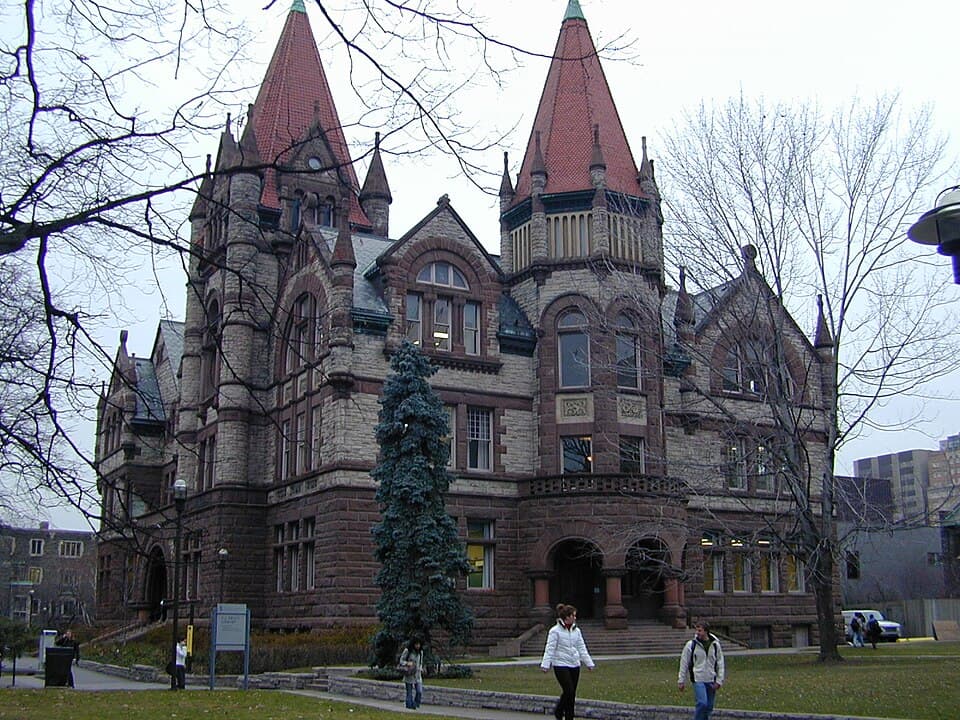

Victoria University
Toronto, Ontario
Compare Victoria University programs, admissions, costs, residence, student support, and career pathways in one source-reviewed guide. Jump to the decision section you need below.
The short answer
- U of T owns Arts & Science admission; Victoria College owns college membership, Vic One, residence, and awards.
- For 2026–27, Ontario Arts & Science tuition is $6,220 and non-Ontario Canadian tuition is $7,610.
- International Arts & Science tuition is $66,110 for students entering 2026 and $68,750 for those entering 2027.
- Domestic Fall 2027 tuition is pending; the current report does not give an approved 2027–28 domestic schedule.
- Victoria's 2026–27 room-only rates run from $10,378 to $17,094, plus a $6,914 Standard or $7,631 All-Access meal plan for first year.
Reviewed August 16, 2026 · Official university sources · How we review guides
Save this to your free account
Keep these dates where you'll see them. Free account; we email you before each saved date; unsubscribe any time. Your account’s email pause still applies. The calendar file needs no account.
- OUAC Group A deadline (Ontario high-school students)January 15, 2027
Free account. No card needed.
Overview
Quick Facts
| Location | Toronto, Ontario |
|---|---|
| School Type | Smaller undergraduate-focused environment |
| Directory Size | Small university |
| Campus Setting | Major-city campus environment |
| Ranking Signal | No QS World 2026 position listed in this guide |
| Program Strengths | Arts, Humanities, Creative Writing, Theology, Seminars |
First, think about campus and program fit. Then check the official admissions, residence, and cost details. Do this before you make your final application list.
Detailed application guides
Ontario University Application Deadlines 2027
OUAC's January 15, 2027 deadline and each university's own dates in one table.
OUAC 101 vs 105: Group A or Group B
Which OUAC group you're in, and which deadline applies to you.
OSAP 2026–2027 Application Guide
Open status, eligibility, residency, course load, grants, deadlines, and documents.
Ontario Universities With Co-op
Direct-entry and later-entry co-op models, work terms, fees, and questions to ask.
Admissions Planning
Fall 2027 admissions by owning institution
Apply to U of T Arts & Science, then seek Victoria membership
This is Victoria University in Toronto—not the University of Victoria in British Columbia. U of T owns undergraduate degree admission; Victoria College owns college preference and profile review. Emmanuel College uses a separate graduate theology application.
Victoria undergraduate route
U of T Arts & Science
College membership follows the U of T application and Victoria preference rules.
General Fall 2027 dates
Pending
The undergraduate deadline and Victoria profile pages still show the 2026 cycle.
Emmanuel Fall 2027
Confirmed
December 1 international and March 31 domestic for September 2027.
Three decisions are not one
U of T assesses the Arts & Science admission category. Victoria College assesses membership using grades. For applicable first-year applicants, it also uses the Victoria profile. Vic One runs another separate selection process. Vic One does not require Victoria membership.
| Route | Published base | Ownership boundary |
|---|---|---|
| Ontario secondary school | OSSD, six Grade 12 U/M subjects, and ENG4U/EAE4U | Apply to U of T St. George Arts & Science, then rank Victoria College. Domestic applicants must rank Vic first and complete the Victoria College Student Profile for Vic consideration. |
| Other Canadian secondary school | Provincial diploma, senior English, and category prerequisites | U of T owns degree admission and publishes curriculum-specific course patterns. Victoria owns the college-membership review, which is separate. |
| International secondary school | Recognized leaving credential, senior English, and program prerequisites | International applicants may rank Vic first, second, or third. The Vic profile is recommended rather than required. It can support some award consideration. |
| Canadian college transfer | Normally a high-B average with sufficient academic content | U of T states that Computer Science and Rotman Commerce do not accept this transfer route. Victoria membership is based on grades and has no profile for upper-year transfers. |
| University or international transfer | Strong full academic record plus program prerequisites | U of T decides degree admission and transfer credit. Where eligible, applicants choose Victoria as a college preference. |
| Emmanuel College graduate theology | Four-year bachelor's degree and normally 70% / 2.70 CGPA | This is a separate Victoria University graduate route. The MPS prefers 3.0, and Emmanuel—not Victoria College or Arts & Science—owns the admission decision. |
Fall 2027 U of T Arts & Science application
Pending
The central deadlines page still identifies its dates as 2026 admissions. No general Fall 2027 Arts & Science deadline was live on August 16, 2026.
Fall 2027 Victoria College Student Profile
Pending
Victoria's live page lists December 2, 2025 and February 2/16, 2026, not a 2027 profile cycle.
Fall 2027 Vic One application
Pending
The current Vic One application page lists February 20, April 6, and May 8, 2026 rounds only.
2027 National Scholarship application
October 30, 2026
U of T also confirms October 9 for school nomination. It also confirms October 16 for the admission application that goes with it.
Emmanuel international application
December 1, 2026
Emmanuel confirms its next intake is September 2027 and its portal opens in September 2026.
Emmanuel domestic application
March 31, 2027
Emmanuel admits only for September and confirms the next intake is September 2027.
Undergraduates apply first to U of T Arts & Science
Current undergraduate admission · Published for this period
Applicants use OUAC for U of T St. George Arts & Science and then rank Victoria College among their college preferences.
Applies to: All applicants, International, Transfer
Victoria College: Victoria College preference, profile, and transfer rules · Verified August 16, 2026
Domestic applicants must rank Victoria first
Current undergraduate admission · Published for this period
Victoria requires domestic first-year applicants to select it as first college preference and complete the Victoria College Student Profile.
Applies to: Ontario high school, Other Canadian
Victoria College: Victoria College preference, profile, and transfer rules · Verified August 16, 2026
International applicants may rank Victoria first, second, or third
Current undergraduate admission · Published for this period
Victoria bases international membership admission on grades and recommends the profile to strengthen the application and support some award consideration.
Applies to: International
Victoria College: Victoria College preference, profile, and transfer rules · Verified August 16, 2026
Upper-year transfers cannot use the Victoria profile
Current transfer admission · Published for this period
Victoria states that upper-year transfer membership is based on grades and that these applicants do not have access to the profile.
Applies to: Transfer
Victoria College: Victoria College preference, profile, and transfer rules · Verified August 16, 2026
Ontario applicants need an OSSD and six U/M subjects
Current undergraduate admission · Published for this period
U of T requires ENG4U or EAE4U within the six Grade 12 U/M subjects. U of T does not consider co-op components for admission.
Applies to: Ontario high school
University of Toronto: Canadian high-school admission requirements · Verified August 16, 2026
Canadian requirements depend on province
Current undergraduate admission · Published for this period
U of T publishes the diploma, senior-English, subject-count, and prerequisite equivalents for each Canadian curriculum.
Applies to: Other Canadian
University of Toronto: Canadian high-school admission requirements · Verified August 16, 2026
International applicants need a recognized credential and senior English
Current undergraduate admission · Published for this period
U of T also requires the senior-level equivalents of any prerequisites for the intended admission category.
Applies to: International
University of Toronto: International high-school requirements · Verified August 16, 2026
College transfer is normally competitive at a high-B average
Current transfer admission · Published for this period
U of T requires sufficient academic content. U of T notes that some areas need higher standing.
Applies to: Transfer
University of Toronto: Canadian university and college transfer requirements · Verified August 16, 2026
College transfers cannot apply to two St. George categories
Current transfer admission · Published for this period
U of T lists Computer Science and Rotman Commerce as Faculty of Arts & Science categories. College transfer applicants cannot apply to these categories.
Applies to: Transfer
University of Toronto: Canadian university and college transfer requirements · Verified August 16, 2026
U of T publishes current English-test thresholds
Current undergraduate admission · Published for this period
Examples are IELTS 6.5 with no band below 6.0. Other examples are CAEL 70 with no part below 60, and Duolingo 120 with 120 in Production for tests after June 2024.
Applies to: International, Other Canadian, Transfer
University of Toronto: Undergraduate English-language requirements · Verified August 16, 2026
TOEFL requirements changed on January 21, 2026
Current undergraduate admission · Published for this period
Earlier tests require 89 with 22 in Speaking and Writing; later tests require 4.5 overall, 4.5 Writing, and 4.0 Speaking.
Applies to: International, Other Canadian, Transfer
University of Toronto: Undergraduate English-language requirements · Verified August 16, 2026
General Fall 2027 undergraduate dates are pending
2027 pending · Fall 2027
The central U of T page labels its application table as 2026 admissions, and Victoria's profile page gives 2025–26 dates.
Recheck both U of T and Victoria College. The degree application and college profile have separate dates.
Applies to: All applicants, International, Transfer
University of Toronto: Current undergraduate application deadlines · Verified August 16, 2026
Emmanuel confirms September 2027 admission
Fall 2027 · Published for this period
The portal opens in September 2026; international applications are due December 1 and domestic applications March 31.
Applies to: All applicants, International, Transfer, Mature / professional
Emmanuel College: Confirmed September 2027 intake and application deadlines · Verified August 16, 2026
Emmanuel normally requires 70% or 2.70 CGPA
Fall 2027 graduate admission · Published for this period
Applicants need a four-year bachelor's degree or equivalent; the MPS program prefers a 3.0 GPA.
Applies to: All applicants, International, Transfer, Mature / professional
Emmanuel College: Emmanuel College graduate admission requirements · Verified August 16, 2026
Official Victoria, U of T, and Emmanuel admission sources
Programs and Pathways
College programs, faculty programs, and theology
Attribute the degree, program, and enrichment route separately
Victoria College houses distinctive first- and upper-year programs. U of T Arts & Science owns the broader degree catalogue. Emmanuel is Victoria University's separate graduate theological college.
Undergraduate degree
U of T HBA/HBSc/BCom
Victoria University suspended non-theology degree conferral under federation.
Vic One
8 streams · 2 credits
Up to 250 students, with no more than 25 in each section.
Graduate theology
Emmanuel College
Separate admission, programs, fees, and theological governance.
College membership is not a major
Arts & Science students may study eligible programs. This is true regardless of college affiliation. Victoria sponsorship identifies the college home of a program or enrichment route. It does not transfer ownership of every U of T course, major, internship, or degree to Victoria.
U of T Arts & Science degree
Victoria College members can pursue eligible humanities, social sciences, life sciences, physical and mathematical sciences, computer science, and commerce study through the Faculty of Arts & Science.
Boundary: U of T owns admission, most courses, program enrolment, tuition, and the HBA/HBSc/BCom degree. College membership does not make every Arts & Science program Victoria-owned.
Vic One
Eight first-year streams provide two full credits in seminars, with enrolment capped at 250 and sections capped at 25.
Boundary: Applicants from Arts & Science, Architecture, and Music may apply no matter their college choice. Vic One selection is separate from Victoria College membership.
Vic One Hundred
A Victoria College first-year seminar route designed to create a smaller academic community.
Boundary: It is a first-year program. It is not a separate U of T degree or an independent admission category.
Victoria-sponsored upper-year programs
Current offerings include Creativity and Society, Education and Society, Literature and Critical Theory, Material Culture and Semiotics, Renaissance Studies, and Science, Technology and Society.
Boundary: These are Arts & Science program components housed at Victoria. The academic calendar controls enrolment and completion.
Scholars-in-Residence and research centres
Victoria created a four-week interdisciplinary Scholars-in-Residence program and houses six named research centres.
Boundary: These research and enrichment chances are not a paid internship for everyone. They are not a guaranteed placement.
Emmanuel College
Victoria University's graduate multireligious college offers basic, conjoint-certificate, graduate, non-degree, and non-credit theological study.
Boundary: Emmanuel has its own admissions, fees, programs, and theological degree governance. It is not an undergraduate Victoria College route.
U of T owns the Arts & Science degree catalogue
Current college system · Published for this period
College membership does not limit you to Victoria-sponsored programs. A U of T program does not become Victoria-owned just because a Victoria member enrols.
Applies to: All applicants
University of Toronto: Arts and Science college membership and program boundaries · Verified August 16, 2026
Vic One has eight first-year streams
Current first-year program · Published for this period
Each stream uses interdisciplinary small seminars focused on a central theme.
Applies to: All applicants
Victoria College: Vic One structure, streams, credits, and enrolment · Verified August 16, 2026
Vic One is capped at 250 students
Current first-year program · Published for this period
Sections are capped at 25, and students complete two full credits of stream-specific courses.
Applies to: All applicants
Victoria College: Vic One structure, streams, credits, and enrolment · Verified August 16, 2026
Vic One is open beyond Victoria membership
Current first-year program · Published for this period
First-year applicants to Arts & Science, Architecture, and Music may apply regardless of college choice.
Applies to: All applicants
Victoria College: Vic One application and separate selection process · Verified August 16, 2026
Vic One and Victoria membership use separate selection
Current first-year program · Published for this period
Selection for one does not mean selection for the other. Applicants may apply to Vic One before they receive a U of T offer.
Applies to: All applicants
Victoria College: Vic One application and separate selection process · Verified August 16, 2026
Victoria houses six named upper-year interdisciplinary areas
Current Arts & Science programs · Published for this period
The current list includes Creativity and Society, Education and Society, Literature and Critical Theory, Material Culture and Semiotics, Renaissance Studies, and Science, Technology and Society.
Applies to: All applicants, Transfer
Victoria College: Victoria College upper-year interdisciplinary programs · Verified August 16, 2026
Creativity and Society requires 4.0 credits
Current Arts & Science program · Published for this period
At least 1.0 credit must be at the 300+ level. The program limits how many 100-level and approved outside-department credits count.
Applies to: All applicants, Transfer
Victoria College: Creativity and Society program requirements · Verified August 16, 2026
Education and Society connects to separate OISE combined routes
Current Arts & Science program · Published for this period
Eligible third-year students may apply to combined degree programs with OISE. Admission is not automatic from Victoria membership.
Applies to: All applicants, Transfer
Victoria College: Education and Society, Vic Reach, and OISE combined routes · Verified August 16, 2026
Emmanuel is graduate and theological
Current Emmanuel programs · Published for this period
Its basic degrees, certificates, graduate programs, and non-degree study use Emmanuel's own route. They do not use Victoria College undergraduate admission.
Applies to: All applicants, International, Transfer, Mature / professional
Emmanuel College: Emmanuel College theological program directory · Verified August 16, 2026
Official Victoria, U of T, and Emmanuel program sources
Residence and Campus Fit
Victoria College residence
Compare five Victoria residence groups and required dining
The current room and meal prices are 2026–27. U of T owns the first-year housing-guarantee framework, while Victoria publishes its own building inventory, room charges, deposits, and upper-year lottery.
Fall 2027 terms are not live
For 2026–27, eligible first-year students had to apply by March 31 and accept admission by June 2. Do not reuse those dates—or the current room, meal-plan, and deposit schedule—as confirmed Fall 2027 terms.
| Building / package | Rooms | Current rate |
|---|---|---|
| Annesley Hall | Single, double, economy loft double/triple, and super single | $10,378–$14,390 room-only for 2026–27 |
| Margaret Addison Hall | Single, double, triple, bath-equipped, and super-single options | $10,378–$14,470 room-only for 2026–27 |
| Burwash Hall Upper Houses | Single, double, economy loft double, super single, and shared-bath rooms | $11,528–$14,390 room-only for 2026–27 |
| Burwash Hall Lower Houses | Single, double, triple, and super-single options | $10,378–$17,094 room-only for 2026–27 |
| Rowell Jackman Hall | Single and double rooms in shared 3–12-bedroom apartments | $12,720–$16,016 room-only for 2026–27 |
| 2026–27 meal plan | Standard or all-access for first year; basic is upper-year only | $6,914 standard or $7,631 all-access |
| Fall 2027 residence | Rates, guarantee dates, and deposits pending | The live guarantee and full fee schedule are explicitly 2026–27, not 2027–28. |
Keep room and meal charges separate
The 2026–27 room-only range is $10,378–$17,094. First-year students then need the $6,914 Standard or $7,631 All-Access plan, and residence council fees may also apply. The $6,016 Basic plan is upper-year only.
Victoria College has five residence groups
2026–27 residence · Latest published information; newer cycle not yet confirmed
The current inventory is Annesley, Margaret Addison, Burwash Upper, Burwash Lower, and Rowell Jackman.
Applies to: All applicants, International, Transfer
Victoria College: Victoria College residence and campus overview · Verified August 16, 2026
Current room-only rates span $10,378 to $17,094
2026–27 residence · Latest published information; newer cycle not yet confirmed
The low is an economy loft triple or triple; the high is a Burwash Lower super single.
Applies to: All applicants, International, Transfer
Victoria College: Victoria College buildings, rates, deposits, and upper-year lottery · Verified August 16, 2026
Rowell Jackman uses shared apartments
2026–27 residence · Latest published information; newer cycle not yet confirmed
Its single and double rooms sit within apartments of three to twelve bedrooms, with current room-only rates from $12,720 to $16,016.
Applies to: All applicants, International, Transfer
Victoria College: Victoria College buildings, rates, deposits, and upper-year lottery · Verified August 16, 2026
First-year meal plans are $6,914 or $7,631
2026–27 residence · Latest published information; newer cycle not yet confirmed
The Standard plan is $6,914 and All-Access is $7,631; the $6,016 Basic plan is restricted to upper years.
Applies to: All applicants, International
Victoria University: 2026–27 residence meal plans · Verified August 16, 2026
U of T owns the first-year guarantee framework
2026–27 residence · Latest published information; newer cycle not yet confirmed
For 2026–27, eligible new full-time first-time postsecondary students had to apply by March 31. They also had to accept admission by June 2.
Applies to: All applicants, International
University of Toronto: 2026–27 first-year residence guarantee · Verified August 16, 2026
Victoria uses two $1,000 deposits
2026–27 residence · Latest published information; newer cycle not yet confirmed
The first is due with residence-offer acceptance and the second in the July week specified on the current page.
Applies to: All applicants, International
Victoria College: Victoria College buildings, rates, deposits, and upper-year lottery · Verified August 16, 2026
Upper-year residence is limited and lottery-based
2026–27 residence · Latest published information; newer cycle not yet confirmed
The current cycle required a 2.0 AGPA and zero ACORN balance. Unsuccessful applicants were placed on a waitlist.
Applies to: All applicants, International, Transfer
Victoria College: Victoria College buildings, rates, deposits, and upper-year lottery · Verified August 16, 2026
Fall 2027 Victoria residence terms are pending
2027 pending · Fall 2027
The published rates, guarantee dates, move-in dates, deposits, and upper-year lottery are for 2026–27 at this time.
Recheck both U of T Housing for the guarantee and Victoria College for room and meal charges.
Applies to: All applicants, International, Transfer
Victoria College: Victoria College buildings, rates, deposits, and upper-year lottery · Verified August 16, 2026
Official Victoria and U of T residence sources
Housing and Location Questions
| Campus Setting | Major-city campus environment |
|---|---|
| Residence | Check the residence guarantee rules and first-year room styles. Also check meal plans, deposit deadlines, and off-campus housing pressure. |
| City Fit | Students should compare transit, weather, cost of living, safety, and community feel in Toronto. |
| Commuting | If you live off campus, map your commute time to classes, labs, placements, and evening activities. Do this before you commit. |
Tuition, Scholarships, and Aid
U of T tuition and Victoria awards
Separate faculty tuition from college-administered aid
U of T sets Arts & Science tuition. Victoria College administers its own scholarships and bursaries, and U of T also offers central awards. Every amount below retains that ownership and cycle label.
Ontario Arts & Science tuition
$6,220
U of T Schedule 2 for 2026–27. This is tuition only, before Victoria/U of T incidental and ancillary charges.
Non-Ontario Canadian Arts & Science tuition
$7,610
U of T Schedule 2 for 2026–27; tuition only.
International Arts & Science, entering 2026
$66,110
U of T 2026–27 tuition report; tuition only and not a Victoria College-set price.
International Arts & Science, entering 2027
$68,750
This is published as 2027–28 information in U of T's current tuition report. Incidental fees and UHIP stay separate.
Domestic Fall 2027 Arts & Science tuition
Pending
The report talks about a future provincial framework. But it does not publish an approved 2027–28 domestic Arts & Science schedule.
Emmanuel College current public webpage
$602 domestic / $3,018 international per course
Latest public amounts are labelled 2025–26. Emmanuel's 2026–27 and 2027–28 public fee values remain pending.
The tuition report has two schedules
Schedule 1 retains the earlier $6,100 Ontario freeze basis. Schedule 2 publishes $6,220 and states it will apply for Fall 2026 and Winter 2027. This guide uses Schedule 2 and preserves the official discrepancy.
Award audit
Victoria admission scholarships
Usually $3,000–$5,000; some up to $20,000
Victoria reports more than 100 awards and over $500,000 each year. Outstanding secondary students must pick Vic as their first-choice college.
Mid-90s automatic consideration
Consideration, not a guaranteed award
Victoria says applicants with a mid-90s average are considered automatically. But it clearly warns that this does not guarantee a scholarship.
Opportunity Awards
$5,000 yearly for up to four years
These are renewable need-based awards for identified priority communities. Victoria selects 10–15 recipients each year. Some awards also cover first-year residence.
In-course A-range guarantee
Up to $1,000 once
Victoria College students without a renewable Vic scholarship are guaranteed one in-course award. This is after an eligible first, second, or third year at 3.50+ GPA (grade point average).
2027 National Scholarship
Tuition, incidental, and residence fees up to four years
This is a central U of T award, not Victoria-owned; the student deadline is October 30, 2026.
Fall 2027 Victoria admission-award amounts
Pending
The live Victoria page gives standing ranges but does not relabel the complete admission-award set for Fall 2027.
Ontario Arts & Science tuition is $6,220
2026–27 tuition · Latest published information; newer cycle not yet confirmed
This is U of T Schedule 2 tuition for 2026–27 before incidental and ancillary fees.
Applies to: Ontario high school, Transfer, Mature / professional
University of Toronto: 2026–27 tuition report with 2027 international information · Verified August 16, 2026
Non-Ontario Canadian Arts & Science tuition is $7,610
2026–27 tuition · Latest published information; newer cycle not yet confirmed
This is U of T Schedule 2 tuition for 2026–27 before incidental and ancillary fees.
Applies to: Other Canadian, Transfer
University of Toronto: 2026–27 tuition report with 2027 international information · Verified August 16, 2026
The tuition report contains two Ontario schedules
Official-source conflict · 2026–27 tuition
Schedule 1 shows $6,100 under the earlier freeze basis. Schedule 2 shows $6,220. It says this will apply for Fall 2026 and Winter 2027.
Use Schedule 2 for Fall 2026/Winter 2027 and preserve why both official figures appear.
Applies to: Ontario high school, Transfer, Mature / professional
University of Toronto: 2026–27 tuition report with 2027 international information · Verified August 16, 2026
International Arts & Science tuition entering 2026 is $66,110
2026–27 tuition · Latest published information; newer cycle not yet confirmed
The value is U of T tuition only. Victoria/U of T incidentals and UHIP are separate.
Applies to: International
University of Toronto: 2026–27 tuition report with 2027 international information · Verified August 16, 2026
International Arts & Science tuition entering 2027 is $68,750
Fall 2027 · Published for this period
U of T publishes the amount as 2027–28 information, excluding incidental fees and UHIP.
Applies to: International
University of Toronto: 2026–27 tuition report with 2027 international information · Verified August 16, 2026
Domestic Fall 2027 Arts & Science tuition is pending
2027 pending · Fall 2027
The current report discusses the future provincial framework. But it does not give an approved 2027–28 domestic schedule.
Do not calculate a future value from the policy ceiling.
Applies to: Ontario high school, Other Canadian, Transfer, Mature / professional
University of Toronto: 2026–27 tuition report with 2027 international information · Verified August 16, 2026
Victoria awards over $500,000 to about 100 incoming students
Current Victoria awards · Published for this period
Most admission awards are $3,000–$5,000, while some multi-year awards provide up to $20,000.
Applies to: All applicants, International
Victoria College: Victoria College admission awards and Opportunity Awards · Verified August 16, 2026
Mid-90s applicants receive consideration, not a guarantee
Current Victoria awards · Published for this period
Victoria automatically considers applicants in that range. But it expressly says an award is not assured.
Applies to: All applicants, International
Victoria College: Victoria College admission awards and Opportunity Awards · Verified August 16, 2026
Opportunity Awards provide $5,000 yearly for up to four years
Current Victoria awards · Published for this period
Victoria selects 10–15 recipients each year. They come from identified priority communities with financial need. Some awards also cover first-year residence.
Applies to: All applicants, International
Victoria College: Victoria College admission awards and Opportunity Awards · Verified August 16, 2026
The 2027 National Scholarship deadline is confirmed
Fall 2027 · Published for this period
School nomination is due October 9. Associated U of T admission is due October 16. The scholarship application is due October 30, 2026.
Applies to: Ontario high school, Other Canadian
University of Toronto: Confirmed 2027 National Scholarship deadlines · Verified August 16, 2026
Emmanuel's current public fee page is stale
2027 pending · Fall 2027 planning
It lists 2025–26 tuition of $602 for domestic students and $3,018 for international students per course. So 2026–27 and Fall 2027 Emmanuel prices are still pending.
Do not present the 2025–26 amounts as current Fall 2027 prices.
Applies to: All applicants, International, Transfer, Mature / professional
Emmanuel College: Latest published Emmanuel College fees and funding · Verified August 16, 2026
Official U of T and Victoria cost sources
Cost Planning
| Tuition | Tuition depends on your program, student status, and year. Check domestic and international tuition on the official fee schedule. |
|---|---|
| Scholarships | Check automatic entrance awards, competitive major awards, faculty scholarships, and international-student awards. |
| Living Costs | Plan for residence or rent, food, books, transit, health insurance, winter clothing, and emergency funds. |
| Proof of Funds | International students should confirm current study-permit financial requirements and school-specific cost estimates. |
Student Life and Support
Fit Signals
| Community | Small university profile: compare class feel, access to professors, student clubs, and how easy it is to build community. |
|---|---|
| Student Supports | Review academic advising, accessibility services, mental health supports, international student services, and writing centres. |
| Clubs and Leadership | Look for discipline clubs, cultural groups, entrepreneurship programs, varsity/intramural sports, and volunteering. |
| First-Year Transition | Ask how orientation, peer mentorship, residence programming, and advising help students settle in. |
Co-op, Research, and Career Outcomes
Research, volunteering, and WIL boundaries
Match each experience to Victoria, U of T, or Emmanuel
Victoria runs Vic Reach and funds specific undergraduate research. U of T and Arts & Science own central internships and WIL, while Emmanuel owns its graduate theological placements. College membership alone does not establish co-op.
Vic Reach
A Victoria-run volunteer education-outreach program. It requires at least 50 hours and normally three hours weekly in Toronto classrooms or online sites. It is not transcript credit.
Milne Research Award
Victoria College Life Science students with 3.50+ CGPA may seek multiple awards up to $5,000 for eligible non-credit summer research.
Northrop Frye Centre award
Non-graduating Victoria College students may propose humanities or social-science research with a faculty supervisor for up to $2,000.
Vic Global status
Victoria's current page says Vic Global funding has been paused indefinitely since February 28, 2025. Historical internships must not be presented as a current funded program.
U of T Arts & Science experiential learning
Eligible Victoria members may access faculty opportunities. But U of T or Arts & Science owns those internships, WIL courses, and central services.
No universal Victoria co-op
Victoria College membership, Vic One, research awards, and volunteer placements do not establish co-op. This applies to every Arts & Science program.
Vic Global is paused
Victoria's current page says Vic Global funding has been paused. It has been paused indefinitely since February 28, 2025. You cannot present old international internships as a live funded pathway.
Vic Reach requires at least 50 volunteer hours
Current experiential learning · Published for this period
Participants normally serve at least three hours weekly in Toronto classrooms or online placements. They receive a Victoria certificate rather than transcript credit.
Applies to: All applicants, International, Transfer
Victoria College: Vic Reach volunteer placement requirements · Verified August 16, 2026
The Milne Research Award provides up to $5,000
Current research support · Published for this period
Eligible Victoria Life Science students need a 3.50 CGPA and undertake non-credit summer research that may be paid or volunteer.
Applies to: All applicants, International, Transfer
Victoria College: Victoria College and U of T undergraduate research opportunities · Verified August 16, 2026
The Northrop Frye Centre award provides up to $2,000
Current research support · Published for this period
Non-graduating Victoria students propose supervised humanities or social-science research. They may use funds as a stipend or for research travel.
Applies to: All applicants, International, Transfer
Victoria College: Victoria College and U of T undergraduate research opportunities · Verified August 16, 2026
Vic Global funding is paused indefinitely
Current experiential learning · Published for this period
Victoria's current page dates the pause to February 28, 2025. It redirects students to central international and college award advice.
Applies to: All applicants, International, Transfer
Victoria College: Current status of Vic Global funding · Verified August 16, 2026
Arts & Science owns central WIL opportunities
Current experiential learning · Published for this period
Victoria members may be able to get U of T experiences. But access depends on faculty, program, course, and selection rules. It does not depend on college membership alone.
Applies to: All applicants, International, Transfer
Victoria College: Victoria College and U of T undergraduate research opportunities · Verified August 16, 2026
Victoria College does not publish universal co-op
Current experiential learning · Published for this period
Vic One, research funding, Vic Reach, and college membership do not give a co-op designation. They do not give it for every Arts & Science program.
Check the U of T admission category and academic calendar for program-owned WIL.
Applies to: All applicants
Victoria College: Current status of Vic Global funding · Verified August 16, 2026
Emmanuel placements belong to theological programs
Current Emmanuel experiential learning · Published for this period
International MDiv and Master of Pastoral Studies students undertake unpaid placements under Emmanuel's professional and contextual-education requirements.
Do not describe these graduate theological placements as Victoria College undergraduate co-op.
Applies to: International, Transfer, Mature / professional
Emmanuel College: International students and unpaid theological placements · Verified August 16, 2026
Official Victoria experiential-learning sources
Career Planning
| Experiential Learning | Check whether your target program offers co-op, internships, clinical placements, practicums, studios, field schools, or research terms. |
|---|---|
| Career Services | Compare job boards, employer partnerships, resume support, interview preparation, and alumni mentoring. |
| Research Access | For graduate-school or professional-school pathways, look for undergraduate research assistant roles and lab access. |
| Outcome Questions | Ask where graduates work or study next, and whether outcomes differ by program, co-op stream, or campus. |
Victoria University applicants need to keep three institutional decisions apart. U of T owns Arts & Science admission, degree conferral, tuition and central services. Victoria College owns membership, its applicant profile, Vic One and sponsored programs, residences, awards and college supports. Emmanuel College owns its graduate theological admission and placements. This guide keeps those boundaries. It also shows unpublished Fall 2027 undergraduate dates, domestic tuition and residence terms as pending.
Victoria University Toronto admissions, programs, tuition, residence, awards and experiential learning FAQ
Current answers for Canadian, international, transfer and Emmanuel applicants planning Fall 2027, with U of T, Victoria College and Emmanuel ownership kept distinct and unpublished undergraduate dates, domestic tuition and residence terms left explicitly pending.
Official Sources and Next Steps
Stellar keeps this guide organized so you can compare. But official university pages are still the source of truth. They are the source for program requirements, tuition, residence, scholarships, deadlines, and policy changes.
Prepared by Stellar Advisers Editorial Team · Reviewed August 16, 2026 · Editorial, corrections, and source methodology
Related Canadian universities
Compare 3 other Ontario records, then continue through the national directory.