.jpg)
Athabasca University
Athabasca, Alberta
Compare Athabasca University programs, admissions, costs, residence, student support, and career pathways in one source-reviewed guide. Jump to the decision section you need below.
The short answer
- Athabasca University admits students age 16 or older, and most undergraduate programs take applications year-round.
- Most individualized courses start on the first of each month; register by the 10th of the previous month.
- For 2026–2027, a 3-credit course costs an Alberta resident $971.50 in Business or Health and $907.50 in Arts or Science.
- There is no student residence or meal plan; AU says it does not run a traditional campus for students.
- A Canadian study permit cannot be issued for an online program, AU states.
Reviewed August 15, 2026 · Official university sources · How we review guides
Save this to your free account
Track Athabasca University with a checklist for how you apply. Free account. Add your dates in the tracker to request reminder emails; unsubscribe any time.
Free account. No card needed.
Overview
Quick Facts
| Location | Athabasca, Alberta |
|---|---|
| School Type | Public online and open university |
| Directory Size | Large university |
| Campus Setting | Online and distance learning, with administrative locations in Alberta |
| Ranking Signal | No QS World 2026 position listed in this guide |
| Program Strengths | Online Learning, Business, Health, Arts, Science |
Start with campus and program fit. Then check official admissions, residence, and cost details. Do this before you build the final application list.
Admissions Planning
Year-round online admission
Athabasca University admission requirements and monthly starts
General undergraduate admission is open to students age 16 or older, and most undergraduate programs accept applications year-round. That flexibility is not universal access to every course: prerequisites, availability restrictions, and separate professional-program entry rules still apply.
General admission
Age 16+
Most undergraduate programs are open admission; check the exact program and course rules.
Typical course start
Monthly
Most individualized undergraduate courses begin on the first of every month.
Registration cutoff
Previous month's 10th
Registration must normally be successfully processed by this date.
There is no universal Fall 2027 undergraduate deadline
AU's year-round model means a usual September-only timeline does not fit most undergraduate study. Graduate programs use separate intakes. Restricted routes also use separate intakes. For example, the Post-LPN Bachelor of Nursing lists a September 1 to November 15, 2026 application window for its 2027 intake.
Athabasca at a glance, verified
Every card below is tied to a first-party athabascau.ca page. Each card is labelled with the cycle it belongs to.
What 'Canada's Open University' actually means
Current institutional model · Published for this period
Athabasca University was founded on June 25, 1970. It introduced its first open, distance course in 1973. AU states it is the only public university in Canada that is fully digital by design. This means all programs and courses are created specifically for online spaces. It also means students learn from anywhere. It also means it does not operate a traditional bricks-and-mortar campus for students. Anyone at least 16 years old who wants to pursue a university education can do so.
Applies to: All applicants
Athabasca University: Athabasca University at a glance: AU by the numbers · Verified August 15, 2026
How many students AU actually has
Official-source conflict · University-published counts
AU's 'at a glance' page publishes 35,592 students. That is 31,043 undergraduate and 4,549 graduate. It says 34,218 live in Canada across all 10 provinces and 3 territories. It says 1,365 international students come from 79 countries. AU's About page says 'over 35,000 students'. AU's History page says the university serves 'over 40,000 students worldwide'. These three first-party numbers do not agree.
The 'at a glance' page is reviewed every year. It has the most detailed breakdown. So treat 35,592 as the working figure. Treat the 40,000 figure on the History page as a rounded marketing number, not audited enrolment.
Applies to: All applicants
Athabasca University: Athabasca University at a glance: AU by the numbers · Verified August 15, 2026
Who studies at AU
University-published counts · Published for this period
The average undergraduate is 32 years old. The average graduate student is 38. AU reports that 81% of undergraduate and 73% of graduate students work while they study. AU also reports that 66% of undergraduate students are women. 4.7% of students identify as First Nations or Métis. 88% of Canadian students live in urban centres, against 12% rural. Notably, 25% of AU's Alberta students are visiting learners from other institutions. They use AU courses to finish their own degrees.
This is an adult-learner institution, not a school-leaver campus. If you are 17 and want a residential first-year experience, AU is a poor fit for that specific goal even though it will admit you.
Applies to: All applicants
Athabasca University: Athabasca University at a glance: AU by the numbers · Verified August 15, 2026
The Town of Athabasca reality
Current campus context · Published for this period
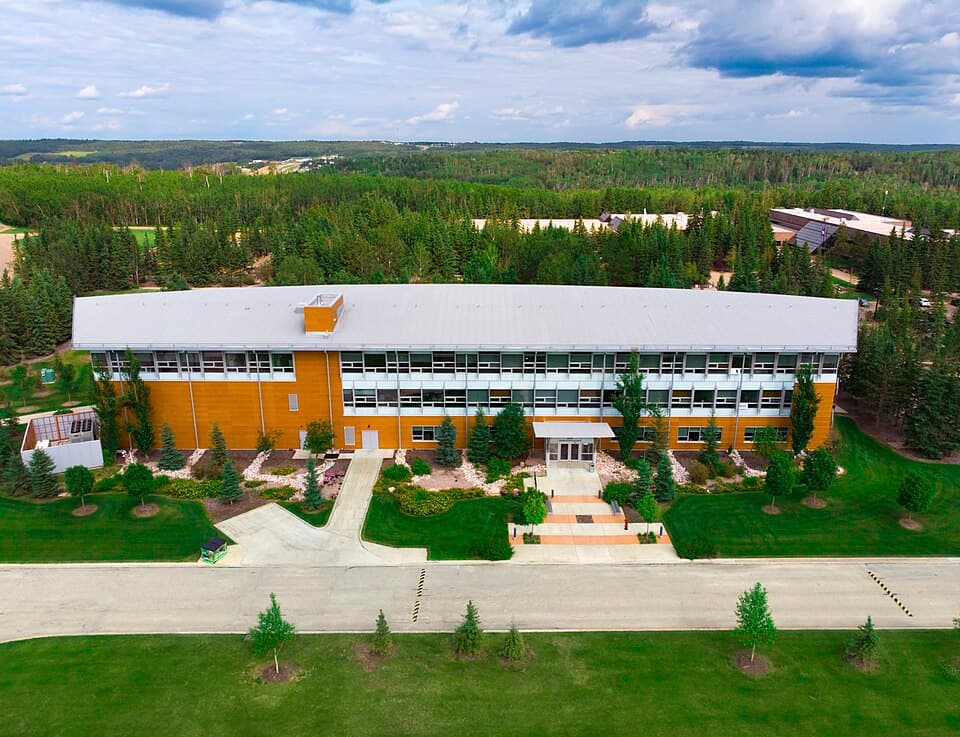
AU's published address is 1 University Drive, Athabasca, Alberta T9S 3A3. A second Athabasca site is the Tim Byrne Centre at 4001 Highway 2 South. It is used for course-materials production. AU moved 145 kilometres north from Edmonton to the Town of Athabasca in 1984. It set up satellite campuses in Calgary, Edmonton, and Fort McMurray. Students could get support and write invigilated exams there. The Fort McMurray location closed in 2000.
Athabasca is an administrative and production headquarters. It is not a student campus. AU states separately that it does not operate a traditional bricks-and-mortar campus for students.
Applies to: All applicants
Athabasca University: History: 1970 founding, move to the Town of Athabasca · Verified August 15, 2026
Accreditation and degree recognition
Current accreditation · Published for this period
AU is a designated public post-secondary institution. It reports to the Government of Alberta through the Ministry of Advanced Education. It is one of Alberta's four comprehensive research-led universities. The Campus Alberta Quality Council reviews quality assurance and program proposals. The Post-secondary Learning Act authorises AU to govern itself and grant degrees. AU states that recognition by the Government of Alberta is equal to accreditation in all Canadian provinces. AU also states that it has graduated over 50,000 program and course alumni from more than 100 countries.
Applies to: All applicants
Athabasca University: Accreditation: Government of Alberta designation and CAQC review · Verified August 15, 2026
Fall 2027 cycle status
Not yet published · Fall 2027
There is no Fall 2027 admission cycle to wait for. AU accepts undergraduate applications year-round. It publishes no application deadline for most undergraduate programs. Individualized-study courses start on the first day of every month. AU's binding regulations and fee tables instead run on an academic year from September 1 to August 31. The current published set covers courses starting September 1, 2026 to August 31, 2027.
The 2027–2028 calendar and fee tables were not published when verified. Plan with the labelled 2026–2027 regulations and re-check the Calendar before treating any figure or rule as a 2027–2028 commitment. Restricted programs such as the Post-LPN Bachelor of Nursing do run dated intakes and must be tracked separately.
Applies to: All applicants
Athabasca University: Undergraduate Calendar general information (2026–2027) · Verified August 15, 2026
Four ways to study at Athabasca
| Route | Best for | Key rule |
|---|---|---|
| Undergraduate program | Students pursuing an AU degree, diploma, or certificate | Most programs use open admission, but program-specific entry and prerequisite rules still apply. |
| Open studies | Students taking courses before choosing an AU credential | Eligible credits can count toward an AU program later. They must meet that program's requirements. |
| Visiting student | Students enrolled at another institution | AU advises a Letter of Permission from the home institution before you register, but does not require it. That institution decides whether the credit transfers. |
| Transfer or post-diploma | Students bringing prior college or university study | An official transfer-credit evaluation requires AU program enrolment, the evaluation fee, and official transcripts. |
Application-to-start timeline
Step 1 · Any time
Apply to become an undergraduate student. AU accepts undergraduate applications year-round.
Step 2 · Before registration
Choose program, open-studies, or visiting status; check course prerequisites and the Course Availability tool.
Step 3 · By the 10th
Have your registration successfully processed by the 10th of the previous month. This applies to most individualized-study courses.
Step 4 · First of the month
Most individualized undergraduate courses begin on the first day of each month. You can complete registration up to three months ahead.
The precise open-admission rule
2026–2027 regulations · Published for this period
The Calendar states: 'As an open university, Athabasca University admits students 16 years of age or older. Students may be of any nationality and reside anywhere in the world.' Applicants under 16 may be admitted only with special consideration. They must petition the Coordinator of Enrolment Services and Academic Records. They must submit the course registration form. They must submit an up-to-date high school transcript or equivalent. They must submit letters of support from the high school principal or designate and from a parent or guardian. They also need permission from the Course Coordinator and an interview.
Applies to: All applicants
Athabasca University: Calendar: Admission (age 16 rule, under-16 petition, nationality) · Verified August 15, 2026
No transcripts for general admission—with real exceptions
2026–2027 regulations · Published for this period
New students complete the online Undergraduate General Application to get a student ID. They pay the one-time, non-refundable application fee. General admission to the university needs no academic transcript. Past academic performance elsewhere does not prevent admission. But a program such as the Bachelor of Nursing may consider it. Applicants suspended or dismissed from another post-secondary institution for academic misconduct may be refused admission or enrolment. This may last until that period has elapsed.
Transcripts become mandatory the moment you want transfer credit: an official evaluation requires transcripts sent directly from every previous institution.
Applies to: All applicants
Athabasca University: Calendar: Admission (age 16 rule, under-16 petition, nationality) · Verified August 15, 2026
Year-round application and the program vs open-studies choice
Current process · Published for this period
AU states 'There are no application deadlines for most undergraduate programs'. Most undergraduate programs are open admission, AU says. They have no specific admission requirements. However, some have specific entry requirements. Before applying, you choose between a program student and an open-studies student. A program student works toward a degree, diploma, or certificate. That path has continuous enrolment. An open-studies student takes courses without registering for a credential. Those credits can later apply toward an AU program.
Applies to: All applicants
Athabasca University: Apply to AU as an undergraduate: program vs open studies · Verified August 15, 2026
The 10th-of-the-previous-month registration rule
2026–2027 regulations · Published for this period
Individualized-study courses begin the first day of each month. You must register by the 10th day of the previous month. For a November 1 start, register by October 10. You may pre-register up to 3 months before the course start date. This guarantees tutorial support for that date. It also locks the fee effective on the day the course begins. AU caps you at 6 active registrations at a time. An overload requires written permission from Enrolment Services. Students living overseas are generally assigned course start dates one month later than students in North America.
Applies to: All applicants
Athabasca University: Calendar: Course procedures, contract periods, and tutor assignment · Verified August 15, 2026
Open admission is not open access to every course
2026–2027 regulations · Published for this period
Before registering, you must have met all course prerequisite and corequisite requirements. This is in line with the Prerequisite Declaration. For a prerequisite waiver on non-academic grounds, contact the course coordinator or professor. That person has authority to waive it before you register. If the prerequisite was completed outside AU, the Prerequisite Waiver Declaration must be completed on the registration. Reading courses need the course professor's approval first. Failure to obtain these pre-registration requirements means the registration is delayed or refused.
Applies to: All applicants
Athabasca University: Calendar: Registration, prerequisites, audit, and zero-credit rules · Verified August 15, 2026
English language proficiency evidence
Current requirements · Published for this period
If your first language is not English, you must demonstrate English Language Proficiency. AU accepts completion of high school in an English-speaking country. AU accepts 15 university credits from a recognised English-speaking university. AU accepts one year at a non-university post-secondary institution with a 75% average (GPA (grade point average) 3.0). AU accepts IELTS 6, CAEL 60%, MELAB 80, PTE 59, or TOEFL PBT 213 with a Test of Written English score of 4.5. AU accepts TOEFL iBT 80 with an essay score of 20. AU accepts its own English Language Proficiency Program completed with a 75% average (GPA (grade point average) 3.0). Graduate programs set different requirements. Individual programs may add their own.
Applies to: International
Athabasca University: International applications, English proficiency, and study permits · Verified August 15, 2026
Post-LPN Bachelor of Nursing: a dated, competitive intake
2027 intake · Published for this period
The Calendar states applications for September 2026 admission are closed. It states the next application cycle is for the 2027 intake. That cycle runs September 1 to November 15, 2026. Admission requires graduation from a College of LPNs and HCAs of Alberta approved practical nursing diploma. It requires regulated practicing LPN registration in good standing without conditions. You must maintain this throughout the program. It requires a minimum of one year of full-time LPN work experience in Alberta (1,700 hours). Employer letters on official letterhead must evidence this. It requires a minimum 75% average in the most recent 30 credits of post-secondary study. It requires proof of Alberta residency. AU states admission is competitive. Meeting the requirements is not a guarantee of entry.
This is the clearest exception to AU's open-admission story. It is Alberta-restricted, licence-restricted, work-experience-restricted, and grade-restricted.
Applies to: Mature, Transfer, Other Canadian
Athabasca University: Post-LPN Bachelor of Nursing regulations and intake window · Verified August 15, 2026
Application Checklist
| Academic Requirements | Verify prerequisite courses, minimum averages, and program-specific requirements on the official admissions pages. |
|---|---|
| Supplementary Review | Competitive programs may ask for essays, portfolios, interviews, experience profiles, or timed video responses. |
| International Applicants | Plan transcript evaluation, English-language proof if required, study permit timing, and proof-of-funds documentation. |
| Deadlines | Confirm application, document, scholarship, residence, and portfolio deadlines every cycle before submitting. |
| Stellar Coaching Use | Bring your target program, transcript, activities, and draft responses to a coaching session. This is for school-specific planning. |
Programs and Pathways
Athabasca University online programs
AU's 2026–2027 undergraduate calendar includes degrees, post-diploma pathways, certificates, a diploma, and open studies. Compare the credential—not just the subject—because prior-education, professional licensing, course delivery, and residency requirements differ.
Arts and social sciences
Arts degrees come in three- and four-year forms. They cover Psychology, Sociology, Political Science, English, History, Labour Studies, and Humanities.
Many routes use AU's general open-admission model.
Business and management
Commerce, Accounting, Finance, Marketing, Human Resources, Indigenous Business, Management, and post-diploma routes
Check the exact credential and whether a post-diploma route matches the credential already completed.
Science and computing
Computing and Information Systems, Applied Mathematics, Human Science, General Science, Architecture, and post-diploma routes
Individual courses can have prerequisites, laboratories, studios, or other delivery requirements even when program admission is open.
Health and nursing
Health Administration, Post-RN Bachelor of Nursing, and Post-LPN Bachelor of Nursing
Professional nursing routes are separate. They have their own licences, prior-credential rules, intake rules, and placement rules. They are not general open-entry degrees.
Online does not always mean all work is asynchronous or has no location. One course may include a lab, studio, practicum, grouped-study schedule, exam, specialized software, or other requirement. Review each course page before you build a program plan.
The 2026–2027 undergraduate credential inventory
2026–2027 Calendar · Published for this period
The Calendar lists a Bachelor of Arts in 3-year form. It includes General plus English, French, History, Psychology, and Sociology concentrations. The Calendar also lists a 4-year form with 11 majors from Anthropology to Women's and Gender Studies. There are 17 BA minors. The Calendar lists a Bachelor of Commerce and BComm Post Diploma. These have Accounting, Business Technology Management, Finance, Marketing, Human Resources Management, and Indigenous Business majors. It lists a Bachelor of General Studies. It lists a Bachelor of Health Administration. It lists a Bachelor of Human Resources and Labour Relations. It lists a Bachelor of Management (3-year). It lists Post-RN and Post-LPN Bachelor of Nursing. It lists a Bachelor of Professional Arts in Communication Studies, Criminal Justice, Governance Law and Management, and Human Services. It lists a Bachelor of Science (General, Applied Mathematics, Computing and Information Systems, Human Science, and Architecture) with 16 BSc minors. It lists the University Diploma in Arts. It lists 13 university certificates. It lists the Post-Baccalaureate Certificate in Inclusive Education. It lists the English Language Proficiency Certificate of Completion.
Most of these degrees exist in both a direct and a Post Diploma version. The Post Diploma route is the one that pays off if you already hold a college credential—check it before enrolling in the standard version.
Applies to: All applicants
Athabasca University: 2026–2027 undergraduate program regulations index · Verified August 15, 2026
Course and program scale
University-published counts · Published for this period
AU publishes over 850 courses across 21 undergraduate and graduate degree programs in the humanities, sciences, business, and health disciplines, seven levels of certificates and diplomas in over 30 specializations, and over 30 professional development programs, courses, and micro-credentials through PowerED by Athabasca University. It also reports over 350 collaborative agreements with Canadian and international post-secondary institutions, professional associations, sporting and employer groups, and First Nations institutions and communities.
Applies to: All applicants
Athabasca University: Athabasca University at a glance: AU by the numbers · Verified August 15, 2026
Faculty of Business standing
Current accreditation · Published for this period
AACSB announced on February 16, 2022 that AU's Faculty of Business had earned accreditation. AU notes that fewer than 6% of the world's schools offering business degree programs hold AACSB business accreditation. The Faculty is re-evaluated every five years to maintain it. The Faculty's Bachelor of Commerce and Bachelor of Management degrees are separately accredited by Chartered Professionals in Human Resources Canada. AU is also a member of the Business Schools Association of Canada, EMBAC, EDBAC, and the MBA Roundtable.
AU does not publish a first-party enrolment count or a 'largest online business school' claim for the Faculty of Business. Do not repeat that framing without a source.
Applies to: All applicants
Athabasca University: Faculty of Business accreditation and memberships (AACSB, CPHR) · Verified August 15, 2026
Grouped study is the cohort exception
Not yet published · 2026–2027 regulations
Grouped study courses are taken with other students in a classroom, usually at a collaborating institution, or in an online environment with common deadlines. Everyone progresses at the same pace. Year-round registration is not available. Courses run at selected sites and times. Availability depends on registration numbers. You register in person at the partner institution or on that institution's grouped study form. The contract period is usually 2, 4, or 6 months. The exam date is shared within the first week of classes. Course extensions are not allowed. Courses offered at another institution may carry different fees and regulations.
The source page gives a 404 as of 2026-08-25. It was not found mirrored elsewhere. The only surviving 'grouped study' page (exams-grades/grouped-study-examinations.html) covers exam-day logistics only. That page says exam dates go out 'within the first two weeks of classes.' This conflicts with the 'within the first week' detail here. Do not treat these registration, contract or withdrawal facts as re-verified until AU republishes an equivalent page.
Applies to: All applicants
Athabasca University: Calendar: Grouped study courses and withdrawal rules · Verified August 25, 2026
What a full AU degree actually requires
2026–2027 regulations · Published for this period
The Bachelor of Arts (4-year) requires 120 credits. At least 75 of these must be senior (300 or 400 level), including 18 at the 400 level. You need 96 credits in Arts and 6 in Science. Residency is a minimum of 30 credits obtained through AU. At least 24 AU credits are needed to be considered for Distinction. Maximums cap any one discipline at 60 credits. Applied studies and/or science are capped at 24, preparatory level at 6, and junior level in one discipline at 15. Prior Learning Assessment and Recognition credits are capped at 9. AU does not offer an Honours BA. Every student must satisfy an English writing skills requirement. This is done through ENGL 255 or a B- (70%) or better in an AU English course above the preparatory level.
Applies to: All applicants
Athabasca University: Bachelor of Arts (4-year), Psychology Major regulations · Verified August 15, 2026
Post-RN Bachelor of Nursing structure
2026–2027 regulations · Published for this period
The Post-RN BN requires 45 credits. This includes 27 required nursing credits. It also includes 6 required non-nursing credits: a university-level English course, ENGL 255 recommended, plus MATH 215 or MATH 216. There are also 12 non-nursing option credits, with at least 6 at the 300/400 level. Residency is a minimum of 15 nursing credits through AU. PLAR is capped at 9 credits. Learners must maintain an overall GPA of 2.00 to graduate. Admission requires graduation from an approved RN diploma program. It also requires regulated practicing RN registration with a Canadian province or territory, maintained throughout. Learners have a maximum of 5 years to finish from the date of admission, with no exceptions. They become inactive if they do not register within 12 months of their last course contract end date.
Applies to: Mature, Transfer, Other Canadian
Athabasca University: Post-RN Bachelor of Nursing regulations and program structure · Verified August 15, 2026
Athabasca University Online Study, Housing & Study-Permit Rules
Online study, housing, and international status
Athabasca is built around distance education. It is not a conventional residential first-year experience. Students should budget for housing where they already live. They should also check whether a planned course requires an exam centre, lab, placement, studio, or shipped material.
How long you get
Each individualized-study course has a contract period: 6 months for a 0-, 1-, 3-, or 4-credit course and 12 months for a 6-credit course. Contract end dates fall on the last day of a month, and everything must be finished inside the contract.
Who teaches you
A tutor or academic expert guides the course. This person marks assignments, quizzes, and exams, and assigns the final grade. Contact details arrive by e-letter in myAU about 10 days before the contract starts. Support does not begin before the start date.
How exams are written
Every AU exam must be supervised by an AU-approved invigilator—ProctorU online, or a place-based centre in AU's Canada-wide Examination Invigilation Network. Request the exam at least 10 days before the write date and inside the course contract.
What it costs beyond tuition
Invigilation fees are not covered by tuition. ProctorU bills students directly in US funds. Fees start at $16.21 for an exam of 60 minutes or less. AU states it is not responsible for making any payments to ProctorU.
Online study is not a study-permit route
AU states that you cannot get a Canadian study permit for an online program. AU does not give letters of acceptance for online-program study-permit applications. International students can study from outside Canada. If you are already at a Canadian institution, you may take an AU course with your home school's permission.
There is no residence, meal plan, or campus housing
Current model · Published for this period
AU states plainly that it does not run a traditional bricks-and-mortar campus for students. AU states plainly that its students learn from anywhere. There is no residence application, no room-rate table, no guarantee deadline, and no meal plan to budget for. Your housing cost is whatever you already pay where you live. It is not part of the AU fee schedule at any point in a degree.
The substitute question is not 'which residence?' but 'can I hold a course contract while working?'—the pacing, tutor, and invigilation rules below are the real equivalent of a residence decision at AU.
Applies to: All applicants
Athabasca University: Athabasca University at a glance: AU by the numbers · Verified August 15, 2026
Course contracts: how long you actually get
2026–2027 regulations · Published for this period
Each individualized-study course has a contract start and end date. Everything must be completed inside it. You get 6 months for a 0-, 1-, 3-, or 4-credit course. You get 12 months for a 6-credit course. Contract end dates always fall on the last day of a month. Contracts begin on the 1st. Then you receive full access to course materials, the course website, and assigned readings. Most courses give limited early access to Brightspace resources 24 to 48 hours after registration. But assignments cannot be submitted and exams cannot be written before the contract begins. Tutorial support and faculty support also start with the contract, never earlier.
Applies to: All applicants
Athabasca University: Calendar: Course procedures, contract periods, and tutor assignment · Verified August 15, 2026
The tutor and academic expert model
Current model · Published for this period
AU courses are not classroom-based or instructor-led. In most courses you are assigned a tutor. The tutor guides you through the course and marks your assignments, quizzes, and exams. The tutor also assigns your final grade. You can call them during their posted office hours without an appointment. Other courses use a service-centre model. There, the AU Service Centre is your first point of contact. It connects you to an academic expert for subject matter. Either way you receive an e-letter through the myAU portal. It has the contact name, email, phone, and support hours. A tutor or academic expert may be unavailable for illness, vacation, or holidays for a maximum of 9 business days. Longer absences trigger alternate arrangements.
The Calendar adds that Faculty of Business courses route through the Student Support Centre and Faculty of Science and Technology courses through the Student Success Centre, both using academic experts rather than a named personal tutor.
Applies to: All applicants
Athabasca University: Academic support at AU: tutors and academic experts · Verified August 15, 2026
How AU exams are actually written
2026–2027 regulations · Published for this period
Every AU exam must be supervised by an AU-approved invigilator. Requesting one is a two-stage process. First, contact the invigilator to pick a date, time, and fee. Then submit the Examination Request through myAU at least 10 days before the write date. You can use ProctorU virtual invigilation from home. Or you can use AU's Canada-wide Examination Invigilation Network of place-based invigilators. If you lack the technical requirements for virtual invigilation, and no approved invigilator is within 40 km, contact Examination Services before proposing a new one. A new invigilator must be proposed 60 days before the write date. Students outside Canada can use a virtual invigilator. Or they can request a list of approved place-based invigilators. Exams must be written inside the course contract period. Only supplemental exams may be written after it. Accessibility accommodations need at least 20 days' notice, occasionally 30.
Applies to: All applicants
Athabasca University: Calendar: Requesting your exam and invigilation options · Verified August 15, 2026
Invigilation is a real cost outside tuition
2026–2027 fees · Latest published information; newer cycle not yet confirmed
AU says most invigilation centres charge a fee for exam invigilation. This fee is not covered by tuition. ProctorU bills the student directly in US funds under flex scheduling. The cost is $16.21 for 60 minutes or less. It is $24.31 for 61 to 120 minutes. It is $31.26 for 121 to 180 minutes. It is $41.67 for 181 minutes or more. Take it Soon is optional and costs +$8.00. Take it Now is optional and costs +$12.00. AU is clear that it is not responsible for making any payments to ProctorU. A supplemental examination request costs $208 and is non-refundable. Lost-exam reimbursement is capped at $200.
AU marks the Take it Soon and Take it Now fees as subject to change. ProctorU prices by the maximum time allowed for the exam. It does not price by the time you actually take.
Applies to: All applicants
Athabasca University: 2026–2027 academic-related fees (application, evaluation, exams) · Verified August 25, 2026
Online study is not a Canadian study-permit route
Current rules · Published for this period
AU answers directly: no, you cannot get a study permit for an online program. IRCC regulations say a study permit cannot be issued for distance education courses or programs. If you already hold a study permit and switch to an AU online program, you cannot maintain its conditions. You cannot renew, extend, or apply for a new permit on the strength of an AU online program. AU does not provide letters of acceptance to students enrolled in online programs. It issues one only when you are ready to begin an in-person part of a program.
An international student already at another Canadian institution can still take AU online courses. They need a Letter of Permission from their home school. This does not touch their permit status.
Applies to: International
Athabasca University: International applications, English proficiency, and study permits · Verified August 15, 2026
Studying from outside Canada: timing and materials
2026–2027 regulations · Published for this period
All students outside Canada must comply with the normal course contract period. Course start dates for students living outside Canada and the continental United States depend on the arrival of the course package. AU couriers packages but requires a street address rather than a PO box, plus a telephone number. Most courses are completely online, including access to textbooks. So start dates are usually not affected by delivery times. Check the syllabus. AU separately advises overseas applicants to sign up for courses at least a month ahead. It also advises them to request any hard copy of an e-textbook or AU-produced material at least 8 weeks before the course begins.
Applies to: International
Athabasca University: Calendar: Course procedures, contract periods, and tutor assignment · Verified August 15, 2026
Community, support, and the students' union
AU tells students their experience will differ from a traditional university. There is no residence life, clubs directory, or varsity athletics programme to plan around. These are the supports AU does publish.
The mandatory Students' Union fee
2026–2027 · Published for this period
A Students' Union fee is included in every course registration and re-registration. The fee is $0 on a 0-credit course. It is $4.50 on 1 credit, $13.50 on 3 credits, $18 on 4 credits, $27 on 6 credits, and $40.50 on 9 credits. There is also a $2 Alumni Relations fee on 3-, 4-, 6-, and 9-credit courses. Students' Union fees are refundable only if you withdraw before the course contract start date. Alumni Relations fees are refunded if you withdraw before or within 30 days of an individualized-study start. Or they are refunded if you withdraw before or within 15 days of a grouped-study start. Neither is included as tuition for the T2202 tax credit.
Applies to: All applicants
Athabasca University: Calendar: Students' Union and Alumni Relations fees · Verified August 15, 2026
What the Students' Union actually provides
Not yet published · Current
This is not published on AU's own site. AU's first-party pages document the mandatory per-course Students' Union fee and its refund rules. But they do not publish a catalogue of Athabasca University Students' Union services, awards, health plans, or advocacy programs. AU's student community platform sits on a separate site outside the pages verified here.
Check current services, bursaries, and any student health coverage with the Athabasca University Students' Union. Do this before you budget around them. Do not assume a conventional campus students' union package.
Applies to: All applicants
Athabasca University: Calendar: Students' Union and Alumni Relations fees · Verified August 15, 2026
The support system that replaces campus services
Current services · Published for this period
AU's Support Services hub covers Accessibility Services for students learning with disabilities, program and course advising with self-assessment guides, financial aid and awards, tutoring and learning support, Indigenous support through Nukskahtowin ('Meeting Place'), exam services support, mental health and wellness with certified health experts, and technical support. AU frames Nukskahtowin as recognising and developing traditional Indigenous knowledge and supporting Indigenous learners.
Applies to: All applicants
Athabasca University: Support Services hub: advising, accessibility, Nukskahtowin · Verified August 15, 2026
AU's own framing of the student experience
Current experience · Published for this period
AU tells current students that 'Your student experience at Athabasca University will differ from that of a traditional university.' The experience it documents is myAU. This is the portal for registering and withdrawing from courses. It is also for applying for extensions, checking grades, and requesting transcripts. It also documents exam procedures with an approved invigilator. It covers financial aid and awards, and the appeals process. There is no clubs directory, varsity athletics program, or campus events calendar on these pages. AU instead points students to Athabasca University Press, an online merchandise store, parchment frames, and grad rings.
If community matters to you, plan to build it deliberately. You can do this through grouped-study courses, the students' union, or local study groups. This is because AU's default experience is solitary by design.
Applies to: All applicants
Athabasca University: Current students: myAU, exams, records, and appeals · Verified August 15, 2026
The one in-person moment
Current · Published for this period
The Calendar defines Convocation as the ceremony held every year. At it, graduates take part in the conferral of degrees. It is usually in Athabasca, Alberta. The degree is otherwise fully distributed. This is the single scheduled in-person gathering.
Check the Convocation website for specific dates before you book travel. The Calendar publishes the location pattern, not the date.
Applies to: All applicants
Athabasca University: Undergraduate Calendar glossary: residency, convocation, audit · Verified August 15, 2026
Advisors, counsellors, and DegreeWorks
Current services · Published for this period
The Calendar defines academic advisers as staff who clarify program requirements. They help choose the next course. They explain university regulations and procedures. They interpret transfer credit evaluations. Counsellors are defined separately. They help students clarify educational and career goals. They help students decide on a program of study. They help students develop study and personal management skills. They help students identify and overcome barriers to learning. DegreeWorks is AU's web-based advising and degree-audit tool. It organizes a student's academic record into an educational plan. The plan shows which courses are complete and which remain.
Applies to: All applicants
Athabasca University: Undergraduate Calendar glossary: residency, convocation, audit · Verified August 15, 2026
Housing and Location Questions
| Campus Setting | Online and distance learning, with administrative locations in Alberta |
|---|---|
| Residence | Check residence guarantee rules and first-year room styles. Also check meal plans, deposit deadlines, and off-campus housing pressure. |
| City Fit | Students should compare transit, weather, cost of living, safety, and community feel in Athabasca. |
| Commuting | If you live off campus, map commute time before you commit. Include classes, labs, placements, and evening activities. |
Tuition, Scholarships, and Aid
Athabasca University tuition for 2026–2027
AU publishes all-inclusive estimates by program length, faculty, and residence category. The figures below apply to courses starting September 1, 2026 through August 31, 2027 and assume 3-credit courses. They are planning estimates, not a fixed degree price.
| Student and program | Business / Health | Arts / Science |
|---|---|---|
| Alberta resident — 120 credits | $38,860 | $36,300 |
| Canadian resident outside Alberta — 120 credits | $46,500 | $43,940 |
| Alberta resident — 90 credits | $29,145 | $27,225 |
| Canadian resident outside Alberta — 90 credits | $34,875 | $32,955 |
Application fee
$141
One-time and non-refundable
Transfer evaluation
$139
One-time and non-refundable
Course extension
$230
Per two-month extension
What one course actually costs
AU bills per course, so the program totals above are simply these amounts multiplied out. Each figure is the all-inclusive 3-credit course total for courses starting September 1, 2026 to August 31, 2027.
| Where the student lives | Business / Health | Arts / Science |
|---|---|---|
| Permanent resident of Alberta | $971.50 | $907.50 |
| Canadian resident outside Alberta | $1,162.50 | $1,098.50 |
| Non-Canadian living temporarily in Alberta | $1,652.50 | $1,540.50 |
| Student living outside Canada | $1,771.50 | $1,707.50 |
Course mix, labs, exams, materials, extensions, annual fee changes, and student location can change the total. Confirm financial-aid course-load rules first. Do this before you assume a self-paced registration qualifies for funding.
2026–2027 per-course fees for Canadian students
2026–2027 · Latest published information; newer cycle not yet confirmed
For courses starting September 1, 2026 to August 31, 2027, an all-inclusive 3-credit course costs an Alberta permanent resident $971.50 in the Faculties of Business and Health Disciplines and $907.50 in Humanities and Social Sciences and in Science and Technology. Canadian residents outside Alberta pay $1,162.50 and $1,098.50 for the same courses because a $191 out-of-province fee is added. Each 3-credit total combines tuition ($681 or $633), the Course Administration and Technology Fee ($185 or $169), the $90 Course Materials Fee where it applies, and $15.50 in Students' Union and Alumni Relations fees. Six-credit courses total $1,666 and $1,554 in Alberta. Re-registrations drop the materials fee: $881.50 and $817.50 for 3 credits in Alberta.
AU prices per course, not per year. Your annual cost is entirely a function of how many courses you register in, which is why AU cannot publish a single 'tuition' figure.
Applies to: Ontario high school, Other Canadian, Transfer, Mature
Athabasca University: 2026–2027 Canadian student course fees (in and out of Alberta) · Verified August 25, 2026
2026–2027 per-course fees for non-Canadians living in Canada
2026–2027 · Latest published information; newer cycle not yet confirmed
AU defines non-Canadian students as people who are not Canadian citizens, permanent residents, landed immigrants, or protected persons. They live temporarily in Canada. For 2026–2027 their tuition is exactly double the domestic rate. That is $1,362 versus $681 for a 3-credit Business or Health Disciplines course. The all-inclusive 3-credit total is $1,652.50 in Business and Health Disciplines. It is $1,540.50 in Humanities and Social Sciences and in Science and Technology while living in Alberta. It is $1,843.50 and $1,731.50 while living in Canada outside Alberta. This happens once the $191 out-of-province fee is added. Six-credit courses total $3,028 and $2,820 in Alberta. There are no reduced fees for non-Canadian senior citizens.
Applies to: International
Athabasca University: 2026–2027 non-Canadian student course fees (living in Canada) · Verified August 25, 2026
2026–2027 per-course fees for students living outside Canada
2026–2027 · Latest published information; newer cycle not yet confirmed
This band applies to all students, Canadian and non-Canadian, who live temporarily or permanently outside Canada. For 2026–2027 an all-inclusive 3-credit course is $1,771.50 in Business and Health Disciplines and $1,707.50 in Humanities and Social Sciences and in Science and Technology, because an $800 out-of-country fee is added to the domestic tuition of $681 or $633 rather than a doubled tuition rate. A 6-credit course totals $2,466 and $2,354, and a 1-credit course carries a smaller $267 out-of-country fee. Re-registration totals are $1,681.50 and $1,617.50 for 3 credits. Canadians abroad working for a Canadian embassy, consulate, or the Canadian Forces are billed on the domestic tables instead.
An international student studying from home pays less per course than one living temporarily in Canada. The out-of-country fee is flat. The non-Canadian-in-Canada rate doubles tuition itself.
Applies to: International, Other Canadian
Athabasca University: 2026–2027 course fees for students living outside Canada · Verified August 25, 2026
2026–2027 estimated all-in program totals
2026–2027 · Latest published information; newer cycle not yet confirmed
For a 120-credit undergraduate program AU estimates $38,860 (Business and Health Disciplines) and $36,300 (Humanities and Social Sciences, Science and Technology) for Alberta permanent residents. It estimates $46,500 and $43,940 for Canadian residents outside Alberta. It estimates $66,100 and $61,620 for non-Canadians temporarily in Alberta. It estimates $73,740 and $69,260 for non-Canadians temporarily in Canada outside Alberta. It estimates $70,860 and $68,300 for students living outside Canada. Indigenous and senior bands are lower. Indigenous students in Alberta pay $36,100 and $33,780. A 90-credit program is $29,145 and $27,225 for Alberta residents and $34,875 and $32,955 outside Alberta.
AU labels these costs estimated. It states it can and may increase tuition annually. It computes every total using 3-credit courses. It excludes academic-related fees such as lab and examination fees plus the one-time application fee. Transfer credit is the single biggest lever on the real number.
Applies to: All applicants
Athabasca University: 2026–2027 estimated undergraduate program fees by credential length · Verified August 25, 2026
2026–2027 one-time and academic-related fees
2026–2027 · Latest published information; newer cycle not yet confirmed
The General Application Fee is $141 and non-refundable; the transfer-credit Evaluation Fee is $139 and non-refundable. A course extension costs $230 per two-month extension, with up to 3 extensions per individualized-study registration. The mandatory, non-waivable laboratory fee is $63 and applies to 25 listed BIOL, CHEM, COMP, GEOG, GEOL, and PHYS courses, including students with lab exemptions. Withdrawal carries a $207 non-refundable processing fee on every tuition refund regardless of timing. Prior Learning Assessment costs $1,042, with $309 withdrawal and $309 extension fees. Parchment replacement is $74, transcripts are $10 plus tax through MyCreds, and a Letter of Permission is free. Post-LPN nursing clinical fees add $408 to NURS 401 and NURS 437 and $612 to NURS 441.
Applies to: All applicants
Athabasca University: 2026–2027 academic-related fees (application, evaluation, exams) · Verified August 25, 2026
How student loans work against self-paced study
2026–2027 regulations · Published for this period
AU states that for financial-aid purposes full-time status is a minimum of 60 per cent of a full course load over a four-month semester. Funding is available to both part-time and full-time students through provincial aid agencies. The catch is pacing. The regular 6- and 12-month course contracts are cut to 4 and 8 months for full-time AU students receiving financial aid. All course start dates in a semester must be the same. Loan programs typically require a minimum of three 3-credit courses per four-month funding period to maintain full-time loan status. Academic progress is monitored. Apply for funding at least four months before your anticipated course start date. Speak to an AU Financial Aid Advisor first to complete the Loan Study Plan.
Full-time students at another institution who take only 1 or 2 AU courses keep the regular 6- and 12-month contracts. If you take student loans through AU, the self-paced flexibility that attracted you is materially reduced.
Applies to: All applicants
Athabasca University: Calendar: Financial assistance and full-time funding rules · Verified August 15, 2026
2027–2028 fee status
Not yet published · 2027–2028
Not yet published. AU's Calendar fee tables run by academic year from September 1 to August 31, and the current set—labelled for courses starting September 1, 2026 through August 31, 2027—is the latest posted. AU states on its own estimated-program-fees page that it can and may increase tuition annually.
Budget with the labelled 2026–2027 per-course tables and re-check the Calendar fee section before treating any figure as a 2027–2028 quote. Because AU bills per course rather than per year, a mid-degree increase changes only the courses you have not yet registered in.
Applies to: All applicants
Athabasca University: 2026–2027 estimated undergraduate program fees by credential length · Verified August 25, 2026
Official Athabasca University sources
Cost Planning
| Tuition | Tuition depends on your program, your student status, and the year. Check domestic and international tuition on the official fee schedule. |
|---|---|
| Scholarships | Check automatic entrance awards, competitive major awards, faculty scholarships, and international-student awards. |
| Living Costs | Budget for residence or rent, food, books, transit, health insurance, winter clothing, and emergency funds. |
| Proof of Funds | International students should confirm current study-permit financial requirements and school-specific cost estimates. |
Student Life and Support
Fit Signals
| Community | Large university profile: compare class feel and access to professors. Also compare student clubs and how easy it is to build community. |
|---|---|
| Student Supports | Review academic advising, accessibility services, mental health supports, international student services, and writing centres. |
| Clubs and Leadership | Look for discipline clubs, cultural groups, entrepreneurship programs, varsity/intramural sports, and volunteering. |
| First-Year Transition | Ask how orientation, peer mentorship, residence programming, and advising help students settle in. |
Co-op, Research, and Career Outcomes
Athabasca University transfer credit and prior learning
Transfer flexibility is one of AU's most useful pathways. But an informal estimate is not an official award. Enrol in an AU program. Request evaluation. Pay the fee. Have every previous institution send official transcripts directly.
Individual course credit
Previous post-secondary courses can be assessed even when the earlier credential was not completed.
Block transfer
Approved diplomas and credentials can receive a defined block of credit. This can happen through an articulation or post-diploma route.
Prior Learning Assessment and Recognition
Documented learning gained outside formal coursework may be assessed through PLAR. Fees and program residency rules apply.
Challenge for credit
Most undergraduate courses above the 100 preparatory level let students show what they already know. You need faculty approval and a non-refundable fee. You get one attempt only. Courses you pass this way do not count toward the residency requirement.
Protect transferability both ways
AU assesses incoming credit against the AU program you chose. If an AU course will go back to another school, get that home institution's Letter of Permission first. Athabasca cannot guarantee another institution will accept the course.
The scale of AU's transfer network
2026–2027 regulations · Published for this period
AU states it has articulated courses and programs from more than 240 institutions and organizations. It publishes those decisions in a searchable online database. Courses will usually be considered for transfer credit no matter when they were completed. There are exceptions. Different programs set different staledating time limits, published in each program's regulations.
Applies to: Transfer, Mature, Other Canadian, International
Athabasca University: Calendar: Evaluations and transfer credit, staledating, IQAS · Verified August 15, 2026
How an evaluation actually happens
Current process · Published for this period
You must be enrolled in an AU program before transfer or advanced credit can be evaluated. You can request the evaluation when you apply. The evaluation requires the one-time non-refundable evaluation fee. It also requires official transcripts sent directly to AU Enrolment Services from every institution you previously attended. These must be accepted by email or mail from the institution itself. AU states the current processing time is 4 weeks after all documents are received, but it can take up to 12 weeks. Existing open-studies or visiting students switch by logging into myAU and selecting 'Change of Program'. They are not charged the general application fee again.
An informal result from AU's transfer credit assessment tool is not an award. Only the paid, transcript-backed evaluation binds.
Applies to: Transfer, Mature, Other Canadian, International
Athabasca University: How to transfer credits: block transfer, PLAR, challenge for credit · Verified August 15, 2026
Block transfer and post-diploma routes
Current rules · Published for this period
Through articulation agreements, AU accepts many college diplomas and other credentials as blocks of transfer credit rather than course by course. AU states this can give up to 3 years of credit toward an AU degree. Only complete credentials qualify for block transfer. Otherwise credit is assessed course by course. Block arrangements are tied to specific programs and may not apply to every AU credential. Holders of a previous undergraduate degree can have courses considered for credit toward up to 50% of an AU degree. But they cannot take a second undergraduate degree in the same or a related field.
Applies to: Transfer, Mature, Other Canadian
Athabasca University: How to transfer credits: block transfer, PLAR, challenge for credit · Verified August 15, 2026
Where transfer openness stops: residency
2026–2027 regulations · Published for this period
Residency is the ceiling on transfer credit. The Bachelor of Arts (4-year) requires a minimum of 30 of its 120 credits through AU. This means up to 90 credits can in principle arrive from elsewhere. But PLAR is separately capped at 9 credits. No more than 60 credits may come from any one discipline. Distinction requires at least 24 AU credits. Professional programs run tighter. The Post-RN BN requires 15 nursing credits through AU out of 45. The Post-LPN BN requires a minimum of 51 NURS credits through AU.
Do not assume a diploma turns into three years of credit. Check the residency line in your program's rules first. The Calendar prints it in every program's structure table.
Applies to: Transfer, Mature, Other Canadian
Athabasca University: Bachelor of Arts (4-year), Psychology Major regulations · Verified August 15, 2026
Letters of Permission run both directions
2026–2027 regulations · Published for this period
Outgoing: an AU program student must ask Transfer Credit Services for a Letter of Permission. Ask before you register in a course elsewhere for AU credit. Ask at least 4 weeks before the external registration date. There is no fee. The letter is valid for 1 year. It keeps your program status active if you are not registered in AU courses at the same time. Credit will not be applied without both the LOP and an official transcript. You must actively ask that the transcript be sent to AU. Incoming: visiting students are advised, but not required by AU, to get an LOP from their home institution. They should check that institution's rules before registering. These rules cover completion timelines, supplemental exams, and challenge-for-credit grades.
Getting an outgoing LOP does not guarantee the course will fit your AU credential. AU states the equivalency is for the course only. It does not account for your program regulations.
Applies to: All applicants
Athabasca University: Calendar: Letter of Permission (outgoing and incoming) · Verified August 15, 2026
Credit for work and life experience
Current rules · Published for this period
Prior Learning Assessment and Recognition awards credit for documented learning gained outside formal coursework. An assigned mentor guides development of a PLAR portfolio. Challenge for credit lets you skip a course by proving you already know the content. It is available for most undergraduate courses above the 100 preparatory level. It requires approval from the responsible faculty member or designate and a non-refundable fee. It gives you a single attempt. Failure or an incomplete challenge means registering in and passing the course. Successfully challenged courses do not count toward the residency requirement. Graduate courses cannot be challenged. Specific course exceptions are listed on each course page.
Applies to: Mature, Transfer
Athabasca University: How to transfer credits: block transfer, PLAR, challenge for credit · Verified August 15, 2026
Foreign credentials need an outside agency first
2026–2027 regulations · Published for this period
Students presenting non-Canadian and non-US credentials for transfer credit must get an evaluation from an international assessment agency. One example is the International Qualifications Assessment Service (IQAS). AU accepts only detailed course-by-course assessments. It requires copies of all foreign transcripts used in the assessment. Assessments from members of the Alliance of Credential Evaluation Services of Canada may also be accepted. So may assessments from NACES members in the United States. AU states that if you elect not to use an assessment agency, you may not obtain any transfer credit for that coursework. It reserves the right to require documents sent directly from the issuing institution.
Applies to: International, Transfer
Athabasca University: Calendar: Evaluations and transfer credit, staledating, IQAS · Verified August 15, 2026
AU as a course supplier to other universities
University-published counts · Published for this period
AU reports that 25% of its Alberta students are visiting learners from other institutions. They rely on AU courses to help complete their degrees. AU's Calendar frames the same arrangement from the other side. It holds transfer arrangements with universities across Canada. These enable visiting students to transfer AU courses back to their home institution.
AU cannot guarantee that another institution will take its credit. The school that receives it decides. Get the incoming Letter of Permission before you register, not after you pass.
Applies to: All applicants
Athabasca University: Athabasca University at a glance: AU by the numbers · Verified August 15, 2026
Career Planning
| Experiential Learning | Check if your target program offers co-op or internships. Check for clinical placements, practicums, studios, field schools, or research terms. |
|---|---|
| Career Services | Compare job boards, employer partnerships, resume support, interview preparation, and alumni mentoring. |
| Research Access | For graduate-school or professional-school pathways, look for undergraduate research assistant roles and lab access. |
| Outcome Questions | Ask where graduates work or study next, and whether outcomes differ by program, co-op stream, or campus. |
Athabasca University applicants must pick a route. The choices are program, open-studies, visiting, and transfer. Keep year-round open admission apart from course prerequisites. Keep it apart from restricted professional programs too. Plan around monthly registration. Check tuition, transfer credit, and international status. Check study-permit limits too. This guide keeps those decisions on one page. The page uses official sources.
Athabasca University admissions, online programs, tuition, transfer credit, and international-student questions
Direct answers to Athabasca University's open-admission rules, year-round application, monthly starts, open studies, visiting-student study, transfer credit, program exceptions, 2026–2027 tuition, English requirements, international online study, and Canadian study-permit limits.
Official Sources and Next Steps
Stellar keeps this guide structured for comparison. But official university pages remain the source of truth. They are the source for program requirements, tuition, residence, scholarships, deadlines, and policy changes.
Prepared by Stellar Advisers Editorial Team · Reviewed August 15, 2026 · Editorial, corrections, and source methodology
Related Canadian universities
Compare 3 other Alberta records, then continue through the national directory.