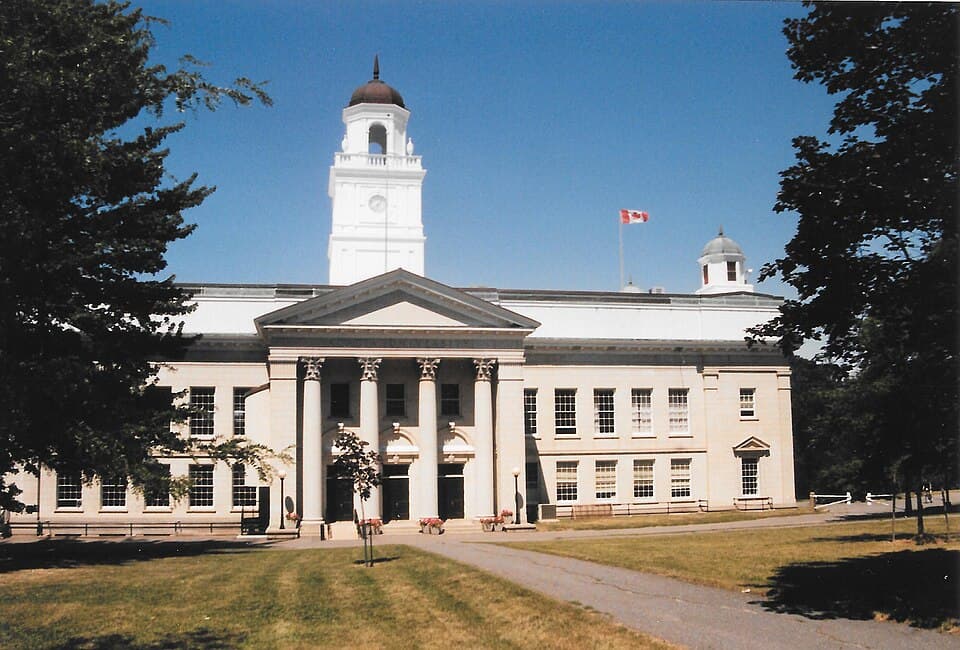

Acadia University
Wolfville, Nova Scotia
Compare Acadia University programs, admissions, costs, residence, student support, and career pathways in one source-reviewed guide. Jump to the decision section you need below.
The short answer
- Acadia University is in Wolfville, Nova Scotia. It offers more than 200 degree combinations.
- Apply straight to Acadia, not through OUAC (the Ontario Universities' Application Centre, Ontario's university application site).
- The application costs $40 CDN. You can apply any time after September 21.
- Scholarship forms are due March 1. Nursing (BScN) closes February 28 for every Fall intake.
- Ontario students need 70% overall in ENG4U plus four more Grade 12 U/M courses (university or university/college preparation courses).
Reviewed August 15, 2026 · Official university sources · How we review guides
Save this to your free account
Track Acadia University with a checklist for how you apply. Free account. Add your dates in the tracker to request reminder emails; unsubscribe any time.
Free account. No card needed.
Overview
Entity answer
A primarily undergraduate university in Wolfville, Nova Scotia
Acadia University has more than 200 degree combinations. These are in Arts, Pure and Applied Sciences, Professional Studies, and Theology. Most undergraduate degrees take four years. The small campus gives you access to honours, research, residence, and paid co-op in eligible disciplines.
70%
Published general admission minimum
75%
Published Biology and Kinesiology minimum
200+
Degree combinations across four faculties
Fall 2027 final admission dates are not yet published
Acadia's live process says you can apply any time after September 21st. Scholarship forms are due March 1. But it does not name a separate final Fall 2027 undergraduate deadline. Nursing is the one exception. The BScN closes February 28 for every Fall intake. Treat the live portal and program availability as the authority.
Fall 2027 cycle status
2027 pending · Fall 2027
Acadia does not publish a single final undergraduate application deadline. Its live process says you can apply any time after September 21st. It also says you must apply by March 1st to be considered for an entrance scholarship. The only dated Fall 2027 items Acadia currently publishes are in Nursing. These are a February 28 deadline for all BScN entry points and a described Fall 2027 program format.
September 21 and March 1 recur annually rather than being labelled for a specific entry year. Treat them as planning dates and re-check the applicant portal before the Fall 2027 cycle opens.
Applies to: All applicants
Acadia University: Canadian undergraduate admission requirements and application window · Verified August 15, 2026
Acadia runs its own application, not OUAC
Current process · Published for this period
Ontario applicants apply directly to Acadia rather than through OUAC (Ontario's university application site). The application takes about 15 minutes. It costs $40 CDN, paid online by credit card. It needs an uploaded unofficial transcript of Grade 11 results and current Grade 12 results. Once all required documents are in, Acadia makes an admission decision within 3 to 4 business days. The exceptions are Education, Music, and Nursing, which add a departmental assessment and may have their own offer release dates.
Applies to: All applicants
Acadia University: After you apply: decisions, offers, deposits, and scholarship timing · Verified August 15, 2026
Size and primarily undergraduate identity
2022 enrolment, latest available · Latest published information; newer cycle not yet confirmed
Acadia's own fast facts report 2022 full-time enrolment of 3,612 undergraduate and 176 graduate students. They report a 1:15 faculty-to-student ratio and an average class size of 31. They also report a 250-acre (100-hectare) campus and more than 200 degree combinations across four faculties. Acadia was founded in 1838.
Acadia labels the enrolment and first-year origin figures 2022. The same page separately cites 3,400+ applications and an 86% average entering grade for the Class of 2021. Do not present either as a current-year admission average.
Applies to: All applicants
Acadia University: Acadia at a glance: enrolment, ratio, class size, athletics, campus · Verified August 15, 2026
Wolfville and the Annapolis Valley
Current campus context · Published for this period
Acadia says it is an integral part of Wolfville, a college town. Wolfville is a one-hour drive from Halifax and its international airport. It looks over the Annapolis Valley and the Bay of Fundy. The campus sits in Mi'kma'ki, the ancestral and unceded territory of the Mi'kmaw nation.
Applies to: All applicants
Acadia University: Acadia at a glance: enrolment, ratio, class size, athletics, campus · Verified August 15, 2026
Official overview sources
Detailed application guides
Admissions Planning
Acadia University Ontario requirements and Fall 2027 timing
The 70% general average is an eligibility floor. It is not a guaranteed offer. Match the exact program before you choose Grade 12 courses. Biology and Kinesiology use a 75% minimum. Business, Computer Science, and Applied Science name specific English, mathematics, or science marks.
| Ontario program route | Published Grade 12 pattern |
|---|---|
| Arts and most general-entry programs | Minimum 70% overall in ENG4U plus four additional Grade 12 U/M courses. Program prerequisites can replace part of the general course pattern. |
| Business Administration | Minimum 70% overall, ENG4U with at least 70%, and either MDM4U or MHF4U. |
| Computer Science | Minimum 70% overall, ENG4U, and MHF4U with at least 60%. Applicants presenting only MDM4U must complete Acadia's MATH 1003 Precalculus in first semester. |
| Biology | Minimum 75% overall, ENG4U, MDM4U or MHF4U, and SCH4U with at least 60%. Add two other eligible Grade 12 U/M courses. |
| Kinesiology | Minimum 75% overall, ENG4U, and either MDM4U or MHF4U. SPH4U is encouraged but not required for admission. |
| Applied Science / Engineering pathway | Minimum 70% overall, ENG4U, MHF4U with at least 60%, and SCH4U with at least 60%. SPH4U is recommended. |
| Nutrition and Dietetics | Minimum 70% overall, ENG4U, MDM4U or MHF4U, and SCH4U with at least 60%, plus the remaining eligible Grade 12 U/M courses. |
| Nursing (BScN, out-of-Nova-Scotia direct entry) | English 12 and academic Math 12 are required. You also need two of Biology, Chemistry, or Physics. You need one more academic Grade 12 course. No grade may be below 70%. Applications close February 28. Limited seating means the BScN is open only to Canadian citizens and permanent residents. |
Fall 2027 final admission deadline
Not separately published
Acadia's live undergraduate process does not publish a final Fall 2027 deadline of its own. Apply early. Program availability can change.
Application opening benchmark
After September 21
The live Canadian and international application pages say applicants may apply any time after September 21st. Check the portal before relying on this for the 2027 cycle.
Entrance scholarship consideration
March 1
Apply for admission, submit required documents, and complete the scholarship forms in the applicant portal by March 1. The Arthur L. Irving Family Foundation environmental scholarships run on a later March 31 deadline.
Nursing (BScN) application deadline
February 28
The only hard undergraduate deadline Acadia publishes. February 28 applies to all three BScN entry points for every Fall intake, and Advanced Standing takes its last intake in September 2027.
Admission decision turnaround
3 to 4 business days
Once all required documents are received, Acadia decides within three to four business days. Education, Music, and Nursing add a departmental assessment and may have their own offer release dates.
Application and decisions
The undergraduate application fee is $40. Acadia says complete applications are usually decided in three to four business days. Education, Music, and Nursing have more review by the department.
International English minimums
Current examples include IELTS 6.5 with no band below 6.0, CAEL 70, PTE 61, or Duolingo 115, each with Acadia's stated subscore floors. TOEFL moved to a 4.5 overall minimum for exams taken on or after January 21, 2026. Three years of English-medium study may support a waiver.
Ontario academic base
Current requirements · Published for this period
Acadia's Ontario guideline is a minimum overall average of 70%. You also need Grade 12 university-level English (ENG4U). You need four more Grade 12 U- or M-level courses. These courses must come from Acadia's published accepted-courses list. The 70% floor is an eligibility minimum. It is not a guaranteed offer.
Applies to: Ontario high school
Acadia University: Canadian undergraduate admission requirements and application window · Verified August 15, 2026
Published program minimums above the 70% floor
Current requirements · Published for this period
Biology and Kinesiology require a minimum overall average of 75%. Business Administration requires ENG4U with a minimum 70% plus MDM4U or MHF4U. Computer Science requires MHF4U with a minimum 60%; an applicant presenting only MDM4U must pass Mathematics 1003 Precalculus in the first semester. Applied Science (the engineering route) requires MHF4U and SCH4U at 60% each with SPH4U recommended. Applied Bioscience, Nutrition and Dietetics, Environmental Science, Environmental Geoscience, Geology, and Chemistry each require MDM4U or MHF4U plus SCH4U at a minimum 60%.
Applies to: Ontario high school
Acadia University: Canadian undergraduate admission requirements and application window · Verified August 15, 2026
Application window, fee, and transcript sequence
Current process · Published for this period
Applications open after September 21st each year with a $40 CDN processing fee. Acadia first reviews an uploaded unofficial transcript and advises admissibility, then requires the official final high-school transcript to be arranged at the end of June to the Admissions Office, 15 University Avenue, P.O. Box 7, Wolfville, NS B4P 2R6. The admission average must hold in the official final results or the offer may be withdrawn.
Applies to: All applicants
Acadia University: Canadian undergraduate admission requirements and application window · Verified August 15, 2026
Nursing is the one program with a hard published deadline
Fall 2027 and recurring · Published for this period
The BScN application deadline is February 28 of each year. This applies to all three entry points and all Fall (September) intakes. Out-of-Nova-Scotia Direct Entry requires English 12 and academic Math 12. It also requires two of Biology, Chemistry, or Physics. It requires one further academic Grade 12 course. No grade may be below 70%. An Early Admission route uses Grade 11 results. You need a minimum 85% in each required course. Seating is limited. So the BScN is open only to Canadian citizens and permanent residents. Preference goes to Nova Scotia residents. Roughly 50% of seats are designated for African Nova Scotian or L'nu Indigenous students.
International applicants without permanent residence cannot apply to Acadia's BScN — plan a different program or a different university if nursing is the goal.
Applies to: All applicants
Acadia University: BScN pathways, CBU delivery agreement, and February 28 deadline · Verified August 15, 2026
English-language evidence
Current requirements · Published for this period
Acadia's published minimums are listed here. IELTS is 6.5 with no subtest below 6.0. CAEL or CAEL Online is 70 with no subtest below 60. PTE Academic is 61 with no subtest below 60. Duolingo English Test is 115 with no subscore below 90. LanguageCert Academic is 70 to 74 overall with no skill under 65. Oxford Test of English Advanced is 135. Cambridge C1 Advanced is 180 or above with no subtest below 173. Cambridge B2 First Pass A is at 180 with no subtest below 173. TOEFL is 90 iBT with no subtest below 20 for exams taken before January 21, 2026. For exams on or after that date, TOEFL is a minimum 4.5 overall with no score below 4.5. Acadia's institution code is 0901. Three years of study in an English medium of instruction may waive the requirement.
Applies to: International
Acadia University: International undergraduate requirements and English proficiency table · Verified August 15, 2026
Conditional-admission English pathway
2027 pending · Fall 2027
Not currently published. Acadia's international requirements page lists test minimums and a three-year English-medium waiver. It names no English for Academic Purposes, bridging, or conditional-admission language pathway. The English Language Centre address elc.acadiau.ca now redirects to Acadia's homepage. The EAP program pages return HTTP 404.
Do not plan on an Acadia language pathway. Email admissions@acadiau.ca in writing. Confirm whether any conditional language admission still exists. Do this before you commit to a Fall 2027 application without a qualifying test score.
Applies to: International
Acadia University: International undergraduate requirements and English proficiency table · Verified August 15, 2026
IB, CEGEP, and transfer routes
Current requirements · Published for this period
The IB Diploma including IB English is accepted with an overall score of 24 or better, final or predicted, for both early and regular admission and for scholarship consideration; a score of 30 or higher earns 30 hours of university credit. One year of CEGEP is treated as equivalent to Nova Scotia Grade 12, and a completed two-year DEC at 70% admits to second year. Transfer courses need a minimum grade of C-; most programs require a 2.0 GPA, while Applied Bioscience, Biology, Business Administration, Computer Science, Environmental Science, Kinesiology, Psychology, Nutrition, Community Development, and Applied Science (Engineering) require 2.5.
Applies to: International, Other Canadian, Transfer, Mature
Acadia University: Canadian undergraduate admission requirements and application window · Verified August 15, 2026
Programs and Pathways
Computer Science, Business, Science, Kinesiology, and Engineering
Program structure matters at Acadia. Some routes are completed entirely in Wolfville. Some offer honours or co-op. The professional Engineering route begins with Acadia's Applied Science certificate. Then it continues to Dalhousie.
Computer Science
CIPS-accredited Bachelor of Computer Science routes include honours and applied options, with project-based study and an eligible co-op pathway.
Business Administration
The BBA includes majors such as Accounting, Business Technology Management, Employment Relations, Entrepreneurship and Innovation, Finance, and Marketing. The degree is eligible for co-op.
Biology, environmental fields, and nutrition
Acadia offers science and honours routes across Biology, Environmental Science, Environmental Geoscience, Geology, Nutrition, Chemistry, Physics, Mathematics, and Psychology. Environmental Science is accredited by ECO Canada. The School of Nutrition and Dietetics runs Consumer Food, Kinesiology, and Dietetics streams. A 48-week accredited practicum is offered with Nova Scotia Health.
Kinesiology
The CCUPEKA-accredited Kinesiology degree combines movement science, health, laboratory work, and options. The options include Exercise Science and Training, Athletic Therapy, Psychology, Biology, or Nutrition. Note that Kinesiology is not on Acadia's co-op list.
Applied Science and Engineering
The two-year Certificate of Applied Science has 23 courses. It covers the first half of the Dalhousie BEng route. Successful certificate completion guarantees entry to third-year Engineering at Dalhousie. This is under an agreement Acadia dates almost to the school's 1904 founding. The separate three-year Bachelor of Applied Science has 30 courses. It is an Acadia-only degree. It does not by itself qualify a graduate for professional-engineer registration.
Nursing (BScN)
Acadia teaches Cape Breton University's BScN curriculum on-site. This is under a 2023 agreement. Acadia is working toward a standalone Acadia BScN. There are three entry points. Direct Entry is 3-year and 8-semester. Advanced Standing is 2-year and 6-semester, with the last intake September 2027. There is also an LPN to BScN pathway. All of them close February 28. They are open only to Canadian citizens and permanent residents.
Compare Canadian Computer Science programs
Compare Acadia's smaller CIPS-accredited environment and co-op route with larger Canadian CS programs.
Compare Canadian Engineering pathways
Distinguish Acadia's certificate-to-Dalhousie path from direct entry to a four-year accredited BEng.
Four faculties, small undergraduate scale
Current structure · Published for this period
Acadia's undergraduate offerings sit in the Faculty of Arts, the Faculty of Pure and Applied Science, the Faculty of Professional Studies, and Theology, together carrying more than 200 degree combinations. Professional Studies holds Business Administration, Community Development, Education, Kinesiology, Music, and Nursing; Pure and Applied Science holds Applied Bioscience, Biology, Chemistry, Computer Science, Engineering, Environmental Geoscience, Environmental Science, Geology, Mathematics and Statistics, Mathematics Education, Nutrition and Dietetics, Physics, and Psychology.
Applies to: All applicants
Acadia University: Undergraduate and graduate program directory by faculty · Verified August 15, 2026
Engineering is a transfer pathway, not a four-year Acadia BEng
Current program · Published for this period
The Ivan Curry School of Engineering offers a two-year Certificate of Applied Science. It has 23 courses. It makes up the first half of Dalhousie's accredited Bachelor of Engineering. The school also offers a three-year Bachelor of Applied Science with 30 courses. It is completed entirely at Acadia. Acadia states admission to third year at Dalhousie is guaranteed on successful completion of the certificate. This is under an agreement going back almost to the school's founding in 1904. Acadia states the BASc on its own does not qualify a graduate for registration as a professional engineer. Dalhousie disciplines available are Chemical, Civil, Computer, Environmental, Electrical, Industrial, and Mechanical.
Applies to: All applicants
Acadia University: Certificate of Applied Science and BASc outline (Dalhousie agreement) · Verified August 15, 2026
Jodrey School of Computer Science
Current program · Published for this period
Acadia states its computer science programs are accredited by the Canadian Information Technology Professionals Society (CIPS). The school offers a Bachelor of Computer Science. It also offers a BCS with Honours, a Bachelor of Applied Computer Science, a BSc with Honours in Computer Science, and an MSc. Applied Computer Science options cover software development, game development, data analytics, mobile and ubiquitous computing, a second major, or interdisciplinary study. No prior programming experience is required to start.
Applies to: All applicants
Acadia University: Jodrey School of Computer Science programs and CIPS accreditation · Verified August 15, 2026
Kinesiology and its accreditation
Current program · Published for this period
Acadia's Kinesiology degree is accredited by the Canadian Council of University Physical Education and Kinesiology Administrators (CCUPEKA). Students can apply to specialized options in Exercise Science and Training, Athletic Therapy, Psychology, Biology, or Nutrition. Within the degree, students can focus on Health Promotion, Wellness and Health Behaviour Change, Adapted Physical Activity, or Teaching, Leadership and Coaching. First year includes anatomy, applied human biology, research methods, and care and prevention of athletic injuries.
Applies to: All applicants
Acadia University: Kinesiology program, CCUPEKA accreditation, and specialized options · Verified August 15, 2026
School of Nutrition and Dietetics
Current program · Published for this period
Acadia offers a BSc in Nutrition and a BSc with Honours. Biology, Chemistry, or Psychology are available as a second major. Chemistry and Biology minors are built into the degree. Three streams exist: Consumer Food, Kinesiology, and Dietetics. Dietetics students are eligible to apply for Acadia's 48-week accredited practicum. It is offered in partnership with Nova Scotia Health. Nutrition is also one of the BSc disciplines that carries a co-op option.
Acadia says Dietetics students must apply for the practicum. It is not an automatic placement. Treat dietetic registration as a competitive second step.
Applies to: All applicants
Acadia University: School of Nutrition and Dietetics streams and accredited practicum · Verified August 15, 2026
Environmental Science and field-based study
Current program · Published for this period
Acadia offers BSc and BSc (Honours) programs in Environmental Science. ECO Canada accredits them. Acadia also offers a two-year research-based MSc. The degree uses biology, earth science, chemistry, and policy. It includes outdoor field schools, community projects, and named courses. The named courses are environmental impact assessment, legal issues, and climate change for environmental practitioners. Environmental Science, Environmental Geoscience, and Environmental and Sustainability Studies all have co-op options.
Applies to: All applicants
Acadia University: Environmental Science degrees and ECO Canada accreditation · Verified August 15, 2026
Nursing is delivered under a Cape Breton University agreement
Fall 2027 published format · Published for this period
Acadia states that in 2023 Cape Breton University agreed to offer its BScN program on-site at Acadia. CBU delivers the curriculum while Acadia works toward offering a standalone BScN. There are three entry points. They are Direct Entry (3-year, 8-semester), Advanced Standing (2-year, 6-semester, with the last intake in September 2027), and an LPN to BScN pathway. For students starting in Fall 2027 the first-year clinical course runs for three weeks in May after Winter exams. Years 2 and 3 are three-semester academic years ending in late July.
Acadia calls the degree-granting arrangement a transitional partnership. For a Fall 2027 start, confirm which institution will confer the degree before you accept an offer.
Applies to: All applicants
Acadia University: BScN pathways, CBU delivery agreement, and February 28 deadline · Verified August 15, 2026
Acadia University Residence Guarantee, Fees & Room Selection
Acadia residence guarantee, deposit, fees, and room selection
Acadia guarantees first-year students a residence room. Accept the admission offer. Activate the Acadia account. Submit the housing application. Pay the $50 one-time application fee and the $500 non-refundable room deposit. May room-selection times are assigned in the order completed applications and deposits are received.
Guaranteed
Published first-year residence commitment
$500
Non-refundable residence room deposit
$6,450+
Published 2026–27 room-price floor
$6,338+
Published 2026–27 residence meal-plan floor
Acadia separately states that international students are guaranteed on-campus residence throughout their studies. The published $2,000 annual international residence discount applies to students who start in Fall 2026. Do not assume it will be extended to Fall 2027. Wait until Acadia confirms the next cohort.
First-year residence guarantee and how to secure it
Current process · Published for this period
Acadia guarantees first-year students a room in residence. Here is the order. Accept the offer and pay the confirmation deposit. Activate the Acadia Network account, which can take up to 48 hours. Complete the residence application in the Student Residence Portal. Then pay a $50 CDN one-time application fee. Also pay a $500 CDN non-refundable room deposit. That deposit is applied to first-semester residence fees. Room-selection time slots in May are assigned in the order completed applications and deposits are received.
Applies to: All applicants
Acadia University: Apply to residence: first-year guarantee, deposits, and room selection · Verified August 15, 2026
Eleven residence buildings
2026–2027 · Published for this period
Acadia publishes 11 residence buildings ranging from high-rise to heritage and from basic double rooms to deluxe singles in suites, each staffed by residence assistants working with security for 24/7 campus safety. The 2026–2027 rate table names Chase Court, Chipman House, Dennis House, Eaton House, Crowell Tower, Seminary House, 55 University Ave, War Memorial House, Whitman House, Christofor Hall, and Roy Jodrey Hall. Student rooms are not co-ed, so doubles and suites are not mixed-gender.
Applies to: All applicants
Acadia University: 2026–2027 residence rates by building and room type · Verified August 15, 2026
2026–2027 room rates by building
2026–2027 · Latest published information; newer cycle not yet confirmed
These are the published 2026–2027 academic-year rates. Crowell Tower: double $6,450, single $7,460, deluxe single $8,455. Seminary House, 55 University Ave, and War Memorial House: doubles $7,335, singles $8,585, deluxe singles $9,600. The latter two also have premium singles $10,680. War Memorial also has a $7,625 deluxe double and a $9,500 single in suite. Chipman, Dennis, Eaton, Whitman, and Christofor: doubles $7,695, singles $8,975–$8,980, deluxe singles $10,085. Singles in suite are $10,540–$10,545 in Chase Court, Dennis, Whitman, and Roy Jodrey. Chase Court single is $8,980 and Roy Jodrey single is $10,085. A $50 residence campus program fee also applies. A single-semester stay is billed at half the listed fee.
Acadia states residence fees are subject to change; use these as the labelled 2026–2027 baseline rather than a Fall 2027 quote.
Applies to: All applicants
Acadia University: 2026–2027 residence rates by building and room type · Verified August 15, 2026
Meal plans are mandatory for everyone living on campus
2026–2027 · Latest published information; newer cycle not yet confirmed
Acadia states that everyone who lives on campus is required to have a meal plan, all served through Wheelock Dining Hall with Chartwells as the dining partner. Published options are the 7 Day Max Plan $7,092.00 with $650 flex dollars, the 7 Day Plus Plan $6,837.00 with $325 flex dollars, the 7 Day Plan $6,504.00, and the 5 Day Plan $6,338.00 covering Sunday-to-Thursday or Monday-to-Friday dining. All prices are listed with no tax.
The dining page does not print an academic year, but the 2026–2027 fee page quotes the same $6,338.00 residence meal-plan floor. Re-check both pages before budgeting a later year.
Applies to: All applicants
Acadia University: Eating on campus: residence meal plan options and prices · Verified August 15, 2026
International residence guarantee and discount
Fall 2026 entry · Latest published information; newer cycle not yet confirmed
Acadia guarantees all international students a spot in on-campus residence for the duration of their studies. International students starting at Acadia in Fall 2026 receive a $2,000 CAD residence discount each year for up to four years. Acadia describes this as an average discount of 25% on accommodation over four years. The discount applies only to a campus residence room. It never applies to tuition or off-campus housing.
Applies to: International
Acadia University: International residence guarantee and Fall 2026 residence discount · Verified August 15, 2026
Fall 2027 residence rates and the international discount
2027 pending · Fall 2027
Not yet published. Acadia's live housing pages cover the 2026–2027 academic year, with room selection open until June 1, 2026 and unselected students assigned by preference after late July. The $2,000 international residence discount is written for students starting in Fall 2026 only.
Budget with the labelled 2026–2027 room and meal rates. Do not assume the international residence discount will be extended to the Fall 2027 cohort until Acadia republishes it.
Applies to: All applicants
Acadia University: International residence guarantee and Fall 2026 residence discount · Verified August 15, 2026
Tuition, Scholarships, and Aid
2026–27 tuition, residence costs, and entrance scholarships
Acadia's current full-course-load totals are useful planning benchmarks. But the final bill depends on your program, course load, residence choice, meal plan, insurance opt-out eligibility, and any future fee changes.
| 2026–27 category | Published amount | Planning note |
|---|---|---|
| Nova Scotia undergraduate | $10,921.14 | Tuition of $10,254.84 less a Nova Scotia Tuition Rebate of $641.50 per term, plus the listed student fees and health/dental plans. |
| Other Canadian undergraduate | $12,935.34 | Tuition of $10,986.04 plus $627.50 technology, $287.00 athletic and health, $250.00 campus renewal, $362.00 ASU, $247.80 health, $165.00 dental, and $10.00 Access fees. |
| International undergraduate | $28,466.86 | Tuition of $25,172.62 plus the same fee stack with the higher $1,592.74 international ASU health plan. |
| Residence room | From $6,450 | A Crowell Tower double is the floor; most published 2026–27 rooms fall between $7,335 and $8,980, and premium singles reach $10,680. |
| Residence meal plan | From $6,338 | Everyone living on campus must hold a plan: 5 Day $6,338.00, 7 Day $6,504.00, 7 Day Plus $6,837.00, and 7 Day Max $7,092.00. |
| Residence deposits | $50 + $500 | There is a one-time $50 residence application fee. There is also a $500 non-refundable room deposit. It applied to first-semester residence fees. |
Entrance scholarship planning
Canadian and international undergraduate applicants are considered automatically. Current initial offers range from $2,000 to $10,000 over four years. Other scholarships and scholar-bursaries can reach $80,000 over four years. The published scholarship threshold is 80%. It is calculated from final Grade 11 and first-semester Grade 12 required courses. Submit the required portal forms by March 1. The Arthur L. Irving Family Foundation environmental scholarships have a separate March 31 deadline.
2026–2027 domestic full-course-load fees
2026–2027 · Latest published information; newer cycle not yet confirmed
Nova Scotia students: tuition $10,254.84 less a Nova Scotia Tuition Rebate of $641.50 per term, for a published total of $10,921.14. Other Canadian students: tuition $10,986.04 for a published total of $12,935.34. Both totals add a $627.50 technology fee, $287.00 athletic and health fee, $250.00 campus renewal fee, $362.00 ASU fees, $247.80 ASU health plan, $165.00 ASU dental plan, and a $10.00 Acadia Access fee. Full load means 24–33 credit hours across the year; fees are due on the first day of classes, September 9, 2026 and January 11, 2027.
Acadia states the Board of Governors may change fees at any time and that the Academic Calendar governs any discrepancy with this page.
Applies to: Ontario high school, Other Canadian, Transfer, Mature
Acadia University: 2026–2027 full course load tuition and student fees · Verified August 15, 2026
2026–2027 international full-course-load fees
2026–2027 · Latest published information; newer cycle not yet confirmed
International undergraduates pay tuition of $25,172.62. They also pay these same fees: $627.50 technology, $287.00 athletic and health, $250.00 campus renewal, $362.00 ASU, $165.00 dental, and $10.00 Access. But they pay a higher $1,592.74 ASU health plan. The published total is $28,466.86. International medical coverage starts only after Student Accounts notifies the plan administrator. That is roughly a month after arrival. So budget to pay medical costs up front. Keep receipts for reimbursement.
Applies to: International
Acadia University: 2026–2027 full course load tuition and student fees · Verified August 15, 2026
2027–2028 tuition status
2027 pending · 2027–2028
Not yet published. The 2026–2027 schedule is the latest posted, and Acadia states the Board of Governors reserves the right to change fees at any time and that the Academic Calendar for the current year prevails over the fees page in any discrepancy.
Budget with the labelled 2026–2027 schedule and re-check the full-course-load fee page before treating any figure as a Fall 2027 quote.
Applies to: All applicants
Acadia University: 2026–2027 full course load tuition and student fees · Verified August 15, 2026
Automatic entrance scholarships and the scholarship average
Current awards · Published for this period
Canadian and international undergraduate applicants are automatically considered. Initial offers range from $2,000 to $10,000 over four years. Other scholarships and scholar-bursaries range up to $80,000 over four years. This is out of more than $8 million awarded annually. Eligibility needs at least an 80% average in the courses required for admission. This is calculated from final Grade 11 and first-semester Grade 12 required courses. The offer is maintained by holding 80% across the required Grade 12 courses. Applicants must be within five years of graduating high school. Transfer applicants need a 3.50 GPA or 80%. They also need no more than two years or 60 credit hours completed. The scholarship forms are due in the Status Portal by March 1.
Applies to: All applicants
Acadia University: Entrance scholarships, scholar-bursaries, and named awards · Verified August 15, 2026
Named awards with separate applications and deadlines
2026-27 awards, latest available · Latest published information; newer cycle not yet confirmed
The Harrison McCain Scholar-Bursary is $16,000 over four years ($4,000 per year, March 1, needs an 80% senior-year average and student-loan-qualifying need). The Arthur L. Irving Family Foundation scholarships in environmental study are $20,000 per year over four years with a March 31 deadline — later than the general March 1. The Edwin Borden Awards are $3,500 annually for an entering Black Nova Scotian student, one award in 2026-27, renewable up to four years. The Raymond E. Ivany Merit Award is $5,000 and requires a 500-word essay. The Spicer-Hennessey Scholar-Bursary is valued at full tuition plus a complimentary base-category residence room for Nova Scotia-born students entering business or named science disciplines with an 85% entering average.
The Ivany award page currently prints a March 1st, 2026 deadline. The Edwin Borden entry names the 2026-27 year. Re-check each award page for the Fall 2027 cycle. Do not assume the same dates.
Applies to: All applicants
Acadia University: Entrance scholarships, scholar-bursaries, and named awards · Verified August 15, 2026
When scholarship decisions arrive
Official-source conflict · Current process
Acadia's own pages disagree. The after-you-apply page says all additional scholarships will be awarded by mid-March. The future-students page says a successful recipient receives the award package in mid-March. The Canadian and international application pages both say that if you are selected to receive an entrance scholarship Acadia will notify you by mid-April.
Plan for mid-April. Then a later decision does not break an accept-by date elsewhere. Ask Financial Aid in writing if a competing offer forces a March commitment.
Applies to: All applicants
Acadia University: After you apply: decisions, offers, deposits, and scholarship timing · Verified August 15, 2026
Official cost and award sources
Student Life and Support
Wolfville campus fit, close faculty access, and first-year transition
Acadia offers a residential campus in a small town. It has four faculties and covers many subjects. You can compare its close community and professor access with the limits of a smaller city. These limits include travel options, off-campus rental supply, specialized course frequency, and the employer mix for your program.
Academic fit
Check the honours, research, laboratory, studio, field, or professional-study options inside the exact degree.
Community fit
Residence, clubs, and athletics can make first-year integration easier. A walkable Wolfville setting can also help. This is for students who want a close campus.
Support fit
Compare academic advising, accessibility, health, international, writing, and career support before accepting.
Location fit
Budget travel to and from Nova Scotia. Check whether a small-town environment supports the student's academic and social goals.
How many clubs and societies Acadia has
Official-source conflict · Current campus life
Acadia's clubs and societies page says it offers over 80 clubs and societies. They are grouped into academic, athletic, and social categories. Students can apply to create their own for funding and space-booking benefits. Acadia's own fast-facts page instead lists 70+ student-run opportunities.
Two first-party pages publish different counts. Treat the figure as roughly 70–80 and confirm a specific club is active through the Acadia Students' Union before planning around it.
Applies to: All applicants
Acadia University: Clubs and societies: categories and examples · Verified August 15, 2026
Axemen and Axewomen varsity athletics
Current, university-published counts · Published for this period
Acadia lists 9 varsity teams and 15 athletic clubs. They compete in U SPORTS and Atlantic University Sport. The school has 10 national championship and 110 AUS/regional titles. Its varsity tradition dates to 1875. Axemen teams are basketball, football, hockey, and soccer. Axewomen teams are basketball, cross-country, rugby, soccer, and volleyball. Facilities include a double gymnasium, an Olympic-sized ice rink, a multi-sport turf field with all-weather track, a high performance centre, and an athletic therapy clinic. Acadia says it has averaged 113 Academic All-Canadians per year over the last decade.
There is no varsity women's hockey team. Women's hockey and baseball appear on Acadia's athletic-club list, not the varsity list.
Applies to: All applicants
Acadia University: Acadia at a glance: enrolment, ratio, class size, athletics, campus · Verified August 15, 2026
Intramurals and recreation
Current campus life · Published for this period
Acadia Athletics, the Alumni Association, and Residence and Student Life run a weekly intramural schedule. It includes flag football, soccer, kickball, run club, dodgeball, futsal, and late-night basketball drop-ins and leagues. It also includes Friday-to-Sunday one-night tournaments and fitness events.
Applies to: All applicants
Acadia University: Intramurals and recreation schedule · Verified August 15, 2026
The honest small-town trade-off
Current published estimates · Published for this period
Acadia says most students live within 2 kilometres of campus. Nearby rental communities such as Kentville, New Minas, and Coldbrook have limited transit service. So many students who live outside Wolfville rely on a car. Kings Transit costs $2.25 per ride, $20 for ten tickets, or $65 for a monthly pass. Wolfville does not permit street parking from December through March. There is no public overnight parking except some on-street areas from April 1 to November 30. Acadia's published estimates put electricity and heat at $100–150 a month and high-speed internet at $80–110.
Applies to: All applicants
Acadia University: Living in Wolfville: transit, parking, utilities, and nearby towns · Verified August 15, 2026
Acadia Students' Union fees and opt-out
2026–2027 · Latest published information; newer cycle not yet confirmed
Every full-load undergraduate is billed $362.00 in ASU fees. They are billed $247.80 for the ASU health plan. International students are billed $1,592.74. They are billed $165.00 for the ASU dental plan and a $10.00 Acadia Access fee. At the start of the first term each year, students can opt out of medical and dental insurance through the Acadia Students' Union. Listed prices cover a single person. Dependants are arranged separately before the last business day of the month the academic year begins.
Applies to: All applicants
Acadia University: 2026–2027 full course load tuition and student fees · Verified August 15, 2026
Wong International Centre
Current services · Published for this period
The Wong International Centre supports students from over 50 countries. It gives non-academic advising on immigration and study permits, personal matters and mental health, advocacy, settlement, and food insecurity. It offers wifi, a chill room, and a kitchen. It was launched in 1997 with support from Gene D. Wong ('49), Acadia's first graduate of Chinese descent. The Centre explicitly does not advise on academic topics such as registration or fees.
Applies to: International
Acadia University: Wong International Centre advising and support · Verified August 15, 2026
Acadia University Co-op Programs, Eligibility & Work Terms
Acadia co-op degrees, eligibility, work terms, and hiring
Co-op is optional and program-specific. It is not automatic for every Acadia degree. Eligible undergraduate BA, BBA, Community Development, Computer Science, and BSc students normally apply after completing 24 to 75 credit hours. They need a minimum 2.5 cumulative GPA.
3 work terms
Three four-month terms for the undergraduate co-op designation
12 or 16 months
An approved long internship can satisfy the work-term structure
Paid and related
A work term must be full-time, paid, discipline-related, and at least 12 weeks
No job guarantee
Students compete for posted roles or secure an approved position themselves
Acadia's co-op portal contains university-sourced postings after required preparation and resume approval. A self-found role must be approved by the coordinator. It must also be documented by an employer offer. Completing fewer than the required work terms still permits degree graduation. But you do not get the Co-op Option designation.
Which degrees carry co-op
Current program · Published for this period
Co-op is available in the Bachelor of Arts in Economics, English, Environmental and Sustainability Studies, French, German, History, Law and Society, Politics, Psychology, Sociology, Spanish, and Women's and Gender Studies; the Bachelor of Business Administration across Accounting, Business Technology Management, Employment Relations, Entrepreneurship and Innovation, Finance, and Marketing; the Bachelor of Community Development; the Bachelor of Computer Science; and the Bachelor of Science in Biology, Chemistry, Economics, Environmental Geoscience, Environmental Science, Geology, Mathematics and Statistics, Nutrition, Physics, and Psychology. Graduate co-op exists in the MSc in Computer Science and the MSc in Applied Mathematics and Statistics.
Kinesiology, Nursing, Music, and Education are not on Acadia's co-op list. Do not assume co-op is available in every Acadia degree.
Applies to: All applicants
Acadia University: Degrees with co-op · Verified August 15, 2026
Co-op is an in-program application, not a direct-entry stream
Current program · Published for this period
Students must have a minimum cumulative GPA of 2.5. They must have completed between 24 and 75 credit hours at the time of application. Undergraduates usually apply at the start of second year. They may apply at the start of third year if they have not passed 75 credit hours. Acadia encourages second-year entry because it allows more scheduling options. Graduate students apply in September of their first year.
Applies to: All applicants
Acadia University: Co-op general information: eligibility, credit, and entrepreneurial co-op · Verified August 15, 2026
Work-term structure and hiring rules
Current program · Published for this period
The undergraduate Co-op Option requires three 4-month work terms or a 12- or 16-month internship. The MSc in Computer Science requires two, and the MSc in Mathematics requires one. Work terms are 4 or 8 months. They must run at least 12 weeks and provide at least 35 hours of work per week. An 8-month term counts as two 4-month terms with two sets of assignments. Terms start in Fall (September/October), Winter (January/February), or Intersession (May/June). Postings appear on the Co-op Portal about four months ahead. A self-found position must be approved by the coordinator. It must be backed by an employer offer letter and be full-time, paid, and related to the degree.
Applies to: All applicants
Acadia University: Co-op work-term rules, hiring, and start periods · Verified August 15, 2026
Credit, entrepreneurial co-op, and what happens if you fall short
Current program · Published for this period
Each work term is an academic course graded Pass or Fail on the transcript. Undergraduates earn two credit hours per co-op course up to a maximum of six. These count as two electives. A 12- or 16-month internship earns six credit hours. Graduate students earn no credit toward graduation. Students who secure only two of three required work terms still graduate, but without the Co-op Option. Entrepreneurial Co-op lets a student run their own venture for a work term. They must first complete one regular work term and BUSI 2773. They must also have a minimum three-page proposal approved by the coordinator.
Applies to: All applicants
Acadia University: Co-op general information: eligibility, credit, and entrepreneurial co-op · Verified August 15, 2026
Co-op fees
2026–2027 · Latest published information; newer cycle not yet confirmed
Acceptance into the co-op program applies a non-refundable $150.00 fee to the student account. Each work term is treated as a course carrying tuition. That tuition is owed even when the student finds the position themselves. Acadia's 2026–2027 schedule shows graduate Computer Science and Mathematics and Statistics co-op students paying a co-op fee instead of tuition for work-term semesters. The fee is $1,062.68 for Nova Scotia students, $1,105.30 for other Canadians, and $2,505.01 for international students.
Acadia's co-op FAQ does not publish an undergraduate per-work-term amount; it points to the financial services fee schedule. Confirm the undergraduate work-term charge with Student Accounts before budgeting.
Applies to: All applicants
Acadia University: Co-op fees FAQ · Verified August 15, 2026
Acadia University applicants need to tell apart the 70% general minimum from 75% and prerequisite-specific program rules. Treat the live September 16 and March 1 dates as process guidance. Do not treat them as an invented final Fall 2027 deadline. You also need to understand the Acadia-to-Dalhousie Engineering pathway. Compare current tuition, scholarships, residence guarantees, and optional co-op. This guide keeps those decisions on one canonical page backed by official sources.
Acadia University requirements, deadlines, programs, tuition, scholarships, residence, and co-op questions
Direct answers to Acadia University's Ontario prerequisites, 70% and 75% minimums, Fall 2027 deadline status, Business, Computer Science and Engineering pathways, 2026–27 tuition, entrance scholarships, residence guarantee, English tests, and co-op rules.
Official Sources and Next Steps
Stellar keeps this guide structured so you can compare. But official university pages remain the source of truth. They are the source of truth for program requirements, tuition, residence, scholarships, deadlines, and policy changes.
Prepared by Stellar Advisers Editorial Team · Reviewed August 15, 2026 · Editorial, corrections, and source methodology
Related Canadian universities
Compare 3 other Nova Scotia records, then continue through the national directory.