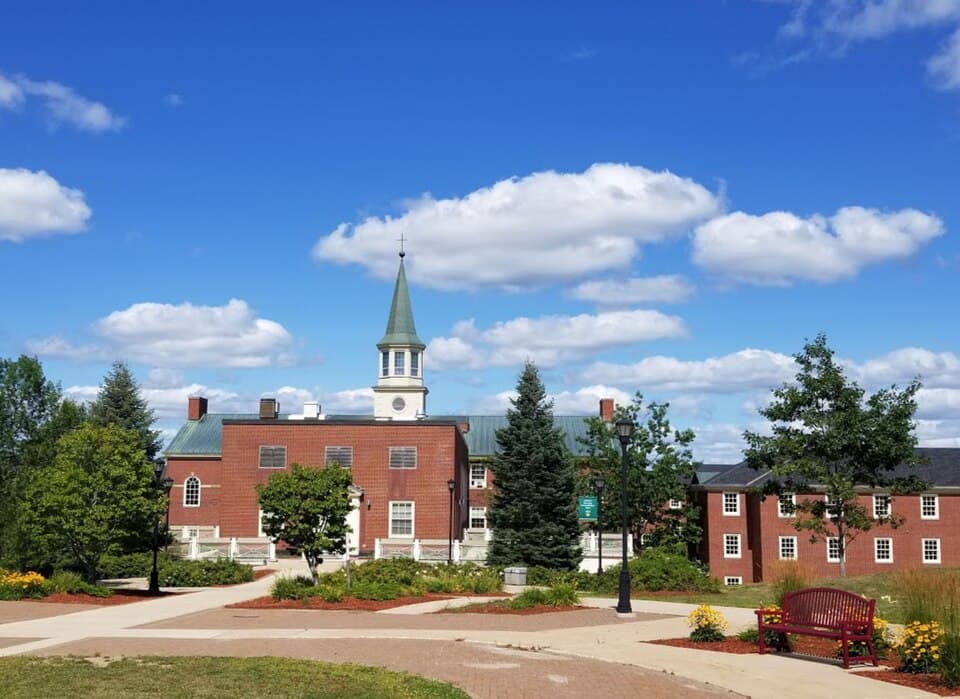

St. Thomas University
Fredericton, New Brunswick
Compare St. Thomas University programs, admissions, costs, residence, student support, and career pathways in one source-reviewed guide. Jump to the decision section you need below.
The short answer
- Apply by August 31, 2027 for the Bachelor of Arts at St. Thomas University in Fredericton, New Brunswick.
- Ontario students need English 4U (a Grade 12 university-prep course) plus four approved Grade 12 academic electives, with a 70% average.
- The application fee is $55, or $40 for New Brunswick applicants, and there is no OUAC (Ontario's university application site) step.
- Tuition for 2026–2027 is $9,224 for Canadian students and $21,135 for international students in the Bachelor of Arts.
- Residence for 2026–2027 costs $6,340 to $11,159 by building and room type. The meal plan is $5,996.
Reviewed August 15, 2026 · Official university sources · How we review guides
Save this to your free account
Track St. Thomas University with a checklist for how you apply. Free account. Add your dates in the tracker to request reminder emails; unsubscribe any time.
Free account. No card needed.
Overview
Direct planning answer
A small Fredericton liberal-arts university with a direct BA route
St. Thomas University in Fredericton, New Brunswick centres its undergraduate experience on the Bachelor of Arts. Ontario applicants need English 4U plus four approved academic electives with a minimum 70% five-course average. The page now separates that direct route from joint Applied Arts, advanced-entry Social Work, and post-degree Education.
What STU is
STU says it is a primarily undergraduate university. It is dedicated to community and excellence in liberal arts education. It sits on the University of New Brunswick's Fredericton campus under a 1963 agreement. But it grants its own degrees and controls its own admissions and curriculum.
What STU is not
It is not St. Thomas More College in Saskatchewan, it is not part of UNB, and it has no direct-entry science, engineering, business, or nursing degree. Social Work and Education are also closed to high-school applicants.
Fall 2027 cycle status
Fall 2027 · Published for this period
Published. STU's application-steps page carries a heading for "Admission for September 2027" with named deadlines: Bachelor of Arts August 31, 2027, Bachelor of Applied Arts February 15, 2027, Bachelor of Education December 1, 2026, Master of Social Work January 30, 2027, and Bachelor of Social Work January 31, 2027. The same page notes that admission for September 2026 remains open until August 31, 2026.
STU admits directly rather than through OUAC, so there is no province-wide Ontario deadline to reconcile. Costs, awards, and residence dates are still published only for 2026–2027.
Applies to: All applicants
St. Thomas University: Application steps and September 2027 admission deadlines · Verified August 15, 2026
Liberal arts is the institution, not a faculty
Current institutional positioning · Published for this period
STU describes itself as "a primarily undergraduate university dedicated to community and excellence in liberal arts education" located in Fredericton, New Brunswick, and states that "our small size is the reason we are able to give each student a big experience." Its mission language centres teaching and learning, a humanistic approach, and experiential education rather than a portfolio of professional faculties.
There is no direct-entry engineering, business, nursing, or science degree at STU. If a student needs one, STU is the wrong shortlist entry regardless of average.
Applies to: All applicants
St. Thomas University: About STU: mission, liberal arts identity, and size framing · Verified August 15, 2026
Size and campus footprint
University-published history page · Latest published information; newer cycle not yet confirmed
STU's history page reports growth from fewer than 500 students, 22 faculty, and three buildings in 1964 to approximately 1,600 students, 90 full-time faculty, and 10 buildings. Academic and residential buildings named there include George Martin Hall, Harrington Hall, Holy Cross House, Vanier Hall, Edmund Casey Hall, Sir James Dunn Hall, the J.B. O'Keefe Fitness Centre, Brian Mulroney Hall, and Margaret Norrie McCain Hall.
These counts sit on a narrative history page with no stated census year. Treat them as scale indicators, not an audited annual enrolment report.
Applies to: All applicants
St. Thomas University: History of STU: UNB federation agreement, campus, and scale · Verified August 15, 2026
STU sits on the UNB Fredericton campus — and stays independent
Founding agreement, still in force · Published for this period
A 1962 New Brunswick royal commission recommended that STU enter a federation agreement with the University of New Brunswick. It also recommended that STU relocate onto UNB's campus. The 1963 agreement provides that STU continues to grant its own degrees in arts and education. It sets its own admission regulations. It also retains control of the content and administration of its curriculum. STU opened its Fredericton premises on September 2, 1964.
Adjacency is real and practical, not cosmetic: STU's own new-student FAQ locates the Campus Bookstore in the UNB Student Union Building at 21 Pacey Drive and lists "HIL — Harriet Irving Library" in its campus lingo.
Applies to: All applicants
St. Thomas University: History of STU: UNB federation agreement, campus, and scale · Verified August 15, 2026
Official university and program sources
Admissions Planning
St. Thomas University admission requirements for Ontario students
For the Bachelor of Arts, complete high school by the end of August. Present five approved academic courses: English 4U and four Grade 12 academic electives. STU publishes a 70% minimum across those five courses. STU warns that meeting the minimum does not guarantee admission.
Ontario academic minimum
Graduate high school by the end of August. You also need at least 70% across five successfully completed academic courses. These are English 4U and four approved Grade 12 academic electives. AP (Advanced Placement courses and exams), IB (the International Baccalaureate diploma), enriched, and French Immersion versions of those electives are acceptable substitutes.
Offer standard
The published 70% is a minimum requirement. It is not an admission guarantee. STU states plainly that fulfilling the minimum requirements does not guarantee admission.
Application
There is no OUAC step. Create a future-student account at STU.ca/signup, start a new application from STU.ca/myaccount, pay the fee, and arrange transcripts. Checklists update within 3–5 business days once documents arrive.
Application fee
According to the current application-steps page, most applicants pay $55. This fee is non-refundable. Applicants from New Brunswick pay $40.
International route
International applicants may use STU's application process or the Common Application. STU encourages submitting by June 1 for September entry. Embassy processing can take up to three months.
English evidence
For five regular academic courses: TOEFL iBT 89, IELTS 6.5, CAEL 60, Duolingo 115, PTE 62+, MELAB 80, or Cambridge C1/C2. Lower bands route to STU's ESL program. Scores must be sent by the testing centre; STU's ETS code is 0803.
Confirming an offer
Admitted BA and Applied Arts students reply in the applicant portal. They pay a $100 CAD admission confirmation deposit. This deposit is non-refundable. It is applied to tuition.
Published September 2027 deadlines
| Route | Deadline | Planning note |
|---|---|---|
| Bachelor of Arts | August 31, 2027 | STU's published September 2027 application deadline. |
| Bachelor of Applied Arts | February 15, 2027 | Joint STU and New Brunswick Community College route. |
| Bachelor of Social Work | January 31, 2027 | Advanced-entry professional program; not direct from high school. |
| Master of Social Work | January 30, 2027 | Graduate route restricted to applicants who already hold a degree. |
| Post-degree Bachelor of Education | December 1, 2026 | Requires a completed bachelor's degree or candidacy by May 15. |
| Entrance awards and bursaries | March 1 | Apply after receiving an offer and providing current transcripts. |
Deadline does not mean “wait”
August 31 is STU's current final BA deadline. It is not a recommended submission date. Apply earlier for transcript follow-up and scholarship consideration. Apply earlier for residence planning and course selection. Apply earlier for study-permit processing, if applicable. A completed application, fee, and supporting documents must arrive by the relevant deadline.
Ontario academic base for the Bachelor of Arts
Current requirements · Published for this period
You must graduate from high school by the end of August of the year you apply. You also need a minimum average of 70% on five successfully completed academic courses. One of these must be English 4U. The four remaining academic electives come from STU's published list. Where they exist, AP, IB, enriched, and French Immersion versions of those electives are acceptable substitutes. Other Grade 12 academic courses may be approved by the Admissions Office.
STU states plainly that "fulfilling these minimum requirements does not guarantee admission to the University." 70% is an eligibility floor, not an offer threshold.
Applies to: Ontario high school
St. Thomas University: Ontario high school admission requirements and approved electives · Verified August 15, 2026
Published September 2027 deadlines
Fall 2027 · Published for this period
Bachelor of Arts August 31, 2027; Bachelor of Applied Arts February 15, 2027; post-degree Bachelor of Education December 1, 2026; Master of Social Work January 30, 2027; Bachelor of Social Work January 31, 2027. STU states that a completed application, the application fee, and all supporting documents must be received by the Admissions Office by these deadlines.
August 31 is a final date, not a recommended one. Scholarship, residence, and study-permit timelines all run months earlier.
Applies to: All applicants
St. Thomas University: Application steps and September 2027 admission deadlines · Verified August 15, 2026
STU's own application and fee
Current process · Published for this period
There is no OUAC (Ontario's university application site) step. Applicants create a future-student account at STU.ca/signup. They start a new application from STU.ca/myaccount. They pay a $55 non-refundable application fee. This fee is $40 for applicants from New Brunswick. International applicants may instead apply through The Common Application. Canadian high school applicants upload a transcript to the applicant portal. Or they have the school email admissions@stu.ca. Checklists update within 3–5 business days once documents arrive.
Applies to: All applicants
St. Thomas University: Application steps and September 2027 admission deadlines · Verified August 15, 2026
Which STU degrees are closed to high school applicants
Current policy · Published for this period
The Bachelor of Arts is open to high school, transfer, returning, and adult-learner applicants. The Bachelor of Education requires a bachelor's degree from a recognized university. Or you must be a candidate for that degree by May 15 of the year of application. STU states there is no direct entry from high school. The Bachelor of Social Work requires at least 60 credit hours in liberal arts courses from a recognized university. Again, there is no direct entry from high school. The Master of Social Work is restricted to degree holders. Certificate programs carry special admission requirements. There is no direct high school entry.
Applies to: All applicants
St. Thomas University: Admission requirements by program and direct-entry limits · Verified August 15, 2026
English-language evidence
Current requirements · Published for this period
Applicants whose primary language is not English may present TOEFL, IELTS, MELAB, CAEL, Cambridge English Qualifications, the Duolingo English Test, or PTE Academic, sent directly by the testing centre; STU's ETS institution code is 0803. To take five regular academic courses the published scores are TOEFL iBT 89 (paper 573), MELAB 80, IELTS 6.5, CAEL 60, Cambridge C1 Advanced or C2 Proficiency, Duolingo 115, and PTE 62+. A lower band — TOEFL iBT 61, MELAB 69, IELTS 5.0, CAEL 40/50, Cambridge B2 First, Duolingo 90, PTE 50–61 — makes an academically admissible applicant eligible for the ESL program instead.
The score requirement may be waived for some applicants. You must graduate from a New Brunswick high school. You must have 70% or higher in English 122 or 121. STU reserves the right to reassess English on arrival. STU may require credit-bearing English Language Support courses.
Applies to: International
St. Thomas University: International admissions, English proficiency, and country criteria · Verified August 15, 2026
International application timing and academic comparability
Current guidance · Published for this period
International applicants must show academic strength. They must be in a college or university preparatory high school program. Their subject distribution and standing must be comparable to Canadian applicants. STU also weighs achievement and class rank. STU encourages applications and supporting documents by June 1 for September admission. For January admission, the date is October 1. Later applicants risk not enough time for study permits. Embassy processing can take up to three months.
June 1 is guidance, not the deadline — the published Bachelor of Arts deadline for September 2027 remains August 31, 2027. Applying to the guidance date is the safer plan.
Applies to: International
St. Thomas University: International admissions, English proficiency, and country criteria · Verified August 15, 2026
AP transfer-credit maximum is stated two different ways
Official-source conflict · Current requirements
Both pages agree on some transfer credit. AP grades of 4 or 5 earn transfer credit. Higher-level IB subject grades of 5, 6, or 7 earn transfer credit. GCE Advanced Level final grades of C or higher earn transfer credit. They disagree on the AP cap. The Canadian high school requirements page groups AP with IB diploma and GCE students. That page states a maximum of 30 credit hours on a 120 credit-hour degree. The international admissions page states AP students are eligible for a maximum of 18 credit hours. It reserves 30 for IB diploma and GCE Advanced Level students.
Do not plan a shortened degree on the 30-credit reading. Get the AP maximum confirmed in writing by admissions@stu.ca before declining a course or a year, and note STU's own advice to check with graduate and professional schools about how non-university credit affects later applications.
Applies to: Ontario high school, Other Canadian, International
St. Thomas University: Canadian high school requirements and AP/IB/GCE transfer credit · Verified August 15, 2026
Accepting an offer: the $100 confirmation deposit
Current process · Published for this period
Admitted Bachelor of Arts and Bachelor of Applied Arts students reply to the offer in the applicant portal. They pay a non-refundable $100 CAD admission confirmation deposit by credit card. This deposit is applied to tuition. The same next-steps sequence covers several items. These are submitting a residence preference profile, applying for scholarships and bursaries, and first-year course registration in the spring. They also cover sending final transcripts. They cover contacting Student Accessibility Services before June 30 where accommodations are needed.
The live next-steps page still shows the September 2026 intake's March 1, 2026 award deadline. So read its dates as last cycle's. Read its process as current.
Applies to: All applicants
St. Thomas University: Next steps for accepted students: deposit, residence, awards · Verified August 15, 2026
Official admission and application sources
Programs and Pathways
BA majors, Applied Arts, Social Work, Education, and Aviation
The direct high-school route is primarily the Bachelor of Arts. Do not treat every STU degree as first-year entry. Applied Arts is a joint technical-and-liberal-arts pathway. Social Work requires prior university credit. Education is post-degree.
Direct from high school
Bachelor of Arts
This is a four-year, 120 credit-hour liberal-arts degree. It has humanities and social-science majors, minors, honours options, interdisciplinary minors, and certificates. STU says the degree takes shape when students declare the major at the end of second year. Students may major in more than one subject.
First-year seminar within the BA
Aquinas: Great Books
A discussion-based first-year programme with no lectures. It links English, Political Science, and Philosophy under a team of collaborating professors. It leaves room for two more classes per semester. It grants first-year credit in all three subjects. The student is free to major in any discipline in second year.
Direct undergraduate route
Bachelor of Arts, Aviation Stream
Combines STU liberal-arts study with ground and flight training delivered with MFC Training. Flight-training costs make this materially more expensive than the standard BA.
Joint STU–NBCC route
Bachelor of Applied Arts
Applied Arts in Criminal Justice and Gerontology combine liberal-arts study with technical training. They normally lead to both an STU degree and an NBCC diploma.
Advanced entry
Bachelor of Social Work
Applicants first complete at least 60 credit hours of liberal-arts coursework at a recognized university. It is not a direct-entry high-school program.
Post-degree
Bachelor of Education
This is a 10-month teacher-education route. It is for applicants who hold a bachelor's degree or are completing one. It is not direct entry from high school.
Build the BA by subject and format
STU lists subjects such as Criminology and Criminal Justice, Journalism, Human Rights, Psychology, Political Science, Business and Social Entrepreneurship, Communications and Public Policy, Digital Media and Creative Arts, International Relations, and Sustainability. Compare major, minor, honours, certificate, internship, and graduate-school prerequisites—not just the subject name.
How the Bachelor of Arts is actually built
Current degree structure · Published for this period
A four-year, 120 credit-hour liberal arts degree. STU states the degree "will start to take shape once you declare your major at the end of your second year," that students may major in more than one subject, that minors carry fewer courses than majors, and that honours — applied for in upper years for students considering graduate school — demands more courses including advanced-level work and often a thesis. Interdisciplinary minors are earned by taking suggested courses from several disciplines around a common theme.
Late major declaration is the design, not a delay. Applicants who need a locked first-year professional cohort should compare that against a direct-entry program elsewhere.
Applies to: All applicants
St. Thomas University: Bachelor of Arts structure, departments, and subject inventory · Verified August 15, 2026
The published BA subject inventory
Current departments · Published for this period
Social sciences: Anthropology, Business and Social Entrepreneurship, Criminology and Criminal Justice, Economics, Gerontology, International Relations, Law Politics and Society, Political Science, Psychology, Sociology, Sustainability and Environmental Studies, and Women's Studies and Gender Studies. Humanities: Catholic Studies, Communications and Public Policy, Digital Media and Creative Arts, Disability Aging and Human Rights, English Language and Literature, English as a Second Language, Fine Arts, French, Great Books, History, Human Rights, Interdisciplinary Studies, the Interdisciplinary Major in Humanities, Irish Studies, Journalism, Native Studies, Philosophy, Religious Studies, Romance Languages, and Spanish and Latin American Studies. Additional course options include Education, Social Work, Italian, Japanese, Maliseet, Latin, and Mathematics.
Departmental listing is not the same as major, minor, honours, and certificate availability in a given year. Confirm the exact credential in the academic calendar before committing.
Applies to: All applicants
St. Thomas University: Bachelor of Arts structure, departments, and subject inventory · Verified August 15, 2026
Criminology and Criminal Justice
Current program · Published for this period
STU teaches criminology in a liberal arts context covering theory, corrections, victimology, police, courts, youth at risk, and criminal procedure. Its published differentiators are small classes emphasizing discussion and debate, lectures and seminars "always taught by professors — not teaching assistants," faculty drawn from criminology, law, psychology, bioethics, and sociology, and faculty expertise in wrongful convictions, the death penalty, missing and murdered Indigenous women, family violence, drug policy, and crime in popular media. Research and service internships with criminal justice agencies and NGOs are offered, alongside courses that visit courtrooms, correctional facilities, and law enforcement agencies.
Applies to: All applicants
St. Thomas University: Criminology and Criminal Justice program page · Verified August 15, 2026
Journalism: the only English-language program in New Brunswick
Current program · Published for this period
STU states that its is "the only English-language Journalism program in New Brunswick." The curriculum covers writing, presentation, and production alongside podcasting, documentaries, and digital journalism; faculty include award-winning journalists still working as reporters, producers, and commentators. STU hosts the annual Dalton Camp Lecture in Journalism, past lecturers including Nahlah Ayed, Daniel Dale, Stephanie Nolen, Emily Bell, and Nelofer Pazira. Upper-year students have the opportunity to complete an internship with the CBC, some with work broadcast on CBC channels, and many journalism students write for the student newspaper, The Aquinian.
Applies to: All applicants
St. Thomas University: Journalism program page · Verified August 15, 2026
Great Books as a major or honours
Current program · Published for this period
STU states its Great Books program "is one of few in Canada and is one of the only programs that allows students to complete a major or honours in the field." Courses are team-taught by two professors and read across novels, histories, poems, autobiographies, and Supreme Court cases around themes such as freedom, human nature, love and friendship, and technology. Because it is interdisciplinary, Great Books students complete a second major.
Applies to: All applicants
St. Thomas University: Great Books program page · Verified August 15, 2026
Aquinas: Great Books first-year seminar
Current program · Published for this period
Aquinas is a discussion-based, strictly first-year seminar programme with no lectures. It links three first-year courses — English, Political Science, and Philosophy — whose professors collaborate on the reading list and co-lead discussion, while leaving room for two more classes per semester. Completing it awards first-year credit in all three subjects and leaves the student free to major in any discipline in second year. STU calls the team-taught seminar model "unique in Canada" and says Aquinas alumni have won Rhodes Scholarships, Governor General's Medals, and Canada Graduate Scholarships. Students wanting a more traditional format can instead take Great Books 1006: Great Thinkers and Writers.
Applies to: All applicants
St. Thomas University: Aquinas: Great Books first-year seminar programme · Verified August 15, 2026
Social Work, Education, Applied Arts, and the Aviation stream
Current programs · Published for this period
The School of Social Work offers the Bachelor of Social Work, Master of Social Work, the Mi'kmaq Wolastoqey BSW, and certificates. The School of Education runs a 10-month post-degree Bachelor of Education in which teacher candidates complete two field placements at different grade levels in New Brunswick. The Bachelor of Applied Arts programs are offered in conjunction with the New Brunswick Community College. The Bachelor of Arts (Aviation Stream) combines undergraduate study with ground and flight training in partnership with MFC Training's Fredericton campus and is described by STU as "one of the few of its kind in Canada." Study abroad runs through partner universities for a semester or year, or two-to-four-week travel-study trips with a professor.
Applies to: All applicants
St. Thomas University: Academic programs: BA, Social Work, Education, Aviation, Applied Arts · Verified August 15, 2026
Official degree and subject sources
St. Thomas University Residence Fees & Fall 2027 Housing
St. Thomas University residence fees and guarantee timing
STU has three residences: Harrington Hall, Vanier Hall, and Holy Cross House. All are located centrally on campus with shared kitchens, lounges, and study spaces. The 2026–2027 schedule prices Holy Cross separately from Harrington and Vanier. It lists Windsor Street at $5,894. It excludes the $5,996 seven-day all-access meal plan, $65 laundry, $50 house dues, and mini-fridge rental.
| Residence | Double | Single | Single ensuite |
|---|---|---|---|
| Holy Cross House | $6,340 | $9,607 | $10,662 |
| Harrington Hall or Vanier Hall | $6,795 | $10,104 | $11,159 |
The guarantee follows acceptance — the Fall 2027 date does not exist yet
STU's residence page tells accepted applicants “we reserved you a spot in residence” and asks them to complete the residence reservation by April 15 to confirm intent — the earlier the preference profile arrives, the more likely STU can match room preferences. The future-student calendar still runs the September 2026 cycle, where April 15, 2026 carried that guarantee. Treat mid-April as the pattern and confirm the real Fall 2027 reservation, deposit, and room-selection rules in your applicant portal after admission.
Three residences, all on campus
Current housing stock · Published for this period
STU houses students in Harrington Hall, Vanier Hall, and Holy Cross House. All three are located centrally on campus with access to classes, faculty offices, the library, the fitness centre, study spaces, and campus events, and all include shared kitchens, lounges, and study spaces. Residence advisors and house committee members live in the buildings, and the Residence Life Office is in George Martin Hall, Room 303.
Applies to: All applicants
St. Thomas University: Living on Campus: residence buildings and reservation rule · Verified August 15, 2026
How the residence guarantee actually works
Current published rule · Published for this period
STU tells accepted applicants "If you've applied and been accepted to STU, we reserved you a spot in residence," and asks them to complete the residence reservation by April 15 to confirm intent to live in residence. The reservation is submitted through the applicant portal under the "Next Steps" tab, and STU states that the earlier the residence preference profile is received, the more likely it can meet stated preferences.
The live page states April 15 without a year. The guarantee follows acceptance, so the practical lever is an early offer plus an early reservation — not the deadline itself.
Applies to: All applicants
St. Thomas University: Living on Campus: residence buildings and reservation rule · Verified August 15, 2026
Fall 2027 residence dates and rates
2027 pending · Fall 2027
Not yet published. STU's future-student dates page still runs the September 2026 cycle. It ends with the April 15, 2026 residence reservation and guarantee deadline. It also ends with April 15, 2026 first-year course registration. It ends with the May 23, 2026 Accepted STUdent event. No September 2027 residence reservation, deposit, guarantee, or room-selection dates appear on it.
Plan against the labelled 2026–2027 rates and the mid-April reservation pattern. Then re-check the dates page and the applicant portal once STU opens the Fall 2027 housing cycle.
Applies to: All applicants
St. Thomas University: Future student dates, open houses, and residence guarantee date · Verified August 15, 2026
2026–2027 room rates by building
2026–2027 · Latest published information; newer cycle not yet confirmed
Holy Cross House: double $6,340, single $9,607, single ensuite $10,662. Harrington Hall and Vanier Hall: double $6,795, single $10,104, single ensuite $11,159. Windsor Street is priced separately at $5,894. Other residence charges are laundry $65, house dues $50, and mini-fridge rental at $125 for a single or $62.50 for a double.
Applies to: All applicants
St. Thomas University: Schedule of Fees 2026-2027: tuition, residence, meal plan, fees · Verified August 15, 2026
2026–2027 meal plan
2026–2027 · Latest published information; newer cycle not yet confirmed
STU publishes a single residence plan for 2026–2027: the 7 Day All Access Plan with $100 Flex Dollars at $5,996. Meal plan refunds are determined by Aramark Food Services rather than by the university's own refund schedule.
Applies to: All applicants
St. Thomas University: Schedule of Fees 2026-2027: tuition, residence, meal plan, fees · Verified August 15, 2026
Residence refund ladder and who lives in STU residence
2026–2027 · Latest published information; newer cycle not yet confirmed
Students who withdraw from residence but continue to live in Fredericton and attend university remain responsible for 100% of their residence charges — a rule STU states applies to "STU, UNB, and NBCC students living in any STU residence." Students withdrawing from the university are refunded 50% of first-semester room cost by September 30 and 25% by October 31, and 50% of second-semester cost by January 31 and 25% by February 28; after those dates the full semester charge stands.
The wording is also the clearest first-party confirmation. It shows that STU residences house students from the neighbouring UNB and NBCC campuses.
Applies to: All applicants
St. Thomas University: Schedule of Fees 2026-2027: tuition, residence, meal plan, fees · Verified August 15, 2026
Official residence and cost sources
Tuition, Scholarships, and Aid
2026–2027 tuition, entrance scholarships, and bursaries
Use current published tuition as a planning base. Then add compulsory student fees, health coverage where applicable, books, residence or rent, food, travel, and personal costs. The Aviation stream has a separate high-cost flight-training schedule.
| 2026–2027 tuition | Canadian | International |
|---|---|---|
| Bachelor of Arts tuition | $9,224 | $21,135 |
| Bachelor of Social Work tuition | $10,441 | $21,403 |
| Post-degree Bachelor of Education tuition | $13,110 | $26,782 |
| Part-time, per three credit-hour course | $926 | $1,917 |
| BA (Aviation Stream), flight-training year total | $42,896 | $51,829 |
Automatic consideration
If you apply with 80% or above, you are automatically considered for the renewable St. Thomas University Scholarship. It is advertised at up to $20,000.
Application-based awards
One application covers many awards. STU currently describes values from $500 to $100,000 over four years, with award-specific criteria.
Entrance bursaries
Current need-based awards range from $500 to $3,000. The common scholarship and bursary deadline is March 1.
2026–2027 annual tuition: STU's flat full-year model
2026–2027 · Latest published information; newer cycle not yet confirmed
STU publishes an annual full-year rate rather than a per-credit price for full-time students, and states the fee "include[s] all the regular charges of the university for the full academic year for registration, tuition, libraries and other academic services, athletics, creative arts, and accident insurance." Bachelor of Arts $9,224 Canadian and $21,135 international; post-degree Bachelor of Education $13,110 and $26,782; part-time per three credit-hour course $926 and $1,917. Full-time status is defined as enrolment in a minimum of three courses (nine credit hours) with full tuition paid.
"Flat" describes the full-time annual rate, not a total cost — the same schedule adds student, health, technology, facility, and bus-pass fees on top.
Applies to: All applicants
St. Thomas University: Schedule of Fees 2026-2027: tuition, residence, meal plan, fees · Verified August 15, 2026
2026–2027 Social Work and Aviation tuition
2026–2027 · Latest published information; newer cycle not yet confirmed
The Bachelor of Social Work costs $10,441 Canadian and $21,403 international. The Master of Social Work costs $1,170 and $2,393 per three credit-hour course. The Bachelor of Arts (Aviation Stream) charges standard full-time BA tuition in first year. Flight training usually begins in second year. After that, the blended rate is STU tuition of $6,918 Canadian or $15,851 international. It also includes MFC Training of $39,578 or $35,978. The totals are $42,896 and $51,829.
The Aviation stream is roughly four to five times the cost of a standard BA year once flight training starts. Budget it as a flight-training cost with a degree attached, not as a BA variant.
Applies to: All applicants
St. Thomas University: Schedule of Fees 2026-2027: tuition, residence, meal plan, fees · Verified August 15, 2026
2026–2027 compulsory fees on top of tuition
2026–2027 · Latest published information; newer cycle not yet confirmed
Compulsory fees on top of tuition include Students' Union $190 full-time, or $31.75 per three credit-hour course. Facility Renewal is $200. Technology is $200. Universal Bus Pass is $165. Mental Health is $100. Welcome Week is $95 for first-year students just out of high school. Student Health Centre is $50. Students' Union media is $33. Recreation and Wellness is $25. Program-specific charges include a $250 Journalism fee in third and fourth year. There is also a $500 Education practicum fee. Health and dental are single $303.03 and $154.87, or family $635.11 and $277.73. There is a separate $264 international student health plan fee.
STU states that mandatory fees including the bus pass, media fee, Welcome Week fee, and Students' Union fee are not pro-rated on withdrawal.
Applies to: All applicants
St. Thomas University: Schedule of Fees 2026-2027: tuition, residence, meal plan, fees · Verified August 15, 2026
2027–2028 tuition status
2027 pending · 2027–2028
Not yet published. The live schedule is headed "Schedule of Fees 2026-2027," and its operational dates — fees posting to student accounts the week of August 17, 2026, enrolment confirmation by September 18, 2026, and balances due January 15, 2027 — all belong to that year. No 2027–2028 rates, deposits, or deadlines appear.
Budget from the labelled 2026–2027 schedule and re-check the tuition page before treating any figure as a Fall 2027 quote.
Applies to: All applicants
St. Thomas University: Schedule of Fees 2026-2027: tuition, residence, meal plan, fees · Verified August 15, 2026
The automatic St. Thomas University Scholarship
Current award · Published for this period
An admissions average of 80% or higher earns automatic consideration for the renewable St. Thomas University Scholarship when the student applies for admission. STU publishes it as valued at up to $20,000, renewable for up to four years, with consideration given to academic achievement, leadership, extracurricular involvement, and community contributions. No separate application is needed, but a student must apply for admission to receive a scholarship assessment.
STU publishes "up to $20,000" as a four-year maximum and does not publish per-band values, so do not assume a specific first-year amount from an average.
Applies to: All applicants
St. Thomas University: Entrance scholarships, application-based awards, and bursaries · Verified August 15, 2026
One application, most of the award catalogue
Current awards · Published for this period
STU offers application-based entrance awards valued between $500 and $100,000 over four years, and states that submitting one scholarship application puts a candidate in consideration for the majority of scholarships available. Unless otherwise specified, entrance awards are open to full-time first-year Bachelor of Arts candidates applying on their high school records, and international applicants with the equivalent of an 80% average or higher are also eligible. The selection committee primarily reviews the admission average and Grade 12 courses and levels — with Grade 11 performance where relevant — and may also weigh leadership, extracurricular involvement, geographical location, and community engagement.
Applies to: All applicants
St. Thomas University: Entrance scholarships, application-based awards, and bursaries · Verified August 15, 2026
Need-based bursaries and the March 1 deadline
Current awards · Published for this period
Entrance bursaries are need-based, valued between $500 and $3,000 as a one-time award, and open to full-time Bachelor of Arts candidates applying from high school or as adult learners; the committee considers family capacity to contribute, employment situation, and any special needs. The scholarship and bursary application deadline is March 1, the form sits under the "Next Steps" tab of the applicant portal, and only students who have received an offer of admission and submitted their most up-to-date transcripts are eligible to apply.
The award application depends on already holding an offer. So a late admission application can cost the entire award catalogue. This is true even when the March 1 date is still open.
Applies to: All applicants
St. Thomas University: Entrance scholarships, application-based awards, and bursaries · Verified August 15, 2026
International deposits, PAL, and refunds
2026–2027 · Latest published information; newer cycle not yet confirmed
New international students who want a Provincial Attestation Letter must pay a $2,500 CAD non-refundable PAL deposit. STU credits it to first-year second-semester tuition. It is not charged as an extra cost. $2,000 of it is refunded only when IRCC denies the study permit. New international students must pay full first-semester tuition by August 14, 2026. Students issued a PAL who simply decide not to attend receive no refund of first-semester tuition or the deposit. Refund requests after a permit refusal must be emailed to financialservices@stu.ca within 10 calendar days. The official IRCC refusal letter must be attached.
Applies to: International
St. Thomas University: Schedule of Fees 2026-2027: tuition, residence, meal plan, fees · Verified August 15, 2026
Family, senior, and payment-plan provisions
2026–2027 · Latest published information; newer cycle not yet confirmed
A 10% tuition discount may be available when two or more immediate members of the same family attend STU concurrently on a full-time basis. It is not for major scholarship recipients or dependents of university employees. Applicants aged 60 or older may apply for a 50% tuition rebate. Applicants 65 and older may audit undergraduate courses free of charge subject to available seating. STU will consider payment plans only for students who pay first-semester fees in full. Those students must also prove they can pay the remaining instalments. STU applies a $50 late payment fee per unpaid term.
Applies to: All applicants
St. Thomas University: Schedule of Fees 2026-2027: tuition, residence, meal plan, fees · Verified August 15, 2026
Official tuition and award sources
Student Life and Support
Small-class liberal arts with hands-on learning
STU describes classes taught by professors rather than teaching assistants. STU emphasizes internships, community engagement, course-based experiences, leadership, and academic support. Test the fit against the exact subject depth you need. Also test it against the upper-year courses you need.
Experiential certificates
The Certificate in Experiential Learning and Community Engagement and the Certificate in Digital and Media Literacy can complement the BA, subject to current requirements.
Campus and city fit
Think about Fredericton's size, winter travel, residence or rent, and transit. Also think about access to government and non-profit organizations. Then weigh the benefits and trade-offs of a small institution.
The published support stack
Current services · Published for this period
STU Mental Health provides counselling, groups, programs, workshops, and trainings. Indigenous Student Services offers exchanges, employment, counselling, Elders in Residence, traditional ceremonies, guest speakers, workshops, conferences, and gatherings. Weekly lunches in the Wabanaki Centre anchor these. Campus Ministry welcomes all students, regardless of background or beliefs. On the academic side, Student Success Advisors handle academic advising and career advising in any year. Accessibility Services arranges accommodations. The Writing Centre offers free consultations at any stage of the writing process. The Registrar's Office runs degree audits and scholarship renewals.
Applies to: All applicants
St. Thomas University: Student supports: mental health, advising, accessibility, writing · Verified August 15, 2026
Clubs, societies, and STUSU
Current directory · Published for this period
STU describes clubs and societies as student-led groups formed outside classes and open to all members of the STU community, and commits to supporting students who want to start one. Published groups include Enactus STU, the St. Thomas University Students' Union (STUSU), the International Students' Association (STUISA), the Q&A queer and ally society, Best Buddies, the Black Students' Association, the Community Outreach Club, the Debate Society, Frontier College, Global Brigades, the History Society, the Human Rights Group and Human Rights Initiative, Inter-Varsity Christian Fellowship, the Mental Health Society, the Pre-Law Society, the Psychology Society, and Rotaract.
STU does not publish a total club count. Confirm a specific society is still active before choosing STU for it — several listed groups are shared with UNB.
Applies to: All applicants
St. Thomas University: Clubs and societies directory · Verified August 15, 2026
STUSU and the first week on campus
2025–2026 orientation cycle · Latest published information; newer cycle not yet confirmed
STU describes STUSU as "a democratically elected body, whose mission is to effectively represent and provide services to the students of St. Thomas University." Welcome Week is the annual experience for the incoming class, built around events that encourage school and house pride and connect first-year students with peers, and it is a dry week — an alcohol and cannabis ban that applies to all students regardless of age or year of study. A Clubs and Societies Fair runs during the week in Sir James Dunn Hall.
This comes from STU's August 2025 new-student FAQ. The dry-week rule and STUSU description are stable. But confirm the current year's Welcome Week schedule before planning arrival.
Applies to: All applicants
St. Thomas University: New to STU FAQ: campus lingo, STUSU, and shared UNB facilities · Verified August 15, 2026
Tommies athletics and recreation
2024 announcement, latest available · Latest published information; newer cycle not yet confirmed
STU reports 180 student athletes competing on nine teams in six sports plus one club team, representing STU in the Atlantic Collegiate Athletic Association and Atlantic University Sport conferences. The department was renamed Athletics and Recreation to reflect a broader fitness, wellness, and recreation mandate, with a weekly intramural program and free weekly fitness classes including yoga, Pilates, dance, and strength training. The J.B. O'Keefe Fitness Centre houses weight training and cardio equipment.
The team and athlete counts come from an August 2024 announcement and STU has not published an updated roster count on stu.ca. Verify the current sport list before choosing STU to play a specific varsity sport.
Applies to: All applicants
St. Thomas University: Change in Name and Expanded Focus for Athletics · Verified August 15, 2026
Fredericton as the surrounding city
Current campus context · Published for this period
STU describes Fredericton as one of the Cultural Capitals of Canada with "small-town safety and big city beat." Published specifics: north- and south-side weekend farmers' markets, more than 115 stores uptown, more than 115 km of city-wide walking, biking, and running trails, Odell Park, kayak and canoe paddling on the St. John River, downhill skiing at Crabbe Mountain 40 minutes away with a shuttle, and STU's own Black Box Theatre alongside The Playhouse downtown. STU students get free admission to the Beaverbrook Art Gallery and its roughly 3,000-piece permanent collection, and the Harvest Music Festival brings 350 artists and 125 performances on 23 stages within four city blocks each fall.
Applies to: All applicants
St. Thomas University: Living in Fredericton · Verified August 15, 2026
Average class size and student-faculty ratio
2027 pending · Current publications
Not published. STU's pages repeatedly describe "small, engaging classes that emphasize personal interaction, discussion, and debate," "professors who know you by name," and lectures and seminars "always taught by professors — not teaching assistants," but no average class size, seminar cap, or student-faculty ratio appears on stu.ca. The only numeric scale figures are the history page's approximately 1,600 students and 90 full-time faculty.
Do not repeat a specific class-size number for STU from a ranking guide or aggregator. Ask admissions for the average enrolment in the first-year courses of the intended major.
Applies to: All applicants
St. Thomas University: Bachelor of Arts structure, departments, and subject inventory · Verified August 15, 2026
Official student-experience sources
St. Thomas University Internships and Experiential Learning
Paid internships—not a universal alternating co-op stream
STU's central work-experience language focuses on internships and course-based experiential learning. Its internship page says BA students can complete two paid internships. It lists more than 40 partner organizations. No alternating work-term sequence, co-op fee, or co-op stream appears anywhere in STU's experiential-learning inventory. So applicants should not relabel this as a guaranteed co-op placement.
Current program evidence
STU's Summer 2026 intake posted full-time placements at 35 hours per week for 12 weeks at $18 per hour. These are capped at two paid terms for domestic students and three for international students. That is one intake's published terms. It is not a guaranteed Fall 2027 wage, duration, employer, or placement.
Questions to verify
Ask about eligibility. Ask about selection. Ask about paid versus for-credit rules. Ask about employer matching and maximum internship terms. Ask about international work authorization and timing. Ask what happens if no placement is secured.
The Internship Program is STU's work-experience system
Current program · Published for this period
STU's Internship Program pairs academic study with paid professional work related to a student's academic and career interests, and "allows students to complete two paid internships during their studies" while completing the Bachelor of Arts. STU states it partners with more than 40 organizations, naming the Atlantic Human Rights Centre, Beaverbrook Art Gallery, Canadian Mental Health Association, Fredericton Chamber of Commerce, Government of New Brunswick, Habitat for Humanity, Immigration Fredericton, John Howard Society, Multicultural Association of Fredericton, Nature Trust of New Brunswick, Charlotte Street Arts Centre, United for Literacy, and York Care Centre among others.
Applies to: All applicants
St. Thomas University: Internship Program: paid terms and partner organizations · Verified August 15, 2026
What one internship intake actually paid
Summer 2026 intake · Latest published information; newer cycle not yet confirmed
For the Summer 2026 intake, STU published that all opportunities were full-time. They were 35 hours per week for 12 weeks at $18 per hour. Applications closed March 1 at 11:59 PM. Admitted students submitted resumes and cover letters directly to employers between March 2 and March 16. Eligibility ran across academic majors for students in good academic standing, domestic and international. It was capped at two paid terms for domestic students and three for international students. Preference went to students who had completed at least one year at STU. Preference also went to students who had participated in at least one experiential-learning or on-campus employment program.
This is one intake's posted terms, not a guaranteed Fall 2027 wage, duration, employer, or placement. Selection is competitive and admission to the program does not guarantee a match.
Applies to: All applicants
St. Thomas University: Applications Now Open for Summer 2026 STU Internship Program · Verified August 15, 2026
STU does not publish an alternating co-op system
Current program inventory · Published for this period
STU's experiential-learning page lists Moot Court, Model United Nations, and research with professors. It also lists the STU Cares Day of Action and Indigenous Experiential Learning. The page lists the Certificate in Experiential Learning and Community Engagement. It lists the Certificate in Digital and Media Literacy too. It also lists the Impact X social enterprise pitch competition and the Internship Program. Named course-based placements are listed as well. No university-wide alternating co-op stream appears anywhere in that inventory. No work-term sequence or co-op fee appears there either.
Do not relabel STU's internships as co-op when comparing against Waterloo, Guelph, or Brock. The structures, guarantees, and fee models are not equivalent.
Applies to: All applicants
St. Thomas University: Experiential learning inventory · Verified August 15, 2026
What the experiential portfolio contains
Current program inventory · Published for this period
STU states it offers "one of few undergraduate Moot Court experiences in the country," earning academic credit for writing legal briefs and arguing in simulated courtrooms. Students travel as delegates to the Harvard Model United Nations and volunteer with the John Peters Humphrey Model United Nations that STU hosts, and can complete research projects with professors — work STU notes is "reserved for graduate students at larger institutions." Impact X winners earn funding for their business plans. Named course-based placements include the Social Enterprise Work Study Placement, Radio and Podcasting, Building Regenerative Food Systems, the Internship Course in Human Rights and Communications and Public Policy, and Applied Forensic Anthropology.
Applies to: All applicants
St. Thomas University: Experiential learning inventory · Verified August 15, 2026
Graduate employment and placement outcomes
2027 pending · Current publications
Not published. STU's internship, experiential-learning, and student-support pages describe programs, partners, and advising. But they publish no graduate employment rate, placement rate, median starting salary, or internship-match rate. The Office of Experiential Learning and Career Development administers the internship intake. Student Success Advisors provide career advising in any year of study.
Ask the Office of Experiential Learning and Career Development directly for the number of internship applicants versus placements in the most recent intake. Do this before treating two paid terms as an expectation.
Applies to: All applicants
St. Thomas University: Internship Program: paid terms and partner organizations · Verified August 15, 2026
Official internship and experiential-learning sources
St. Thomas University applicants need to tell the direct Bachelor of Arts apart from joint Applied Arts, advanced-entry Social Work, and post-degree Education. Treat the 70% Ontario minimum as an eligibility floor. Use the genuine September 2027 deadlines. Compare current tuition, awards, residence, and internships. Do not relabel them as guaranteed future costs or co-op. This guide keeps those decisions on one canonical, official-source-backed page.
St. Thomas University admission, programs, tuition, scholarships, residence, and internship questions
Direct answers to St. Thomas University's 70% Ontario minimum, five-course and English 4U rules, September 2027 deadlines, application fee, BA and advanced-entry programs, 2026–2027 tuition, entrance scholarships, residence fees, housing guarantee status, paid internships, and the distinction from St. Thomas More College.
Official Sources and Next Steps
Stellar keeps this guide organized so you can compare. But official university pages are still the source of truth. They are the source for program requirements, tuition, residence, scholarships, deadlines, and policy changes.
Prepared by Stellar Advisers Editorial Team · Reviewed August 15, 2026 · Editorial, corrections, and source methodology
Related Canadian universities
Compare 3 other New Brunswick records, then continue through the national directory.