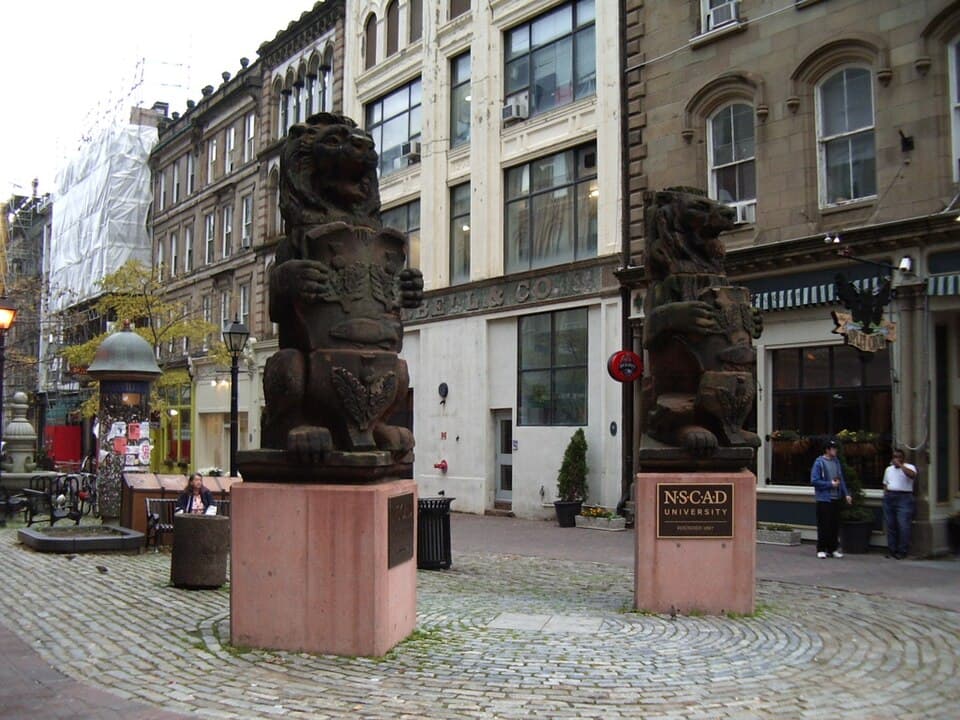

NSCAD University
Halifax, Nova Scotia
Compare NSCAD University programs, admissions, costs, residence, student support, and career pathways in one source-reviewed guide. Jump to the decision section you need below.
The short answer
- NSCAD asks for a 70% overall high-school average and 70% in Grade 12 university-prep English.
- Apply through SlideRoom by March 1 for entrance scholarships. Extended deadlines are May 1 international, June 1 transfer, and July 31 domestic.
- At 18 credits, Fall 2026 costs $6,247.38 for Nova Scotia residents. Other Canadians pay $7,367.90 and international students pay $16,307.60.
- NSCAD has no residence. You can apply to partner housing at Saint Mary's, King's, the Atlantic School of Theology, or Mount Saint Vincent.
- The portfolio needs 10–20 finished works in at least three media, plus 5–10 process pieces and 5–10 sketchbook pages.
Reviewed August 15, 2026 · Official university sources · How we review guides
Save this to your free account
Track NSCAD University with a checklist for how you apply. Free account. Add your dates in the tracker to request reminder emails; unsubscribe any time.
Free account. No card needed.
Overview
Quick Facts
| Location | Halifax, Nova Scotia |
|---|---|
| School Type | Smaller undergraduate-focused environment |
| Directory Size | Small university |
| Campus Setting | Major-city campus environment |
| Ranking Signal | No QS World 2026 position listed in this guide |
| Program Strengths | Fine Arts, Design, Media, Craft, Art History |
Start with campus and program fit. Then check official admissions, residence, and cost details. Do this before you build the final application list.
Admissions Planning
Fall 2027 application planning
NSCAD University admission and portfolio requirements
NSCAD's published academic base is a 70% overall high-school average. It also needs at least 70% in Grade 12 university-preparation English. The application is not grades-only. Applicants also submit official records, a one-page admissions essay, finished work, process work, and a portfolio through SlideRoom.
NSCAD at a glance: what is verified today
This is Atlantic Canada's dedicated art and design university. It is small and specialist. It is spread across three downtown Halifax campuses. Each card below has its own first-party source. Each card also has a status. The status shows if the fact is confirmed for the coming cycle, the latest available figure, or still unpublished.
Fall 2027 cycle status
2027 pending · Fall 2027
NSCAD's live deadlines page publishes an unlabelled, recurring fall-entry sequence. Applications open October 1. March 1 is the deadline for entrance-scholarship consideration. The extended deadlines are May 1 international, June 1 transfer, and July 31 domestic. No NSCAD page names a Fall 2027 cycle. The university states it considers applications year-round. It gives priority to applicants who apply by the official deadlines.
Treat these as a recurring pattern, not confirmed Fall 2027 dates. Re-check the deadlines page after applications open on October 1, and never assume the extended domestic deadline will be repeated.
Applies to: All applicants
NSCAD University: Admissions deadlines (current published cycle) · Verified August 15, 2026
Size, class sizes, and student mix
University-published counts · Published for this period
NSCAD publishes 854 undergraduate students and 55 graduate students. It publishes an 8:1 student-to-faculty ratio. It publishes an average class size of 13. It states 93% of classes are under 30 students. It states 26% of students are international, from 24 countries.
These are NSCAD's own marketing counts. No collection year is stated. Treat them as directional, not as audited enrolment data.
Applies to: All applicants
NSCAD University: Why study at NSCAD: published enrolment and outcome statistics · Verified August 15, 2026
Founded 1887 as a dedicated art and design school
Institutional history · Published for this period
NSCAD started as the Victoria School of Art and Design. Anna Leonowens founded it in Halifax in 1887 with Helen Kenny and sisters Ella and Eliza Ritchie. In 1925 it was renamed the Nova Scotia College of Art. In 1969 it was renamed again to the Nova Scotia College of Art and Design and given degree-granting status. NSCAD describes itself as one of Canada's oldest independent cultural institutions.
Applies to: All applicants
NSCAD University: Who we are: history, mission, and university news · Verified August 15, 2026
Three downtown Halifax campuses
Current campus structure · Published for this period
NSCAD has three campuses. The Fountain Campus is at 5163 Duke Street. It is a National Historic Site and takes up a city block of Victorian terrace buildings near the Halifax boardwalk. The Port Campus is at 1107 Marginal Road. It is a renovated warehouse on the waterfront. The Academy Campus is at 1649 Brunswick Street. It is an 1878 Gothic Revival building at the base of Citadel Hill.
Applies to: All applicants
NSCAD University: Our campuses: Fountain, Port, and Academy · Verified August 15, 2026
Published 2026-27 operating budget position
2026-27 budget year · Latest published information; newer cycle not yet confirmed
NSCAD's Board of Governors approved a 2026-27 operating budget. The budget projects $20.1 million in revenue against $22.1 million in expenditures. That is a projected deficit of $1.996 million, funded from the university's operating reserve. NSCAD says the gap is partly due to changes in international student policy. NSCAD says the budget maintains academic programs and student-facing services.
This is a small specialist university. It is running a planned deficit. Before you commit, ask admissions a direct question. Ask about the continuity of your intended major. Also ask about its studio access.
Applies to: All applicants
NSCAD University: Who we are: history, mission, and university news · Verified August 15, 2026
Academic minimum
70% overall + English
Minimum eligibility is not an admission guarantee because the creative submission is reviewed too.
Finished portfolio
10–20 works
NSCAD asks for recent original work across at least three media.
Scholarship consideration
March 1
This is the current published fall-entry deadline for automatic entrance-award consideration.
NSCAD undergraduate admission checklist
| Application item | Current requirement |
|---|---|
| High-school average | At least 70% overall after you complete Grade 12. Or the highest grade required for secondary graduation. |
| English | At least 70% in Grade 12 university-preparation English. Separate proof may apply when prior instruction was not in English. |
| International Baccalaureate | A complete IB Diploma with a minimum grade of 24. |
| Admissions essay | A brief one-page essay. It is about the applicant, the path to NSCAD, intended learning, and possible future direction. |
| Academic records | Official records from high school and every post-secondary institution, sent by the issuing institution. |
| Creative review | A portfolio uploaded through SlideRoom, including finished work and evidence of process. |
| Program-specific documents | Some programs ask for extra material for that discipline. This may be personal statements, letters of reference, or accreditations. You must check the program page yourself. |
| Application fee | Paid inside SlideRoom at the payment step. NSCAD's public admissions pages do not publish the amount, so confirm it in the portal or with admissions before applying. |
What NSCAD asks for in the portfolio
Finished work
10–20 recent examples of original work using at least three media.
Process work
5–10 examples such as observational drawings, maquettes, research, storyboards, concept development, or sketchbook work.
Sketchbook
5–10 pages showing research, ideas, experiments, sketches, writing, or other steps behind finished work.
Time-based work
Film, sound, video, or performance excerpts may be linked; the combined running time should not exceed 15 minutes.
Submission
Upload digital files or links through SlideRoom. Give the title, date, dimensions, and media for finished pieces.
Fall 2027 status
NSCAD has not yet labelled its live deadline page as Fall 2027
The university currently publishes the recurring fall-entry dates below. Use them to plan. But verify the cycle after applications open October 1. Do not assume an extended deadline is guaranteed for every applicant group.
October 1
Undergraduate applications open for fall entry.
March 1
Submit the undergraduate application by this date for entrance-scholarship consideration.
May 1
Current extended fall deadline for international applicants.
June 1
Current extended fall deadline for applicants transferring post-secondary credit.
July 31
Current extended fall deadline for domestic applicants.
Academic minimums by credential
Current requirements · Published for this period
High-school applicants must complete Grade 12, or the highest grade required for secondary graduation. They need an overall average of 70% or higher. This includes a minimum 70% in Grade 12 university-preparation English. An IB Diploma with a minimum grade of 24 is acceptable. CEGEP (a Quebec college most Quebec students attend before university) applicants need at least one full year of a DEC (Diplôme d'études collégiales). They need a 70% overall average. GCE applicants need at least two Advanced Level subjects. They also need three Ordinary Level subjects. They need an overall 'C' average and no subject below 'D'.
Meeting the minimum is not an admission decision. Faculty review the portfolio, process work, sketchbook, and essay. They review these alongside the transcript.
Applies to: All applicants
NSCAD University: Undergraduate admission requirements by applicant background · Verified August 15, 2026
One application route: SlideRoom
Current process · Published for this period
Every NSCAD application runs through SlideRoom. Applicants complete the online form, pay the application fee, and upload the admissions essay, finished work, and process work. Transcripts must be sent by the issuing institution to admissions@nscad.ca, through a service such as MyCreds, or by mail. Nova Scotia public high school students can instead supply their Provincial Student ID. NSCAD states applications are reviewed by faculty. NSCAD states applicants can expect a decision 4-6 weeks after the application deadline. After that, accepted applicants return a signed commitment statement with a deposit.
Applies to: All applicants
NSCAD University: Admissions checklist and the SlideRoom application process · Verified August 15, 2026
Undergraduate application fee amount
2027 pending · Current cycle
NSCAD does not publish this amount on its public admissions pages. The requirements page and the checklist both tell applicants to pay an application fee. The checklist says the payment page appears inside SlideRoom after the required sections are complete. But no amount is stated on nscad.ca.
Do not budget from a third-party figure. Open the SlideRoom payment step, or email admissions@nscad.ca, to get the fee in writing before you apply.
Applies to: All applicants
NSCAD University: Admissions checklist and the SlideRoom application process · Verified August 15, 2026
Portfolio, process work, and sketchbook counts
Current requirements · Published for this period
NSCAD asks for 10-20 examples of original finished work in at least three mediums. It also asks for 5-10 examples of process work. Process work includes observational drawing, maquettes, writing and research, storyboards, concept development, or sketchbook pages. The sketchbook itself should show five to 10 pages of process toward making art. Time-based excerpts in performance, film, sound, or video are linked from Vimeo, YouTube, or a personal site. They must total no more than 15 minutes. In SlideRoom you supply dimensions, media, title, and date for each finished piece. You may add a few sentences of context.
Applies to: All applicants
NSCAD University: How to build your portfolio, sketchbook, and Portfolio Day · Verified August 15, 2026
What the Admissions Committee actually looks for
Current guidance · Published for this period
NSCAD names the criteria clearly. They are original work you have confidence in. They are diversity of subject matter and medium. They are evidence of looking closely and carefully at a subject. They are curiosity and creativity. They are maturity and self-motivation. They are your editing and presentation choices. They are your ability to carry something from start to finish. They are how well you communicate the quality of your ideas. NSCAD states the Committee is particularly interested in work carried out independently of classroom assignments. It asks for work completed in the past two years. If you include anything older, you must give an explanation.
Applies to: All applicants
NSCAD University: How to build your portfolio, sketchbook, and Portfolio Day · Verified August 15, 2026
Portfolio Day and pre-application feedback
Recurring pattern · Published for this period
NSCAD hosts information sessions and portfolio previews twice yearly, on the third Saturday of February and of October, where applicants can discuss visual submissions with members of the Admissions Committee. NSCAD is a member of the National Portfolio Day Association and attends NPDA events across Canada and the United States. The Office of Admissions also offers feedback and advice before you apply, and NSCAD Extended Studies sells an online Portfolio Preparation course.
The third-Saturday pattern is how NSCAD describes the sessions. It is not a published dated calendar. Confirm the specific date before booking travel.
Applies to: All applicants
NSCAD University: How to build your portfolio, sketchbook, and Portfolio Day · Verified August 15, 2026
Winter entry and late applications
Current published cycle · Latest published information; newer cycle not yet confirmed
Beyond fall entry, NSCAD publishes a Winter (January) intake. The deadline is October 1 for international, domestic, and transfer applications. There is a November 30 extended deadline for domestic applications. Non-degree and visiting applicants have their own dates. These are August 1 for fall, December 1 for winter, April 1 for Summer A, and June 1 for Summer B. NSCAD states late applications for fall and winter may be considered on request through admissions@nscad.ca.
These dates carry no year label. Re-verify them against the live deadlines page before relying on a winter start.
Applies to: All applicants
NSCAD University: Admissions deadlines (current published cycle) · Verified August 15, 2026
English-language evidence and the exemption
Current requirements · Published for this period
Applicants whose language of instruction was not English for at least three years of high school or one year of post-secondary study must submit a test. Published undergraduate minimums: TOEFL 90 with no section below 20 (code 3265), IELTS 6.5 with no band below 6.0, CAEL 69 with no band below 60, CAE at least B, MELAB 82 with no test below 80, Duolingo 120 with no sub-score below 110, PTE Academic 70 with no score below 65, Oxford ELLT 7 with no band below 6, IB English A1 or A2 HL at 5, or AP English Language or Literature at 4. Scores must be sent directly from the testing service; otherwise only a conditional offer is made.
All degree students must also meet a separate writing requirement. They normally meet it by passing FNDN 1800 Writing for the Arts in the Foundation year.
Applies to: International
NSCAD University: International applications, English tests, and study permits · Verified August 15, 2026
Mature applicant route
Current requirements · Published for this period
NSCAD defines a mature applicant as someone at least 22 years old. This person has never been enrolled in a full-time post-secondary institution. They have been out of school for three years or longer. They may or may not have graduated from high school. Mature applicants submit all available official academic records plus two letters of recommendation. They are considered case by case. They may not be held to the exact academic requirements in the academic calendar. They should apply to the Foundation program.
Applies to: Mature
NSCAD University: Undergraduate admission requirements by applicant background · Verified August 15, 2026
Transfer credit ceilings and articulation agreements
Current policy · Published for this period
NSCAD transfers a maximum of 75 credits toward a degree. That is up to 30 credits per year or 15 per semester. A course needs a minimum grade of 60% or C to transfer. Advanced Placement transfers cap at 30 credits. An IB Diploma caps at 24. Credits transfer at par only from Universities Canada members or accredited degree-granting bodies. Named articulation agreements include NSCC Graphic Design, Screen Arts, and Photography diplomas. They also include Dawson College Illustration and Design, Fanshawe Fine Art, and Fleming's Haliburton School of the Arts. They also include Holland College Fundamental Arts, New Brunswick College of Craft and Design, and Vancouver Community College Jewellery Art and Design. They also include Yukon SOVA and College of the North Atlantic. Some programs offer a 2+2 pathway.
Applies to: Transfer
NSCAD University: Transfer, articulation, and pathway agreements · Verified August 15, 2026
Official NSCAD admissions sources
Verify each admissions claim at the source
- Undergraduate admission requirements by applicant background
- Admissions deadlines (current published cycle)
- Admissions checklist and the SlideRoom application process
- How to build your portfolio, sketchbook, and Portfolio Day
- International applications, English tests, and study permits
- Transfer, articulation, and pathway agreements
Application Checklist
| Academic Requirements | Verify prerequisite courses, minimum averages, and program-specific requirements on the official admissions pages. |
|---|---|
| Supplementary Review | Competitive programs may ask for essays, portfolios, interviews, experience profiles, or timed video responses. |
| International Applicants | Plan transcript evaluation, English-language proof if required, study permit timing, and proof-of-funds documentation. |
| Deadlines | Confirm application, document, scholarship, residence, and portfolio deadlines every cycle before submitting. |
| Stellar Coaching Use | Bring your target program, transcript, activities, and draft responses. Take them to a coaching session. The session is for school-specific planning. |
Programs and Pathways
NSCAD University programs and Foundation year
New undergraduates begin with Foundation Studies. After that, they move into specialized art, craft, media, design, or art-history pathways. That common first year is part of the program choice. Applicants should compare how much exploration they want before committing to a major.
| Degree or stage | Current options |
|---|---|
| Foundation Studies | The shared first year. Term one is four mandatory courses: Introduction to Studio Practice, Introduction to Visual Culture, Writing for the Arts, and Foundation Drawing I. Term two is four chosen courses from at least two of Design, Craft, Media, and Fine Arts. |
| Bachelor of Design (BDes) | Interdisciplinary Design. |
| Bachelor of Arts (BA) | Art History (Non-Studio) and Art History (Studio). |
| Bachelor of Fine Arts (BFA) | Ceramics. Expanded Media. Film. Interdisciplinary Arts. Jewellery+Metalsmithing. Photography. Textiles+Fashion. Fine Art in Drawing. Fine Art in Painting. Fine Art in Printmaking. Fine Art in Sculpture. |
Current undergraduate degree inventory
Current inventory · Published for this period
NSCAD's live undergraduate list has 14 majors across three degrees. These are a BDes in Interdisciplinary Design. They also include a BA in Art History in both Non-Studio and Studio streams. There is a BFA in Ceramics, Expanded Media, Film, Interdisciplinary Arts, Jewellery+Metalsmithing, Photography, Textiles+Fashion, and Fine Art in Drawing, Painting, Printmaking, and Sculpture. Every new undergraduate starts in Foundation Studies before declaring one of these.
Applies to: All applicants
NSCAD University: Undergraduate degree programs list · Verified August 15, 2026
How the Foundation year is actually built
Current structure · Published for this period
Foundation splits into two unlike halves. In the first term every student takes the same four courses. These are Introduction to Studio Practice, Introduction to Visual Culture, Writing for the Arts, and Foundation Drawing I. In the second term students choose four courses. They pick from at least two of Design, Craft, Media, and Fine Arts. The choices draw on Design 1000 and 1100, Ceramics 1000, and Jewellery 1000. They also draw on Textiles 1000, Fashion 1000, Film 1000, Expanded Media 1000, Photography 1000, and Sculpture 1000. They also draw on Print 1000, Painting 1000, and Drawing 1000. Every new undergraduate enters Foundation, so the whole entering cohort shares those first classes.
Completing ARTS 1000 in Foundation is what unlocks access to NSCAD's equipment and fabrication shops. Foundation students also get a dedicated space for course-related work.
Applies to: All applicants
NSCAD University: Foundation program structure and first-year courses · Verified August 15, 2026
Craft and fabrication strength at the Port Campus
Current facilities · Published for this period
Ceramics, Jewellery+Metalsmithing, and Textiles+Fashion are standing BFA majors. The Port Campus houses NSCAD's more industrial art, design, and craft practices. It has wood and metal fabrication shops, a sculpture studio, a plastics lab, and a foundry. NSCAD publishes 12 fabrication studios run by technicians. It says undergraduates have nearly unlimited studio access.
Applies to: All applicants
NSCAD University: Our campuses: Fountain, Port, and Academy · Verified August 15, 2026
Film and Media Arts at the Academy Campus
Current facilities · Published for this period
The Academy Campus is the home of the Media Arts division, including NSCAD's film program. It holds edit suites, studio space, sound rooms, a screening room, animation facilities, and faculty offices. Film, Expanded Media, and Photography all appear as standing BFA majors. Film 1000, Expanded Media 1000, and Photography 1000 are available as Foundation second-term choices.
Applies to: All applicants
NSCAD University: Our campuses: Fountain, Port, and Academy · Verified August 15, 2026
Exchange and off-campus study
Current program · Published for this period
NSCAD publishes more than 70 student exchange opportunities. It lists signed or renewing agreements. These include the Association of Independent Colleges of Art + Design, the University of New South Wales, and Lingnan University. They also include KEA Copenhagen School of Design and Technology, Hochschule Bielefeld, and Kunsthochschule Berlin-Weissensee. Exchange requires declaring intent roughly a year in advance. NSCAD's published example is an October 1 to November 1 declaration window. It is for the following academic year. NSCAD must nominate students first. The host school decides after that.
NSCAD says the partner list may change. NSCAD also states that placement is not guaranteed. Confirm a specific partner is active before you build a plan around it.
Applies to: All applicants
NSCAD University: Outgoing student exchange partners and nomination timeline · Verified August 15, 2026
Careers, internships, and the Anna Leonowens Gallery
NSCAD publishes no co-op program. Its dedicated Career Services page currently carries no content. So treat the internship course, the design practicum, and the gallery system as the concrete professional-practice routes. The claims below record exactly what NSCAD publishes. This includes which figures are unaudited self-reported alumni survey results.
The Career Services page currently publishes nothing
2027 pending · Current site state
NSCAD's Career Services page and its Internships and Practicums child page both load successfully. But they contain no published body content, only navigation and footer. The live, substantive information about internships and placements sits instead on the Office of Opportunity and Belonging's experiential learning page. NSCAD does not publish graduate employment rates, a co-op program, or an employer-partner list anywhere on nscad.ca.
Ask admissions directly what career supports exist. Ask who staffs them. Ask how a Foundation-year student books an appointment. Do not assume a full career centre.
Applies to: All applicants
NSCAD University: Career Services landing page (currently publishes no content) · Verified August 15, 2026
How the internship course is structured and gated
Current program · Published for this period
Internship and Community Service Learning is a studio course. You take it for three credits, six credits, or in exceptional circumstances nine. Students submit a one-page proposal. It sets out their skill set, the organization's needs, the duties involved, and how those duties match their area of study. Eligibility requires a GPA (grade point average) of 3.0 or higher. It also requires nine credits of Liberal Arts and Sciences coursework, including six credits of art history. It requires 60 credits completed at the time of application.
The 60-credit gate means an internship is realistically a third- or fourth-year option. It is not something to plan for in Foundation.
Applies to: All applicants
NSCAD University: Internships, practicum placements, and community service learning · Verified August 15, 2026
Design practicum, research internship, and placement deadlines
Current program · Published for this period
NSCAD students may apply for a design practicum in their fourth year. Art history students may register for the three-credit research internship AHIS 4600. They must have completed 15 credits of art history coursework. They also need a one-page proposal and the consent of the chair of art history and contemporary culture. Published placement deadlines are March 15 for Summer, March 15 for Fall, and September 15 for Winter. NSCAD names a WildBrain investment that supports paid internships with animation, media, and design firms.
Applies to: All applicants
NSCAD University: Internships, practicum placements, and community service learning · Verified August 15, 2026
The Anna Leonowens Gallery as professional practice
Current programming · Published for this period
The Anna Leonowens Gallery and the Treaty Space Gallery are NSCAD's public exhibition spaces. NSCAD frames the Anna around the curatorial, artistic, and educational development of students. It publishes over 125 exhibitions and over 50 events each year. These attract more than 20,000 visitors annually. There are Monday night openings and lunch-hour artists' talks. The Port Loggia Gallery on the Port Campus expands that exhibition programming. The gallery runs concurrent student shows across Gallery 1, Gallery 2A, and Gallery 2B.
NSCAD's why-study page says 'over 120 shows a year'. The facilities page says 'over 125 exhibitions'. Both are the university's own rounding of the same programme.
Applies to: All applicants
NSCAD University: Facility overview: library, shops, and the gallery system · Verified August 15, 2026
Published alumni outcome statistics
University-published outcomes · Latest published information; newer cycle not yet confirmed
NSCAD publishes four alumni figures. 85% of alums work in a field related to their studies. 50% run their own business. 91% of graduates found their NSCAD degree to be a good investment. 93% agreed NSCAD played an important role in their development as a person.
These are self-reported alumni-survey figures with no published sample size, response rate, or survey year. They are not Statistics Canada or provincial graduate-outcome data — treat them as marketing, not evidence.
Applies to: All applicants
NSCAD University: Why study at NSCAD: published enrolment and outcome statistics · Verified August 15, 2026
Working in Canada during and after the degree
Current guidance · Published for this period
NSCAD states that study permit holders are eligible to work in Canada within IRCC guidelines. They can obtain a social insurance number from Service Canada after arriving. Its acceptance letters carry the Designated Learning Institution number 019021269652. NSCAD points eligible graduates to the Post-Graduation Work Permit Program. It also points them to the Study and Stay in Nova Scotia program for mentoring from student to professional. NSCAD notes that visiting or exchange students staying under six months do not require a study permit.
Work and post-graduation permit rules are set by IRCC. They change independently of NSCAD. Verify eligibility on the federal site before relying on it.
Applies to: International
NSCAD University: International applications, English tests, and study permits · Verified August 15, 2026
NSCAD University Residence and Halifax Housing
NSCAD University residence and Halifax housing
NSCAD states directly that it does not offer on-campus residences. Students can apply for partner-university housing at Saint Mary's, King's, the Atlantic School of Theology, or Mount Saint Vincent. This is subject to availability. You use the student ID number on your acceptance letter. NSCAD also names Moore Suites and ALMA South End among private options. It lists Halifax-region property managers. There is no residence guarantee, and every rate is set elsewhere.
Housing action plan
- 1. Apply to partner residences as early as their portals allow.
- 2. Compare the commute to the campus used by the intended program.
- 3. Confirm meal plans, deposits, cancellation rules, and term dates.
- 4. Verify private listings and avoid deposits before confirming legitimacy.
NSCAD operates no residence of its own
Current arrangement · Published for this period
NSCAD states plainly that it does not offer on-campus residences. As a NSCAD student you can access residence spaces at partner universities. This is subject to availability. The partners are Saint Mary's University, the University of King's College, the Atlantic School of Theology, and Mount Saint Vincent University. NSCAD publishes a step-by-step infographic with links to each partner's application portal. It also lists each residence office's contact details.
Your NSCAD student ID number is printed on the acceptance letter. This number lets you register for accommodation. The residence halls are at the neighbouring university.
Applies to: All applicants
NSCAD University: Housing information: partner residences and off-campus renting · Verified August 15, 2026
Residence room and meal-plan rates
2027 pending · 2027-28
NSCAD does not publish this, and there is nothing for NSCAD to publish. It runs no residence. So every room rate, meal-plan rule, deposit, and application deadline is set by the partner university you apply to. NSCAD's housing page warns that many residences require a mandatory meal plan regardless of usage. It also warns that single and double rooms often do not include a personal washroom, kitchen, or laundry.
Budget from each partner university's own published rate card. Apply as early as their portals allow. NSCAD's guarantee does not exist, so availability is the binding constraint.
Applies to: All applicants
NSCAD University: Housing information: partner residences and off-campus renting · Verified August 15, 2026
Off-campus and homestay options NSCAD actually names
Current listings · Published for this period
NSCAD says most students rent a furnished room from a private owner or share an apartment, flat, or house. It names Moore Suites for temporary furnished accommodation between residences. It names ALMA South End for studio and three-, four-, and five-bedroom student suites. It lists Halifax-region property managers including Killam, Templeton, Universal Realty, and Southwest. For international students, the Canada Homestay Network manages homestay placement for NSCAD. It provides a furnished room, private storage, a shared bathroom, and a quiet place to study.
NSCAD states it is not affiliated with any of these listing sites and cautions students about rental scams.
Applies to: All applicants
NSCAD University: Housing information: partner residences and off-campus renting · Verified August 15, 2026
Nova Scotia tenancy rules NSCAD publishes for renters
Current guidance · Published for this period
NSCAD's housing page says a landlord can only ask for a security deposit of half a month's rent. Rental application fees are illegal. Asking for last month's rent at the start of a lease is illegal. You can end a tenancy if you are not given a signed lease copy within 10 days. Rent can be raised only once every 12 months. The cap is 5%. Written notice is usually four months ahead. It directs students in dispute to Dalhousie Legal Aid Service before acting.
Applies to: All applicants
NSCAD University: Housing information: partner residences and off-campus renting · Verified August 15, 2026
Three campuses, SUNSCAD, and Halifax student life
Where you live matters more at NSCAD than at most universities, because the program you choose decides which of the three campuses you spend your days on. The waterfront Port Campus holds most Foundation classes and the heavy fabrication shops; Media Arts sits up at the Academy Campus.
Fountain Campus
5163 Duke Street
A National Historic Site of Canada covering a city block of Victorian terrace buildings near the Halifax boardwalk. Home to the Craft, Design, Fine Arts, and Media Arts divisions and the Anna Leonowens Gallery.
Port Campus
1107 Marginal Road
This is a renovated warehouse on the Halifax waterfront. It has a glass curtain seawall. It holds many first-year Foundation classes. It also holds the wood and metal fabrication shops, sculpture studio, plastics lab, foundry, and the Port Loggia Gallery.
Academy Campus
1649 Brunswick Street
This is an 1878 Gothic Revival building at the base of Citadel Hill. It houses the Media Arts division and the film program. It has edit suites, sound rooms, a screening room, and animation facilities.
What day-to-day life across three campuses looks like
Current campus life · Published for this period
The Fountain Campus holds the Craft, Design, Fine Arts, and Media Arts divisions. These are in interconnected Victorian buildings near the boardwalk. The Port Campus holds Foundation plus Craft, Design, and Fine Arts studios. These are on the waterfront behind a glass curtain seawall. The Academy Campus holds Media Arts at the base of Citadel Hill. NSCAD states directly that many of its campuses are historic sites. They were not originally designed to meet modern accessibility standards. Physical barriers still exist despite improvements.
If you use mobility aids, read NSCAD's physical accessibility page for your specific buildings and studios. Do this before committing to a major that is based at one campus.
Applies to: All applicants
NSCAD University: Facility overview: library, shops, and the gallery system · Verified August 15, 2026
SUNSCAD and the compulsory fee lines
Fall 2026 · Latest published information; newer cycle not yet confirmed
Every full-time undergraduate fee bill carries the same compulsory lines. At 18 credits in Fall 2026 those are a $51.29 Union Fee for the Student Union of NSCAD, a $60.36 Student Service Fee, a $102.59 Facility Renewal Fee, a $72.36 Technology Renewal Fee, $44.40 for Adobe software, $51.45 for the Centre for Experiential Learning, and the U-Pass at $178.20. NSCAD states the U-Pass is compulsory and non-refundable for all full-time students, and that SUNSCAD administers the domestic health plan and its opt-out.
Applies to: All applicants
NSCAD University: Fall 2026 and Winter 2027 tuition and fee tables · Verified August 15, 2026
The U-Pass and the surrounding Halifax arts scene
Current campus context · Published for this period
NSCAD students receive a U-Pass. It gives unlimited access to Halifax Transit buses and ferries. NSCAD describes Halifax as a pedestrian-friendly city that keeps transportation costs low. It says NSCAD is surrounded by over a dozen art galleries, including the Art Gallery of Nova Scotia. Live music venues, independent shops, and cinemas are within walking distance. Coastal hikes, lakes, old-growth forest, and beaches are a 15-minute drive from downtown.
Applies to: All applicants
NSCAD University: Our city: Halifax, the U-Pass, and living costs · Verified August 15, 2026
Where NSCAD students actually get health care
Current services · Published for this period
NSCAD has no campus clinic of its own. Students see a doctor through the Saint Mary's Student Health Clinic. That clinic is appointment-only and for non-emergency matters. International students are automatically enrolled in the StudentVIP international plan. The domestic plan is managed by SUNSCAD. NSCAD states students may become eligible for Nova Scotia MSI coverage 13 months after arriving in the province. At that point, the SUNSCAD domestic plan becomes available.
NSCAD's international applications page states MSI eligibility after more than 12 months. The health page says 13 months. Confirm the exact threshold with MSI directly.
Applies to: All applicants
NSCAD University: Health care and insurance for domestic and international students · Verified August 15, 2026
Community composition and the public showcase calendar
Current campus life · Published for this period
NSCAD publishes that 65% of its students identify as 2SLGBTQIA+. It also publishes that 41% of its community identify as gender diverse. It lists 50+ visiting artists, artists-in-residence, and public lectures each year. Its MAYHEM year-end showcases run from April through May. They cover fine arts, design, film, fashion, and craft. NSCAD states all shows are open to the public and nearly all are free. The calendar includes fixtures such as the Spring Makers' Market at the Port Campus and departmental open houses.
The 2SLGBTQIA+ and gender-diverse percentages come from NSCAD's own why-study page. No survey year or sample size is stated. Treat them as directional.
Applies to: All applicants
NSCAD University: MAYHEM year-end showcases and public events calendar · Verified August 15, 2026
Official NSCAD housing source
Campus, city, and student-support sources
Housing and Location Questions
| Campus Setting | Major-city campus environment |
|---|---|
| Residence | Check residence guarantee rules. Check first-year room styles. Check meal plans. Check deposit deadlines. Check off-campus housing pressure. |
| City Fit | Students should compare transit, weather, cost of living, safety, and community feel in Halifax. |
| Commuting | If you live off campus, map your commute time. Map it to classes, labs, placements, and evening activities. Do this before committing. |
Tuition, Scholarships, and Aid
NSCAD tuition, scholarships, and bursaries
The latest complete undergraduate schedule covers Fall 2026 and Winter 2027. Both terms are shown below at an 18-credit load. This includes the compulsory fees NSCAD lists. Course-specific material fees are extra. NSCAD marks the whole schedule subject to change.
| Student type | Course load | Fall 2026 tuition and fees | Winter 2027 tuition and fees |
|---|---|---|---|
| Nova Scotia resident | 18 credits | $6,247.38 | $6,006.20 |
| Domestic, outside Nova Scotia | 18 credits | $7,367.90 | $7,126.72 |
| International undergraduate | 18 credits | $16,307.60 | $15,933.74 |
Scholarship-page discrepancy
NSCAD says applicants submitted by March 1 are automatically considered. But the same page contradicts itself twice. It gives the entrance-award range as both $500–$9,000 and $500–$6,000, with a top award of approximately $25,000. It also states both about $200,000 and about $100,000 awarded per academic year. Get the specific award value in writing before using it in a net-cost comparison.
Fall 2026 and Winter 2027 domestic tuition and fees
Fall 2026 / Winter 2027 · Latest published information; newer cycle not yet confirmed
At an 18-credit load, a Nova Scotia resident undergraduate pays $5,862.92 in semester tuition and a Fall 2026 total of $6,247.38 after the $641.50 Nova Scotia Bursary Reduction, the $178.20 U-Pass, and $456.24 health insurance. The Winter 2027 total for the same load is $6,006.20. Out-of-province Canadian students pay $6,341.94 in tuition with a Fall 2026 total of $7,367.90 and a Winter 2027 total of $7,126.72, and receive no bursary reduction.
NSCAD labels these tables subject to change and for information purposes only. It directs students to Self-Service for the amount actually owed.
Applies to: Other Canadian, Transfer, Mature
NSCAD University: Fall 2026 and Winter 2027 tuition and fee tables · Verified August 15, 2026
Fall 2026 and Winter 2027 international tuition and fees
Fall 2026 / Winter 2027 · Latest published information; newer cycle not yet confirmed
An 18-credit international undergraduate pays $14,883.60 in semester tuition. The Fall 2026 total is $16,307.60. That includes $854.28 of international health insurance. The Winter 2027 total is $15,933.74. NSCAD recommends prospective international students budget a minimum of $20,000 to $25,000 CAD. That is for eight to 12 months of study, excluding airfare. Graduates of a Nova Scotia public high school through the Nova Scotia International Student Program pay the Canadian out-of-province rate. They pay it for the full length of their undergraduate degree.
Higher figures circulating for NSCAD internationals come from the graduate MDes, MFA, and MAAE tables on the same page. They do not come from the undergraduate one.
Applies to: International
NSCAD University: Fall 2026 and Winter 2027 tuition and fee tables · Verified August 15, 2026
2027-28 tuition status
2027 pending · 2027-28
Not yet published. The Fall 2026 and Winter 2027 tables are the latest posted, and NSCAD marks them subject to change and for information purposes only. There is no published 2027-28 undergraduate schedule to plan from.
Budget from the labelled Fall 2026 and Winter 2027 tables and re-check the tuition page before treating any figure as a Fall 2027 quote.
Applies to: All applicants
NSCAD University: Fall 2026 and Winter 2027 tuition and fee tables · Verified August 15, 2026
Materials are a real, mostly unpublished cost
Current policy · Published for this period
NSCAD states that students are expected to provide materials for their classes. These are usually bought from the NSCAD Supply Store. Where the university bulk-purchases materials, the amount of the Materials Fee is published in the course outline at the first class meeting. It is charged automatically to the student account. The tuition tables carry an explicit note that some classes have a material fee not shown in the examples. New students also pay a $20 building access card fee, refunded $10 on return.
You will not find a dollar range for studio materials anywhere on nscad.ca. Ask the department for a realistic per-term estimate for your intended major.
Applies to: All applicants
NSCAD University: Fall 2026 and Winter 2027 tuition and fee tables · Verified August 15, 2026
Entrance scholarships: the page contradicts itself
Official-source conflict · Current published awards
If you apply for admission by March 1, you get automatic consideration for entrance scholarships and bursaries. But the same page publishes two statements that do not match. One says the current range of individual entrance awards is $500 to $9,000, with some renewable for up to four years. The next says the current range is $500 to $6,000, with some renewable for each of four years, 'making our top award approximately $25,000'. The page also states the university awards about $200,000 per academic year in one sentence. The next sentence says about $100,000 annually. The page also lists more than 90 internal scholarships and bursaries. It also lists external funding that can top $40,000 per year.
Do not use either range in a net-cost comparison. Get the specific award value in writing from admissions or your offer letter before you decide.
Applies to: All applicants
NSCAD University: Scholarships and bursaries, including entrance awards · Verified August 15, 2026
Payment dates, penalties, and the 60+ discount
Fall 2026 / Winter 2027 · Latest published information; newer cycle not yet confirmed
Fall 2026 fees are due by September 20, 2026 and Winter 2027 fees by January 19, 2027, and registration is treated as incomplete until fees are paid in full. Credit cards are not accepted for tuition and student fees. Interest of 12% begins accruing 30 days after the due date and a $75 late payment fee is assessed on past-due accounts. Students with outstanding balances are removed from future terms at July 31, November 15, and March 1. NSCAD offers a 40% discount on the tuition portion to Canadian citizens or permanent residents aged 60 or over in an undergraduate degree program.
Applies to: All applicants
NSCAD University: Fall 2026 and Winter 2027 tuition and fee tables · Verified August 15, 2026
Student emergency bursaries
Current program · Published for this period
NSCAD Student Emergency Bursaries help students with unforeseen expenses who demonstrate need. You can apply for one emergency bursary per semester in Fall and Winter. Bursaries are typically valued at $500. They may be up to $700 under exceptional circumstances. Apply through the NSCAD Forms Portal.
Applies to: All applicants
NSCAD University: Housing information: partner residences and off-campus renting · Verified August 15, 2026
Official NSCAD cost and award sources
Cost Planning
| Tuition | Tuition depends on your program. It also depends on your student status and year. Verify domestic and international tuition on the official fee schedule. |
|---|---|
| Scholarships | Check automatic entrance awards, competitive major awards, faculty scholarships, and international-student awards. |
| Living Costs | Budget for residence or rent, food, books, and transit. Also budget for health insurance, winter clothing, and emergency funds. |
| Proof of Funds | International students should confirm current study-permit financial requirements and school-specific cost estimates. |
Student Life and Support
Fit Signals
| Community | Small university profile: compare the class feel and access to professors. Also compare student clubs and how easy it is to build community. |
|---|---|
| Student Supports | Review academic advising, accessibility services, mental health supports, international student services, and writing centres. |
| Clubs and Leadership | Look for discipline clubs, cultural groups, entrepreneurship programs, varsity/intramural sports, and volunteering. |
| First-Year Transition | Ask how orientation, peer mentorship, residence programming, and advising help students settle in. |
Co-op, Research, and Career Outcomes
Career Planning
| Experiential Learning | Check if your target program offers co-op, internships, or clinical placements. Also check for practicums, studios, field schools, or research terms. |
|---|---|
| Career Services | Compare job boards, employer partnerships, resume support, interview preparation, and alumni mentoring. |
| Research Access | For graduate-school or professional-school pathways, look for undergraduate research assistant roles and lab access. |
| Outcome Questions | Ask where graduates work or study next, and whether outcomes differ by program, co-op stream, or campus. |
Applicants most often compare admission requirements and deadlines. They also compare program options. They compare tuition and scholarships too. They also look at residence and experiential learning. For NSCAD University, popular program questions are about Interdisciplinary Design, Fine Arts, and Art History.
NSCAD University admissions, portfolio, programs, tuition, scholarships, and housing questions
Direct answers to NSCAD's 70% minimum, portfolio pieces, process work, sketchbook, current deadlines, SlideRoom application, Foundation year, programs, tuition, entrance scholarships, international English requirements, and partner housing.
Official Sources and Next Steps
Stellar keeps this guide structured for comparison. But official university pages remain the source of truth. They are the source for program requirements, tuition, residence, and scholarships. They are also the source for deadlines and policy changes.
Prepared by Stellar Advisers Editorial Team · Reviewed August 15, 2026 · Editorial, corrections, and source methodology
Related Canadian universities
Compare 3 other Nova Scotia records, then continue through the national directory.